

More news on this day
Hundreds of travelers were left stranded at Philadelphia International Airport after extensive disruptions saw 101 flights delayed and 2 canceled, snarling connections on major U.S. carriers and affecting routes to New York, Chicago, Los Angeles, Miami, Boston, and other key domestic hubs.
Get the latest news straight to your inbox!
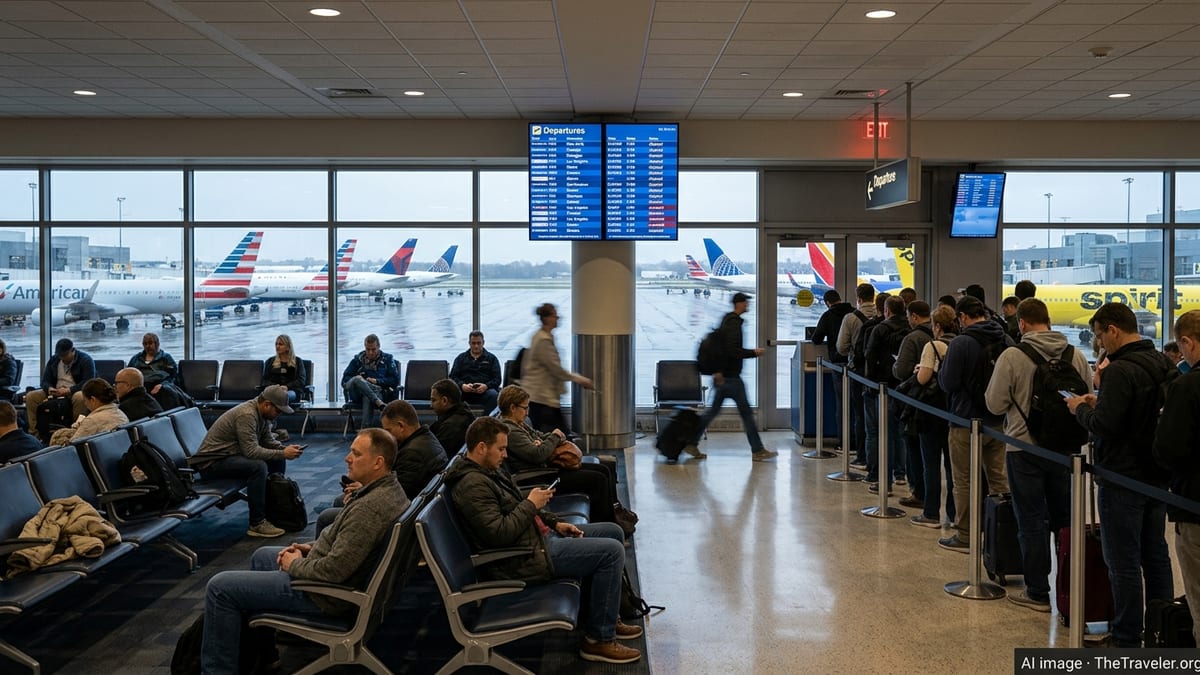
Widespread Disruptions Across Major U.S. Carriers
Flight tracking data and published airport status boards show that operations at Philadelphia International deteriorated sharply as delays accumulated across the day, ultimately affecting at least 101 departures and arrivals and leading to the cancellation of 2 flights. The disruption cut across multiple major airlines, including American Airlines, Delta Air Lines, United Airlines, Southwest Airlines, Spirit Airlines, and several regional affiliates operating under their banners.
The irregular operations at Philadelphia had an immediate ripple effect across carrier networks. Because the airport serves as a significant connecting point, particularly for American Airlines and several low cost carriers, delays in Philadelphia quickly translated into missed onward flights and tight connection windows at other busy airports.
Reports from flight status services indicate that delays ranged from short holdups of 30 to 45 minutes to extended waits stretching several hours, leaving travelers facing long lines at service counters and crowded gate areas. In many cases, rolling delay extensions meant passengers remained at the gate for prolonged periods as revised departure times continued to shift.
Published coverage of recent disruption patterns at major U.S. hubs suggests that when a critical mass of flights is delayed at one airport, airlines often struggle to reposition aircraft and crew efficiently. That dynamic appeared to be at play in Philadelphia, where recovery operations were still in progress as carriers worked through backed up departures.
Key Routes to Major U.S. Cities Affected
The disruption in Philadelphia was felt most acutely on high frequency domestic routes to major business and leisure destinations. Flight status boards showed significant delays on services linking Philadelphia with New York area airports, Chicago, Los Angeles, Miami, and Boston, among others.
On transcontinental routes, flights between Philadelphia and Los Angeles faced knock on effects as aircraft arriving late from earlier segments turned around behind schedule. Travel industry analysis has previously highlighted how delays on long haul domestic routes can be especially challenging to recover because there are fewer daily frequencies and limited spare aircraft available.
Short haul connections in the busy Northeast corridor, including flights to New York and Boston, were also hit. Even modest delays on these routes can cause outsized inconvenience, as many passengers rely on tight connections to link with onward flights across the country. When schedules compress, travelers often find that alternative same day options are limited, particularly during peak travel periods.
Services to warm weather destinations such as Miami saw additional strain, with aircraft and crews arriving late and turning around under time pressure. For travelers heading to Florida and other sunbelt destinations, rebooking often meant accepting later departures, downgraded itineraries with additional stops, or travel shifting to the following day.
Operational Strain and Contributing Factors
While specific causes for each affected flight varied, publicly available information on recent U.S. aviation disruptions points to a familiar mix of contributing factors, including weather challenges in parts of the national airspace system, air traffic control flow constraints, and tight airline schedules that leave little room for recovery when issues arise.
Recent analyses of flight performance in the United States note that airlines have been operating with leaner staffing and aircraft utilization models, which can magnify the impact of even minor disturbances. When one or two early banks of flights experience delays, subsequent rotations are more likely to depart behind schedule, as appeared to be the case at Philadelphia International.
Travel industry commentary has also highlighted how congestion at major hubs can lead to cascading delays. When arrival and departure slots are compressed and taxi times increase, airlines may hold flights on the ground awaiting available gates, further contributing to extended waits for passengers already onboard.
Airline operations teams typically respond by adjusting schedules in real time, consolidating lightly booked flights, and rerouting aircraft where possible. However, as seen in recent disruption episodes across the country, those measures take time to implement, and passengers on the earliest affected services often bear the brunt of the uncertainty as revised plans unfold.
Impact on Passengers and Options for Recovery
For the hundreds of passengers stranded or significantly delayed in Philadelphia, the disruption meant a range of knock on consequences, from missed family events and business meetings to lost vacation time at destination resorts. Crowded concourses, longer waits at concessions, and the difficulty of finding available seats on later flights added to the frustration for many travelers.
Published consumer travel guidance notes that in such situations passengers generally have several options, depending on the airline and fare type. These can include requesting rebooking on later flights, seeking rerouting through less congested hubs, or, where eligible, asking for meal vouchers or hotel accommodations when overnight stays become unavoidable.
Passengers booked on multi segment itineraries often face the added complication of coordinating changes across several flights, sometimes on different carriers. Travel experts frequently recommend monitoring airline apps and flight status tools closely and proactively exploring alternative routings, rather than waiting until a delay or cancellation is formally announced at the gate.
In recent months, transportation regulators in the United States have also emphasized the importance of clear communication to travelers during disruption events, encouraging airlines to publish up to date policies on customer care, refunds, and rebooking. Passengers at Philadelphia encountering extended delays are generally advised by consumer advocates to document their experiences and keep records of expenses incurred as a result of disrupted plans.
What Travelers Through Philadelphia Should Expect Next
As airlines work through the backlog of delayed flights at Philadelphia International, operational data suggests that some knock on effects may continue into subsequent departure banks, particularly for routes that rely on aircraft cycling through the airport multiple times per day. Travelers booked to depart later the same day or early the following morning are likely to face schedule adjustments, aircraft swaps, or gate changes as carriers reposition their fleets.
Travel industry reporting indicates that in similar disruption events, airlines often prioritize restoring core trunk routes to major hubs such as New York, Chicago, Los Angeles, Miami, and Boston, in order to reestablish connectivity for the highest number of passengers. Once those links are stabilized, carriers typically turn to recovering service on secondary and leisure oriented routes.
Passengers planning to travel through Philadelphia in the near term are widely encouraged by consumer advocates to allow extra time at the airport, verify check in and security wait times, and confirm the latest status of their flights before leaving home. For those with flexible schedules, same day changes to less congested travel windows may offer a smoother experience.
As the system gradually resets, airlines operating at Philadelphia International are expected to adjust schedules and staffing to mitigate further knock on delays. However, given the interconnected nature of U.S. air travel, even a localized disruption of more than 100 flights can send ripples across the national network, underscoring the importance for travelers of staying informed and building buffer time into their journeys.