

More news on this day
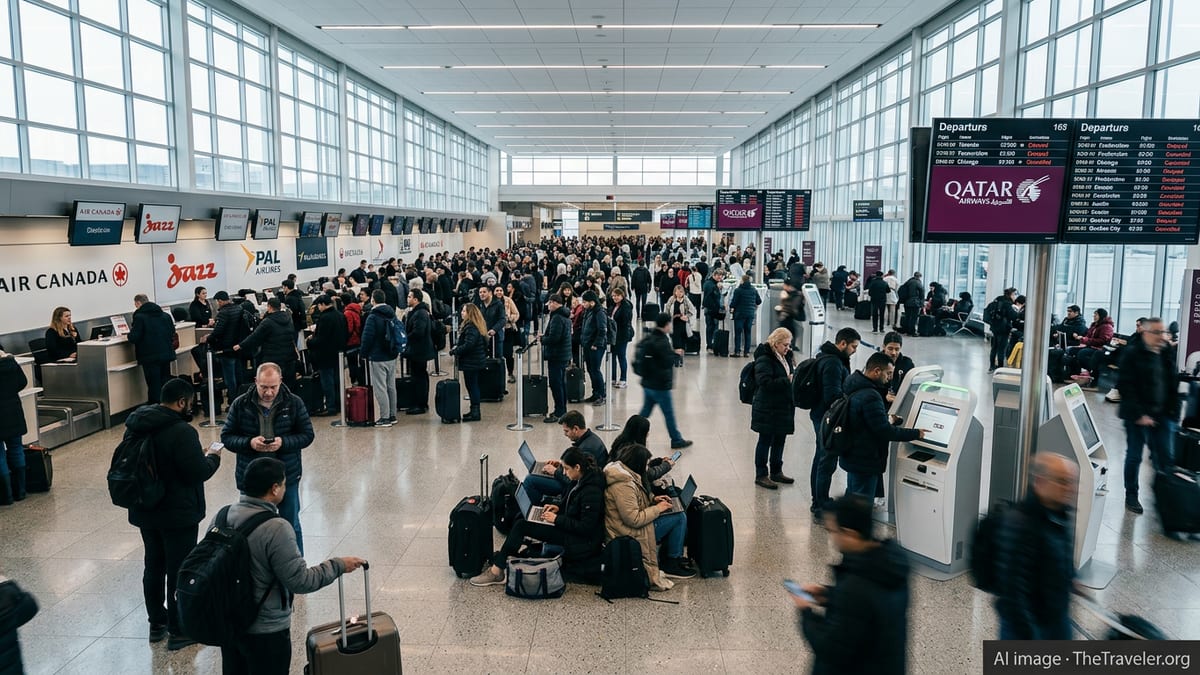
Hundreds of travelers were left waiting at Montreal-Trudeau International Airport as publicly available flight-status data showed 25 cancellations and at least 159 delays affecting services operated by Air Canada, WestJet, Jazz Aviation, Emirates and other carriers, with disruptions spreading across North America, the Caribbean and Europe.
Get the latest news straight to your inbox!
Wide-Ranging Disruptions at a Key Canadian Hub
Operational data from airline and airport trackers indicates that Montreal-Trudeau (YUL), one of Canada’s primary international gateways, has been contending with an unusually high level of schedule disruption, with 25 flights canceled and 159 delayed over the course of the day. The figures cut across both domestic and international services, underscoring the airport’s vulnerability to network shocks in peak travel periods.
Publicly available information shows that the cancellations and delays involve a mix of mainline and regional services, including flights marketed or operated by Air Canada, WestJet, Jazz Aviation and Emirates, as well as several codeshare partners. The disruptions have been most visible in the transborder market to the United States and on popular leisure routes to Mexico and the Caribbean, where aircraft and crew rotations are tightly scheduled.
Montreal-Trudeau regularly handles a dense mix of business and holiday traffic, and the spread of delays across so many airlines suggests a combination of factors rather than a single isolated issue. Recent weather volatility, lingering air traffic control constraints in North America and ongoing supply and staffing pressures across the industry have all been cited in recent months in coverage of airline operations in the region.
As flights fall behind schedule, the knock-on effects quickly accumulate. A late aircraft arriving from a US hub can leave passengers to Mexico or Europe stranded at the gate in Montreal, while crews face regulated duty-time limits that can trigger further cancellations when thresholds are reached.
Impact Spreads to the United States, Mexico and the Caribbean
Flight-status boards and tracking platforms show that services between Montreal and major US hubs are among the hardest-hit. Delayed and canceled departures have been reported on routes to cities such as New York, Boston and Chicago, where winter-weather patterns and congested airspace frequently complicate recovery efforts. When departures from Montreal miss their takeoff slots, downstream arrivals at US airports can also be affected, amplifying the disruption for connecting passengers.
Disruptions have also rippled south toward sun destinations in Mexico and the Caribbean, important winter markets for Canadian carriers. In recent weeks, Canadian airlines have already been navigating separate operational challenges in Mexico and parts of the Caribbean, including infrastructure constraints and fuel-related issues at certain airports. Against that backdrop, additional delays originating in Montreal increase the risk of missed connections, truncated resort stays and complex rebooking scenarios.
Publicly available data and traveler accounts suggest that some aircraft are now arriving late into Mexican and Caribbean airports, compressing turnaround times and heightening the risk that return flights to Canada and the United States will depart behind schedule or be canceled altogether. Such delays can also push crew duty times to their legal limits, forcing airlines to stand down aircraft even when the weather has improved.
For passengers already at destination, the result can be long lines at check-in counters and customer-service desks, as travelers attempt to secure seats on limited alternative flights back to Montreal or onward to Europe. With high cabin loads during peak periods, the available spare capacity to absorb disrupted passengers is often thin.
Canadian and Transatlantic Routes Under Pressure
Within Canada, the day’s 25 cancellations and triple-digit delays at Montreal-Trudeau have also affected flights to other major hubs, including Toronto, Vancouver and Calgary, as well as regional centers served by Jazz Aviation under capacity-purchase agreements. When short-haul feeder flights are delayed or scrubbed, travelers bound for international destinations via Montreal often find themselves forced into overnight stays or last-minute rerouting through other hubs.
Transatlantic services have not been immune. Published schedules show Emirates and European flag carriers operating long-haul flights linking Montreal with Europe and the Middle East, and disruptions to feeder traffic can quickly erode these flights’ on-time performance. Even when widebody aircraft depart relatively close to schedule, passengers misconnecting from delayed domestic or US flights may be left behind, requiring rebooking on later departures or on partner airlines.
In recent seasons, industry data and operational reports have highlighted how tightly interconnected Canada–Europe and transborder networks have become. A weather system affecting a single hub can cascade across multiple time zones, with Montreal often serving as a critical junction point. Today’s elevated rate of delays and cancellations at Montreal-Trudeau fits into that broader pattern, where even incremental schedule pressure can lead to significant disruption for long-haul travelers.
The combination of domestic, transborder and transatlantic strain at a single airport poses particular challenges for airline planners, who must decide whether to prioritize the integrity of long-haul operations or focus on stabilizing regional schedules that feed those flights.
Weather, Air Traffic Constraints and Operational Strain
Recent coverage of North American aviation has pointed to several overlapping stressors that help explain spikes in disruption like those observed at Montreal-Trudeau. A series of winter systems in early 2026 produced heavy snow, freezing rain and low-visibility conditions across parts of Canada and the northern United States, contributing to large waves of flight cancellations and leaving airlines with aircraft and crews out of position for days afterward.
At the same time, air traffic control staffing and capacity constraints in busy corridors have periodically forced airlines to trim schedules or accept ground delays. Industry reports have noted that reduced runway capacity, mandatory deicing operations and flow-control measures can all limit the number of flights an airport can safely handle per hour, particularly during peak departure banks.
Operationally, airlines at Montreal-Trudeau also continue to adjust to fleet and crew changes introduced over the past few years. The retirement of older aircraft, delivery delays for new jets and ongoing training requirements for pilots and cabin crew have all narrowed the margin for absorbing irregular operations. When a winter storm or ATC restriction hits, airlines have fewer spare aircraft and crew available to step in.
The result is that a cluster of 25 cancellations and 159 delays at a single hub can be both a symptom and a cause of wider instability. Flights that are delayed for technical inspections, deicing or late-arriving crews can force airlines to reshuffle rotations across Canada, the United States, Mexico and Europe, extending the impact well beyond Montreal.
What Travelers Can Expect in the Coming Days
While schedules are designed to recover gradually after disruption peaks, publicly available data and recent patterns suggest that passengers using Montreal-Trudeau should anticipate continued knock-on effects for at least several flight banks. Aircraft and crews must be repositioned, and backlogs in customer service, baggage handling and aircraft maintenance can take time to clear, especially when demand remains strong.
Travelers with itineraries touching Montreal or connecting through affected hubs in the United States, Mexico, the Caribbean or Europe are likely to see schedule changes, equipment swaps and revised connection times reflected in their bookings. Industry observers note that same-day rebooking within a carrier’s own network can be difficult when flights are already heavily booked, increasing the chances of overnight stays and extended layovers.
Consumer advocates and regulatory agencies in Canada and abroad continue to emphasize the importance of clear communication on delays, cancellations and passenger entitlements. Publicly available guidance urges travelers to monitor flight-status tools frequently, keep boarding passes and receipts, and familiarize themselves with compensation or care standards that may apply depending on the cause of disruption.
With Montreal-Trudeau serving as a key link between North America, Europe and popular sun destinations, the current wave of 25 cancellations and 159 delays offers another illustration of how quickly airline networks can be strained, and how widely the consequences can be felt across continents when a single hub experiences a difficult operating day.