

More news on this day
Travel to and from Egypt has been severely disrupted after more than 80 flights were cancelled on Thursday, as Egyptair and several Gulf carriers including Qatar Airways and Gulf Air scrapped services on key routes to Bahrain, Doha, Kuwait, Dubai, Abu Dhabi, Riyadh, Jeddah, Baghdad, Amman, Beirut, London Luton and other destinations amid ongoing airspace restrictions across the region.
Get the latest news straight to your inbox!
Regional Airspace Restrictions Hit Cairo and Alexandria Hubs
Airlines operating in and out of Egypt spent Thursday rapidly reworking schedules as wider Middle East airspace restrictions rippled across the country’s main gateways at Cairo and Alexandria. Carriers including Egyptair, Qatar Airways and Gulf Air cancelled a combined total of more than 80 flights, according to industry and airport sources, with many more delayed or rerouted as they attempted to skirt closed or highly constrained corridors over the Gulf and Iraq.
The disruption follows a week of rolling airspace closures and capacity limits affecting Bahrain, Qatar, Kuwait, the United Arab Emirates, Iraq and parts of the Eastern Mediterranean, forcing airlines to suspend or curtail services on short notice. Egypt-based routes that normally feed heavy traffic to Gulf hubs for onward connections to Asia, Europe and North America have been particularly affected, leaving aircraft and crews out of position and schedules in disarray.
Operational data from regional aviation trackers on Thursday showed sharply reduced movements on traditional trunk routes linking Cairo with Bahrain, Doha, Kuwait, Dubai, Abu Dhabi, Riyadh and Jeddah. Services that did operate were often forced onto longer, less direct routings, adding flight time and fuel costs while further compressing already limited capacity for stranded passengers.
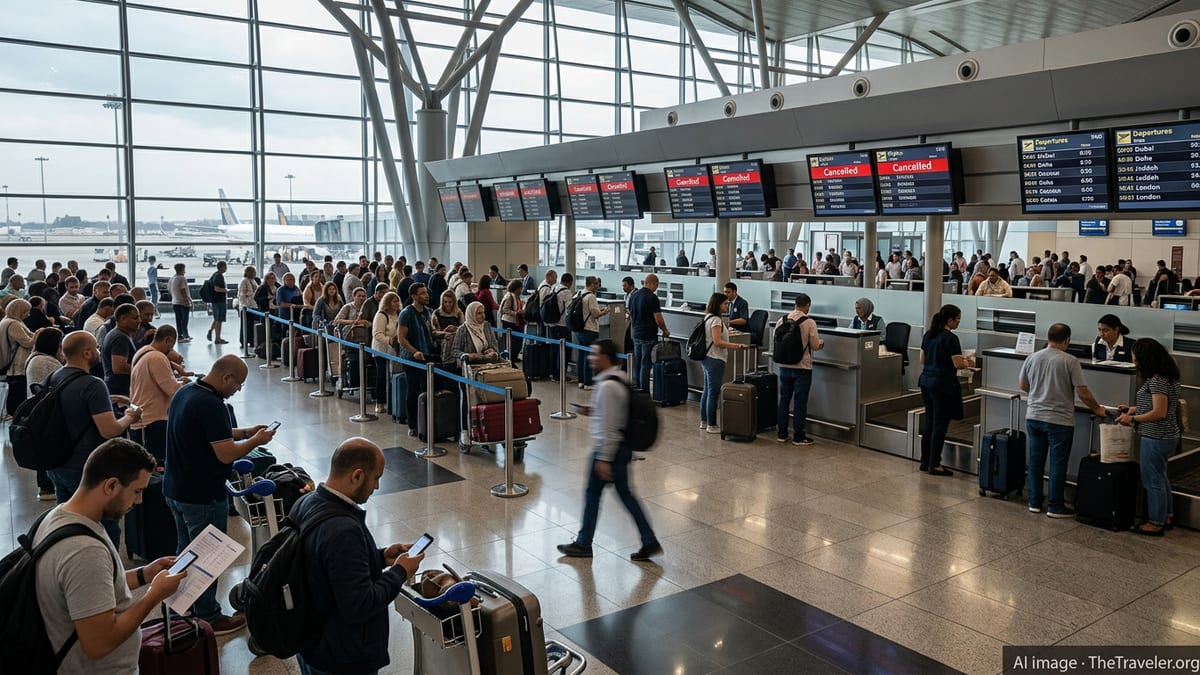
At Cairo International Airport, passengers reported long queues at airline desks and departure boards filled with cancellations to Gulf and Levant destinations. Airport officials said priority was being given to repositioning aircraft and operating limited services where safe air corridors were available, while urging travellers to contact airlines before heading to the airport.
Key Gulf and Levant Routes Among the Worst Affected
The heaviest impact has been felt on routes linking Egypt with neighbouring Gulf states and the Levant, which together account for a large share of outbound labour, family and business travel. Multiple daily services between Cairo and Bahrain, Doha, Kuwait, Dubai and Abu Dhabi were either cancelled outright or temporarily suspended, cutting off what are normally some of the busiest corridors in the region.
Flights between Egypt and Saudi Arabia have also seen significant disruption, particularly on links to Riyadh and Jeddah. These routes are critical not only for bilateral traffic, but also for religious travel and onward connections through Saudi hubs. Travel agents in Cairo reported that some passengers bound for Asia and Africa via Gulf and Saudi hubs were being advised to consider rerouting via European or alternative Middle Eastern gateways where capacity remained available.
In the Levant, services to Baghdad, Amman and Beirut were among those affected as carriers adjusted to shifting overflight permissions and operational risk assessments. While some flights continued on modified routings, others were pulled from schedules at short notice, complicating travel plans for passengers holding through tickets that linked these cities with onward connections via Egypt.
European links have not been immune. At least one Egypt-bound service connected to London Luton was among the cancellations, according to industry reports, as airlines reshuffled aircraft away from secondary European points to shore up core operations. Aviation analysts said further adjustments on European routes were likely if regional airspace constraints persist or tighten in the coming days.
Passengers Face Cancellations, Long Delays and Limited Alternatives
For travellers, the immediate impact has been a wave of cancellations, extended delays and a scramble for scarce alternative seats. With many Gulf hubs operating at reduced capacity and several carriers still suspending regular commercial operations on key routes, same-day rebooking options for Egypt-origin passengers were limited, particularly for those heading to or from Bahrain, Doha, Kuwait and the United Arab Emirates.
Passengers at Cairo and Borg El Arab airports described scenes of confusion as information screens repeatedly updated and airline staff worked through long lines of customers seeking answers. Some travellers reported being offered vouchers or free date changes, while others were advised to wait for further updates as airlines assessed when safe routing and slots might become available again.
Travel agencies in Egypt and across the Gulf said they were fielding a high volume of calls from customers booked in the coming days who were uncertain whether to proceed to the airport or attempt to proactively change itineraries. Agents noted that, in many cases, carriers were relaxing fare rules to allow one-time free changes or refunds, but warned that alternative routings via unaffected hubs were quickly selling out and often came with longer journey times and higher costs.
Some passengers with urgent travel needs have turned to indirect routings via European capitals or alternative regional gateways where airspace constraints are less severe. However, these options typically involve multiple connections and overnight stays, making them less feasible for families and price-sensitive travellers who dominate many of Egypt’s Gulf-bound flows.
Airlines Adjust Schedules While Monitoring Security and Airspace Developments
Carriers operating in the region have emphasised that safety remains the overriding factor in all operational decisions. Egyptair and other airlines linked to the current wave of cancellations are closely monitoring guidance from civil aviation authorities and air navigation service providers, as well as coordinating with airports and ground handlers to align staffing and gate availability with rapidly changing schedules.
Industry experts noted that airlines are walking a fine line between maintaining essential connectivity and avoiding last-minute disruptions that can leave aircraft and crews stranded in the wrong locations. Many carriers have opted to consolidate operations, focusing on a reduced number of core flights rather than operating a larger schedule that could be subject to sudden, cascading cancellations if airspace conditions change again.
Operational planners are also having to factor in extended flight times as aircraft are rerouted around closed or heavily restricted airspace. This reduces daily utilisation of aircraft and crews, limits the number of rotations that can be flown and tightens maintenance windows, all of which contribute to further schedule volatility. As a result, airlines have warned that additional short-notice changes remain possible even after revised timetables are published.
Aviation analysts said that once regional authorities begin easing restrictions, carriers are likely to prioritise restoration of high-demand corridors such as Cairo to Riyadh, Jeddah, Dubai, Doha and Kuwait, before gradually rebuilding frequencies to secondary destinations including London Luton and smaller Levant points. However, the timing and pace of any normalisation will depend on both security assessments and the availability of workable flight corridors.
Advice for Travellers Holding Tickets in the Coming Days
With the situation still evolving, travel industry bodies and airport authorities have urged passengers booked on Egyptair, Qatar Airways, Gulf Air and other affected airlines to check the latest status of their flights directly with the carrier before travelling to the airport. Many airlines are pushing real-time updates through mobile apps, text messages and email, although delays in notifications have been reported during the busiest disruption periods.
Passengers whose flights have already been cancelled are generally being offered a choice between free rebooking to a later date, route changes subject to seat availability, or refunds according to airline policies. Travel agents recommend that travellers with flexible plans consider postponing non-essential journeys or routing through less affected regions where viable alternatives exist.
For those who must travel, experts advise building in additional buffer time for connections, avoiding tight layovers through Gulf hubs that are still operating at reduced capacity, and keeping documentation such as visas and hotel bookings easily accessible in case itineraries need to change mid-journey. Travellers are also encouraged to monitor local news and official aviation advisories, as further adjustments to airspace restrictions could quickly reshape which routes are viable.
While airlines and authorities work to stabilise operations, passengers planning trips between Egypt and key Gulf, Levant and selected European destinations over the next several days should be prepared for potential last-minute changes. Industry observers say the pattern of rolling cancellations and gradual restoration of limited services is likely to continue until regional airspace conditions become more predictable.