

More news on this day
Numerous flights at Houston’s William P. Hobby Airport were cancelled this week amid wider disruption across U.S. air travel, leaving scores of passengers grounded, rebooked, or forced to abandon trips altogether.
Get the latest news straight to your inbox!
What Is Behind the Latest Wave of Cancellations
Publicly available flight-tracking data and airline advisories indicate that the latest cancellations at William P. Hobby Airport are tied to a broader storm system affecting large parts of the central United States. A powerful low-pressure system that intensified between March 13 and March 17, 2026 brought blizzard conditions to the Upper Midwest and High Plains, along with severe thunderstorms and disruptive winds across the South and lower Mississippi Valley. This system has been linked in published coverage to more than 5,000 flight cancellations nationwide over March 15 and the morning of March 16.
Houston itself has not experienced the extreme snowfall seen farther north, but the city has been affected by strong crosswinds, bands of heavy rain, and thunderstorms associated with the same storm complex. When these conditions line up with peak arrival and departure banks, airlines often reduce schedules or temporarily pause operations for safety, which can quickly ripple into large numbers of same-day cancellations at a busy airport such as Hobby.
Even when conditions at Hobby improve, aircraft and crews are frequently out of position because of earlier weather impacts in other cities. According to publicly available airline operations updates, this has led to situations where flights to or from Houston appear on-time in local forecasts but are ultimately cancelled due to aircraft or crew availability constraints elsewhere in the system.
Travel forums and social media posts from March 16 and March 17 describe travelers in multiple hubs dealing with last-minute cancellations and diversions as storms swept across the country. Those reports align with the timing of disruptions at Hobby, suggesting passengers are being caught in a chain reaction of delays and cancellations rather than a single, isolated issue at the airport.
How Southwest and Other Carriers Are Affected
William P. Hobby Airport functions primarily as a base for Southwest Airlines, which operates the bulk of the domestic schedule there, alongside more limited service from carriers such as Delta and others. Historically, when storms or national air traffic constraints arise, Hobby is particularly sensitive because such a large share of its daily flights are concentrated under one airline’s network.
Recent weather advisories shared by Southwest earlier in the winter for storms like January’s Winter Storm Fern specifically named Houston Hobby among the airports where flights could be delayed, diverted, or cancelled. While that advisory applied to an earlier event, it illustrates the pattern that is now repeating: when major storm systems sweep across the country, Hobby tends to see clusters of cancellations as airlines preemptively trim schedules to manage safety and logistics.
In the current disruption, travelers at Hobby have reported cancelled morning departures, missed connections to points across the Midwest and East Coast, and rebookings through alternate Texas airports such as Dallas or even farther afield. For a point-to-point carrier like Southwest, cancelling one leg can also strand an aircraft that was scheduled to operate multiple additional flights throughout the day, compounding the effect.
Other airlines operating limited service into Hobby can be affected differently. If a carrier only runs one or two flights a day on a specific route, a single cancellation may mean there is no same-day alternative service, increasing the likelihood that travelers will be rebooked through Houston’s larger George Bush Intercontinental Airport or another hub city.
What Stranded Passengers Are Experiencing on the Ground
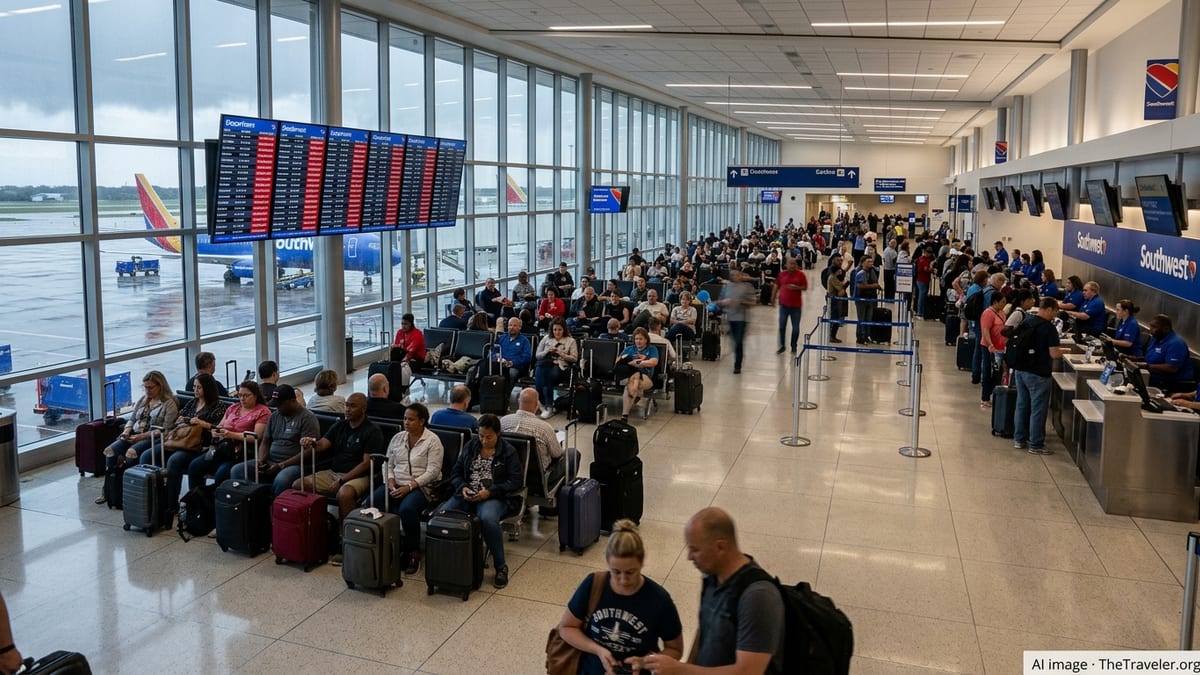
Travelers passing through Houston and other storm-affected airports this week have described long lines at rebooking counters, packed gate areas, and difficulty reaching customer service by phone or app during peak disruption periods. Those conditions have also been reflected in posts from passengers at Hobby, who report scrambling to secure seats on later flights or to arrange overnight stays when same-day options disappear.
Because Hobby serves a mix of business travelers, leisure passengers, and those connecting to cruises or events along the Gulf Coast, cancellations can quickly derail carefully timed itineraries. Some travelers have described having to rebook into different Texas or Gulf Coast cities and then complete the last leg by car, a pattern also seen recently at other storm-affected airports nationwide.
These disruptions can be especially stressful for passengers with tight schedules, families traveling with children, or those who have already experienced earlier delays elsewhere in the network. For visitors unfamiliar with Houston, a sudden overnight stay can also mean scrambling for hotel rooms and transportation during periods when demand is high around both Hobby and Bush Intercontinental.
At the same time, publicly shared images and accounts from inside Hobby in recent days show operations continuing on many routes, with some flights departing close to schedule even as others are cancelled. The result is a patchwork experience in which some travelers move relatively smoothly through the airport while others face extended, often expensive, delays.
Key Steps Passengers Should Take Now
Travel experts and consumer advocates generally recommend that anyone scheduled to fly from William P. Hobby Airport in the coming days monitor their flight status closely, using both airline apps and airport departure boards. During large, system-wide disruptions, schedules can change repeatedly within a few hours, and a flight that appears on time overnight can still be delayed or cancelled by morning if crews or aircraft remain out of position.
When a cancellation occurs, airlines typically offer rebooking on the next available flight on the same route at no additional cost, subject to seat availability. In some cases, especially when major weather is the primary cause, carriers may also allow changes to nearby airports in the same region, such as switching from Hobby to Bush Intercontinental, without additional fare. Travelers are encouraged to review their specific carrier’s weather or travel waiver pages to understand what options apply to their ticket.
For those whose trips are time-sensitive, same-day alternatives may involve connecting itineraries that add stops or longer travel times. Publicly available industry guidance suggests that travelers who can be flexible with departure times, routings, or even travel dates often have the best chance of securing workable alternatives during disruptive periods. Remaining logged into the airline app and enabling notifications can also give a head start when rebooking options appear.
Passengers already at Hobby during a wave of cancellations may find that customer service counters quickly develop long queues. In those situations, experts often advise using multiple channels at once, such as standing in line while also calling the airline or using live chat in an app, to reach assistance sooner. Travelers should also keep all receipts for meals, ground transport, and lodging, in case their airline or travel insurance provider offers partial reimbursement later.
Looking Ahead for Travelers Using Houston Hobby
Forecasts indicate that the intense storm complex affecting the central United States is expected to weaken as it moves away from the region. As conditions stabilize, airlines usually work to restore normal schedules within a few days, though some residual delays can persist as crews and aircraft return to their regular rotations.
For near-term travelers, the most practical response is careful preparation. That includes allowing extra time to reach the airport if thunderstorms or heavy rain are in the Houston forecast, checking in as early as possible, and packing essential medications, chargers, and a change of clothes in carry-on luggage in case of an unexpected overnight delay. Travelers connecting through other hubs should pay close attention to weather conditions not only in Houston but also at intermediate airports.
In the medium term, recent events serve as a reminder that Houston’s position within major domestic and regional air networks means Hobby is likely to feel the effects of large-scale winter and early spring storms, even when the most severe weather occurs hundreds of miles away. Publicly available historical data from earlier winter systems in 2026, as well as past storms affecting the Houston area, show consistent patterns of elevated cancellations when wide-reaching storms disrupt air travel across multiple regions.
Passengers planning travel through Hobby later in the season may find it helpful to build additional flexibility into their itineraries, whether by avoiding the tightest possible connections, opting for earlier departures, or considering refundable fares or travel insurance for critical trips. While severe disruptions of the scale seen this week remain relatively infrequent, their impact on individual journeys can be significant, making preparation and real-time awareness increasingly valuable for anyone flying through Houston.