

More news on this day
Passengers across Canada and the United States faced cascading travel disruption after significant delays and cancellations at Vancouver International Airport disrupted flights linking Vancouver with Palm Springs, Montreal, Trail, Minneapolis and several other destinations.
Get the latest news straight to your inbox!
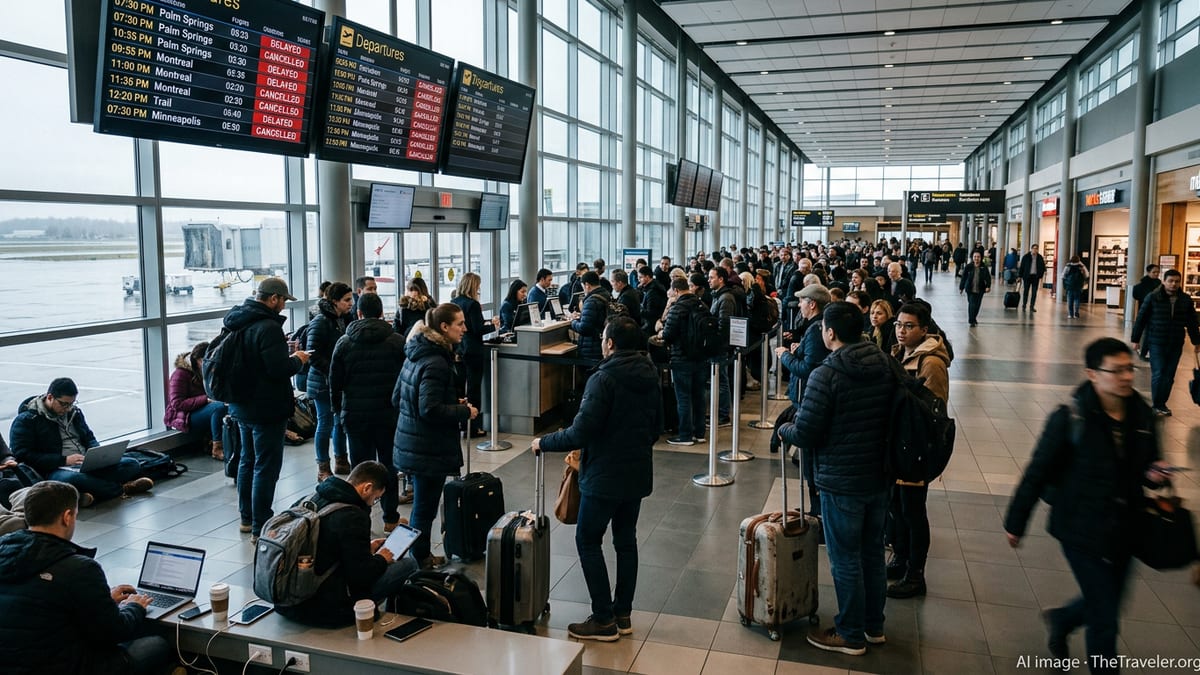
Significant Disruptions at Vancouver International Airport
Operational data and local reports indicate that Vancouver International Airport has experienced a sharp spike in schedule disruption, with at least 68 flights delayed and 40 canceled in a compressed period. While the precise mix of affected airlines and routes continues to evolve in real time, the pattern points to an operational event large enough to send knock-on effects throughout the airport’s domestic and transborder network.
Vancouver is one of Western Canada’s busiest hubs, and even a few dozen cancellations can quickly ripple outward. When flights are removed from the schedule or pushed back by several hours, aircraft and crews are left out of position, which in turn forces additional changes later in the day. This creates what aviation analysts often describe as a rolling disruption, where the original trigger is compounded by resource constraints, weather windows and airport capacity limits.
Publicly available information from aviation trackers and airport route documents shows that Vancouver serves a dense mix of regional British Columbia destinations, major Canadian cities and U.S. leisure and business markets. Once irregular operations begin, the airport’s role as a connecting hub means disruption is rarely confined to a single corridor and can affect passengers who never planned to stop in Vancouver for more than a brief connection.
Routes Hit: From Regional Trail to Sun-Seeking Palm Springs
The disruption has been particularly visible on routes that link Vancouver with smaller regional destinations and popular leisure spots. Trail, a community in British Columbia’s interior served by regional carriers, relies heavily on Vancouver for onward connections. When flights on this short sector are delayed or canceled, passengers can lose entire itineraries, as missed connections to larger cities cannot always be rebooked the same day.
Montreal and Minneapolis, both major urban centers, are also part of Vancouver’s regular network, with multiple weekly services operated by a mix of Canadian and U.S. airlines. Schedule disturbances on these routes can quickly affect business travelers, sports fans and families connecting onward to Europe, the U.S. Midwest or Eastern Canada. Based on published route brochures and airline timetables, these flights typically support both point-to-point demand and complex itineraries that depend on tight connections.
At the same time, the disruption has reached classic winter and shoulder-season escape routes such as Palm Springs. Vancouver’s links to sun destinations in the U.S. Southwest are popular with Canadian travelers seeking warmer weather, particularly around weekends and holiday periods. When departures to Palm Springs are delayed or canceled, passengers may face a limited set of same-day alternatives, since these leisure routes often operate at specific times and sometimes only a few days per week.
What Is Causing the Chaos?
While a single clear-cut cause is not immediately evident, irregular operations of this scale at a large hub typically result from a combination of factors rather than a single incident. Winter and early-spring weather patterns across North America have been especially disruptive in recent months, with major storms leading to widespread cancellations and lengthy delays at numerous airports. When such systems intersect with a hub like Vancouver, they can constrain runway capacity, require extended de-icing procedures or force temporary ground holds.
Infrastructure and operational pressures can play a parallel role. Past disruption episodes at large airports have been linked to a mix of runway maintenance, staffing constraints in air traffic control or ground handling, and the knock-on effects of earlier weather events that left aircraft and crews out of position. Once a threshold of disruption is crossed, airlines begin making tactical decisions to cut certain flights to protect long-haul operations or core business routes, leading to a higher concentration of cancellations on shorter or lower-frequency services.
Airline scheduling practices can intensify the passenger experience of such events. Many carriers operate tightly timed banks of arrivals and departures designed for smooth connections. When a first wave of flights is delayed, the carefully constructed sequence begins to unravel. Even if only a portion of the day’s schedule is formally canceled, the shifting of gates, equipment and crews can result in rolling delays that last long after the original trigger has passed.
Impact on Travelers Across Canada and the United States
For passengers, the practical consequences have included missed connections, unplanned overnight stays and last-minute changes to ground transportation and accommodation. Travelers connecting in Vancouver from regional airports like Trail, or from major Canadian gateways such as Montreal, have reported needing to rebook entire multi-leg journeys when a single segment failed to operate as scheduled.
Across the border, disruptions on routes to U.S. cities such as Minneapolis and Palm Springs have created uncertainty for those relying on precise arrival times, including business travelers with same-day meetings and vacationers connecting to cruise departures or resort shuttles. Even when flights eventually depart, extended delays can push arrivals into the early hours of the morning, complicating hotel check-ins and car rental arrangements.
Airline policies on rebooking and compensation vary by carrier and by the reason for the disruption. In many jurisdictions, passenger entitlements are stronger when delays or cancellations are linked to factors within the airline’s control, such as crew scheduling or maintenance, rather than weather or air traffic restrictions. Travelers are therefore closely watching how airlines classify the cause of their specific flight’s delay, as this can affect meal vouchers, hotel coverage and potential financial compensation.
What Affected Passengers Should Do Now
For those with upcoming trips involving Vancouver, industry guidance suggests acting as early and proactively as possible. Travelers are generally advised to monitor their flight status through official airline apps or customer service channels rather than relying solely on airport departure boards, which can lag behind real-time updates during periods of heavy disruption.
Passengers already en route to the airport may benefit from arriving with additional time, particularly if they are connecting onward to destinations such as Montreal, Minneapolis or Palm Springs. Extra buffer helps manage longer check-in lines, potential terminal changes and any last-minute retiming of departures. Those with non-essential travel have, in some past disruption events, chosen to contact airlines to explore voluntary rebooking options to later dates or more stable time periods.
Travel planning experts often recommend carrying digital copies of all booking confirmations, maintaining flexible ground transport arrangements, and ensuring that any essential medications or valuables remain in carry-on luggage in case checked bags become separated during irregular operations. Where possible, travelers with complex itineraries may also consider confirming their rights under applicable passenger protection rules so they can reference them if rebooking or accommodation becomes necessary.