

More news on this day
America’s busiest airports are hurtling into a new era of supersized travel, with Hartsfield-Jackson Atlanta, Las Vegas Harry Reid, Charlotte Douglas and Miami leading a surge in passenger volumes that is shattering records and redefining what peak season looks like.
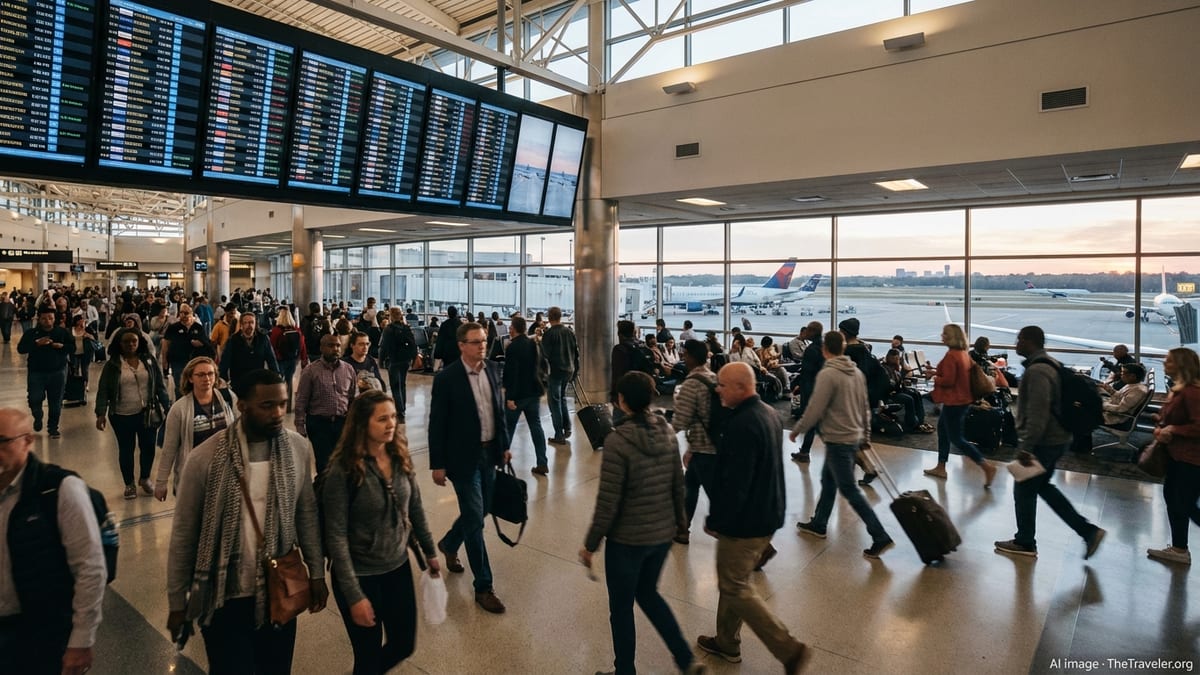
Atlanta Still Reigns as Mega-Hub as Volumes Climb
Hartsfield-Jackson Atlanta International Airport remains the undisputed heavyweight of global air travel, retaining its status as the world’s busiest hub while absorbing another year of robust demand. Recent operational data show the airport handling tens of millions more passengers than any other U.S. gateway, as both domestic connections and international links continue to grow. Airlines have leaned heavily on Atlanta’s geographic advantage and mature hub structure to funnel traffic across the Southeast and beyond.
That growth has not come without pressure. A recent disruption analysis of U.S. airports highlighted Atlanta’s packed schedule, with roughly one in four flights experiencing some level of delay, underscoring how fragile the system can become when volumes push against infrastructure and airspace limits. Airport managers and carriers are responding with targeted investments in gate utilization, airfield efficiency and technology designed to keep passengers moving even at peak hours.
Despite those strains, demand shows little sign of easing. Strong business travel across the Sun Belt, a rapidly expanding leisure market and the continued rise of Atlanta as a corporate headquarters hub are all feeding traffic through Hartsfield-Jackson. For travelers, it means more nonstop options and frequencies, but also a heightened need to plan for crowds, longer queues and tighter connection windows during busy banks.
Las Vegas Harry Reid Rides Event Boom and New Routes
In the desert, Las Vegas Harry Reid International Airport has transformed into a bellwether for the city’s high-stakes tourism economy. The airport closed 2024 with a record 58.4 million passengers and followed that with nearly 55 million travelers in 2025, the third-highest total in its history. That surge reflects a potent mix of marquee events, convention traffic and an expanding roster of direct flights that connect Las Vegas to more than 170 markets.
Airport officials credit the momentum to a strategy focused on both capacity and experience. Harry Reid has rolled out new terminal amenities, upgraded hold rooms, enhanced baggage systems and services such as curbside concierge check-in and advance parking reservations. Those improvements are aimed at smoothing the journey for visitors arriving for everything from major sporting events to mega-conferences, many of which now anchor the city’s year-round calendar.
At the same time, Las Vegas has had to navigate headwinds that tested the resilience of that growth, including a prolonged federal government shutdown and softening demand from some international markets. Even so, the airport has maintained full operations, using its diversified network of domestic and international carriers to keep passenger flows strong. For Southern Nevada, Harry Reid’s sustained volumes remain a critical pillar of tourism revenue and local employment.
Charlotte Douglas Balances Record Growth With Reconstruction
Charlotte Douglas International Airport has rapidly climbed into the top tier of U.S. hubs, riding the expansion of the Carolinas and its role as a major connecting base. After shattering its all-time record with 58.8 million passengers in 2024, the airport recorded 53.6 million travelers in 2025, still its second-busiest year on record. The slight pullback reflects airline schedule adjustments rather than a collapse in demand, with carriers shifting toward more regional flying and smaller-gauge aircraft.
Local traffic in Charlotte, however, is still surging. The airport is seeing a growing share of passengers beginning or ending their journeys in the region, mirroring the area’s population boom and rising corporate footprint. Nearly 12 million travelers passed through security checkpoints in 2025, and Charlotte continues to build out an increasingly global network, adding new nonstop routes to destinations such as Athens and preparing for long-haul service to Abu Dhabi.
To cope with this growth, Charlotte Douglas is in the thick of a sweeping infrastructure overhaul. A multiyear Terminal Lobby Expansion has added and renovated hundreds of thousands of square feet of space, while the consolidation and modernization of security checkpoints is designed to handle hundreds more passengers per hour. Parallel runway construction and concourse renovations are scheduled into 2027, signaling that the airport is racing to get ahead of demand rather than merely reacting to it.
Miami’s Record-Breaking Momentum Reshapes U.S. Gateway Map
Further south, Miami International Airport has emerged as one of the standout growth stories among America’s mega airports. In 2024, MIA set new records with nearly 56 million passengers and about 3 million tons of cargo, marking its third straight year of record passenger traffic and fifth consecutive record in cargo volumes. Driven by an 8.4 percent jump in international travelers and solid domestic gains, Miami has become a dominant connector between the United States, Latin America, the Caribbean and an expanding mix of European routes.
The airport’s rapid growth has reordered the U.S. gateway landscape, placing Miami alongside traditional giants like Atlanta and Los Angeles as one of the country’s busiest international entry points. Airlines have poured additional capacity into the market, restoring and surpassing their pre-2019 seating levels and using Miami as a springboard into secondary cities across the hemisphere. For the tourism-heavy South Florida economy, those numbers translate into full hotels, packed cruise terminals and intense pressure on local transportation systems.
In response, Miami is rolling out a sweeping modernization strategy branded as its Future-Ready Modernization in Action plan. With a projected 9 billion dollars in capital investment, the program targets everything from conveyance units and restrooms to boarding bridges and terminal interiors. Dozens of escalators and elevators have already been overhauled, most of the airport’s hundreds of conveyance units are now back online, and further upgrades are scheduled through 2025 and beyond to keep pace with demand.
Airports Race to Add Capacity as Travelers Flood the Skies
Together, Atlanta, Las Vegas, Charlotte and Miami highlight a broader transformation across the U.S. aviation system. After the pandemic-era slump, passenger numbers have roared back and, in many cases, pushed well beyond 2019 levels. That resurgence is revealing just how stretched airport infrastructure has become, from gate availability and runway capacity to security screening, baggage handling and curbside congestion.
Across these hubs, the response is strikingly similar: multibillion-dollar capital programs, redesigned terminal layouts, expanded security lanes, and a heavier emphasis on technology to speed travelers through chokepoints. Airports are betting that investments made now will pay dividends for decades, allowing them to capture growing demand, attract new long-haul routes and support regional economic development that increasingly depends on fast, reliable global connectivity.
For travelers, the mind-blowing surge in traffic brings a mixed reality. On one hand, there are more flight options, more nonstop city pairs and upgraded facilities. On the other, peak days at these mega hubs now feel like permanent holidays, with crowded concourses and tight margins for on-time operations. As the travel boom shows few signs of slowing, how successfully these airports execute their expansion plans will help determine whether the current surge feels like an opportunity seized or a capacity crunch that caught the system off guard.