

More news on this day
Malta’s cruise industry is entering a new phase of expansion, with record passenger volumes, fresh investment in port infrastructure and a stronger emphasis on homeport operations consolidating the island’s role as a strategic hub in the central Mediterranean.
Get the latest news straight to your inbox!
Record Passenger Numbers Cement Malta’s Cruise Momentum
Valletta Cruise Port closed 2025 with 962,966 passenger movements, the busiest year on record and a 2.3 percent increase over 2024, according to recently released figures. The milestone confirms that Malta has not only recovered from the pandemic shock but is now outperforming its previous peaks and climbing the rankings of Mediterranean cruise destinations.
The uptick follows a strong performance in 2024, when Valletta first surpassed pre-2019 highs and signalled a durable rebound in cruise tourism. Industry observers note that growth is being driven both by larger vessels and by a more diverse mix of itineraries that place Malta at the centre of central Mediterranean routes.
Data from Malta’s National Statistics Office for 2025 show that cruise traffic has remained resilient even through seasonal fluctuations, with more ship calls and slightly lower average vessel capacity pointing to a broader spread of operators using the island. This trend supports a strategic shift from relying solely on high-volume transit calls to cultivating repeat and higher-value business.
Stakeholders at Valletta Cruise Port say the latest numbers validate years of investment in terminal facilities, passenger services and destination marketing that have positioned Malta as a competitive alternative to larger Mediterranean hubs.
Homeport Operations Gain Strategic Importance
Alongside headline passenger totals, one of the most significant developments for Malta’s cruise sector has been the steady rise in homeporting, with more ships embarking and disembarking passengers in Valletta. Port operators report growing interest from major cruise brands in using Malta as a turnaround base for central and eastern Mediterranean itineraries.
Homeport operations are particularly prized by local authorities because they generate more overnight stays in hotels, higher spending in restaurants and shops, and increased demand for ancillary services such as provisioning, bunkering and technical support. Industry executives say that for many visitors Valletta is now both a gateway to the region and a destination in its own right at the start or end of a cruise.
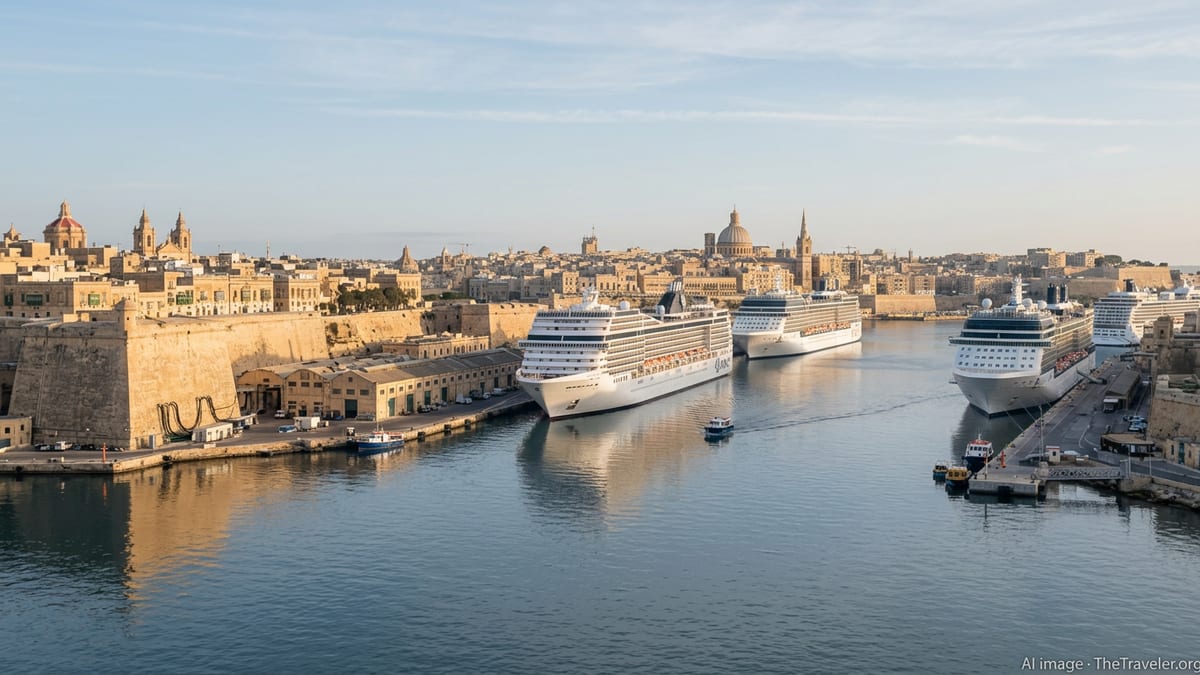
Valletta’s modern cruise terminal, housed within the historic Magazino Hall on the Grand Harbour waterfront, has been configured to handle embarkation and disembarkation flows efficiently while preserving the character of the UNESCO-listed cityscape. The infrastructure allows the port to manage multiple large ships at once, with dedicated areas for baggage handling, security screening and check-in that align with the requirements of leading cruise lines.
According to financial disclosures from the port’s operator, repeat cruise travellers already account for a sizeable share of passengers, suggesting that Malta’s appeal as a homeport is building through word of mouth and brand loyalty rather than volume alone.
Infrastructure Upgrades Target Capacity and Sustainability
To sustain growth and appeal to environmentally conscious cruise brands, Malta has embarked on a series of infrastructure upgrades at the Grand Harbour. A flagship project is the installation of shore-to-ship power, inaugurated in recent months after an investment of around 33 million euros, co-financed through the European Union’s Connecting Europe Facility.
The onshore power system allows berthed cruise ships to switch off their engines and connect directly to Malta’s national grid, substantially cutting emissions of sulphur oxides, nitrogen oxides and particulate matter in and around Valletta’s historic harbour. Authorities describe the project as one of the first large-scale cruise-focused shore power deployments in the Mediterranean, positioning Malta as a regional leader on green port technologies.
Official figures indicate that dozens of cruise calls have already made use of the new shore power network in its first year of operation, and the system has capacity to expand as more vessels are fitted with compatible technology. The project is part of a broader plan that enables the Grand Harbour to accommodate up to five cruise ships simultaneously while keeping local air quality and noise under tighter control.
Infrastructure Malta and the transport ministry have signalled that further investments are in the pipeline, including upgrades to quays, traffic management around the waterfront and digital systems to streamline passenger flows. These improvements are intended to support both higher capacity and an improved experience for transit and homeport passengers alike.
Competitive Edge in the Mediterranean Cruise Market
Within the Mediterranean, Malta is working to leverage its location, compact size and cultural appeal to stand out in an increasingly competitive cruise market. Membership in MedCruise, the association representing ports across the region, has helped the island secure greater visibility among itinerary planners and coordinate on shared priorities such as sustainability and marketing.
Industry analysts say that Valletta’s combination of deep-water berths, efficient turnaround operations and immediate access to a historic city centre gives it an advantage over some larger but more logistically complex ports. With major Western Mediterranean hubs grappling with congestion and tighter limits on ship calls, lines are showing renewed interest in alternative turnaround points that can offer smoother operations and distinctive shore experiences.
At the same time, Maltese authorities are aware of rising sensitivities around overtourism in historic cities and are framing growth in cruise traffic within broader tourism and urban strategies. Port and tourism officials stress that their focus is on managing volumes, spreading arrivals over the year and encouraging visitors to explore beyond the immediate harbour area, with curated excursions to other parts of the islands.
Local businesses, from tour operators to hospitality groups, are tailoring products to the needs of cruise travellers who start or end their journey in Malta, including pre- and post-cruise stays and integrated cultural packages. This is reinforcing the island’s image as more than a short stop on a wider itinerary.
Future Outlook: Balancing Growth, Quality and Community Impact
Looking ahead to the 2026 season, Valletta Cruise Port forecasts a further increase in vessel calls, with estimates of around 435 ship visits while maintaining passenger numbers close to current record levels. This shift implies more frequent but slightly smaller ships on average, a pattern that could help distribute arrivals more evenly over the calendar.
Port executives and government officials argue that the next phase of growth will be judged less by sheer volume and more by value, quality and sustainability. There is a growing emphasis on smoothing turnaround procedures, enhancing terminal services and ensuring that shore excursions respect local communities and heritage sites.
Consultations are ongoing between the port operator, tourism authorities and city stakeholders to address practical issues such as traffic congestion near the waterfront, crowding in Valletta’s narrow streets and the distribution of economic benefits across the wider Maltese economy. Policy discussions include refining scheduling practices and continuing investments that align with climate and air-quality commitments.
With record-breaking seasons now the norm rather than the exception, Malta’s cruise sector is shifting from recovery mode to long-term positioning. By expanding homeport operations, modernising infrastructure and foregrounding environmental performance, the country aims to consolidate its status as a central Mediterranean cruise hub that can grow while preserving the distinctive character of its historic harbour city.