

More news on this day
After more than a decade without commercial flights, Manston Airport in Kent is edging toward a long-awaited relaunch as a dedicated air freight hub, a move backers say could relieve pressure on congested UK airports and reposition the southeast as a strategic gateway for global trade.
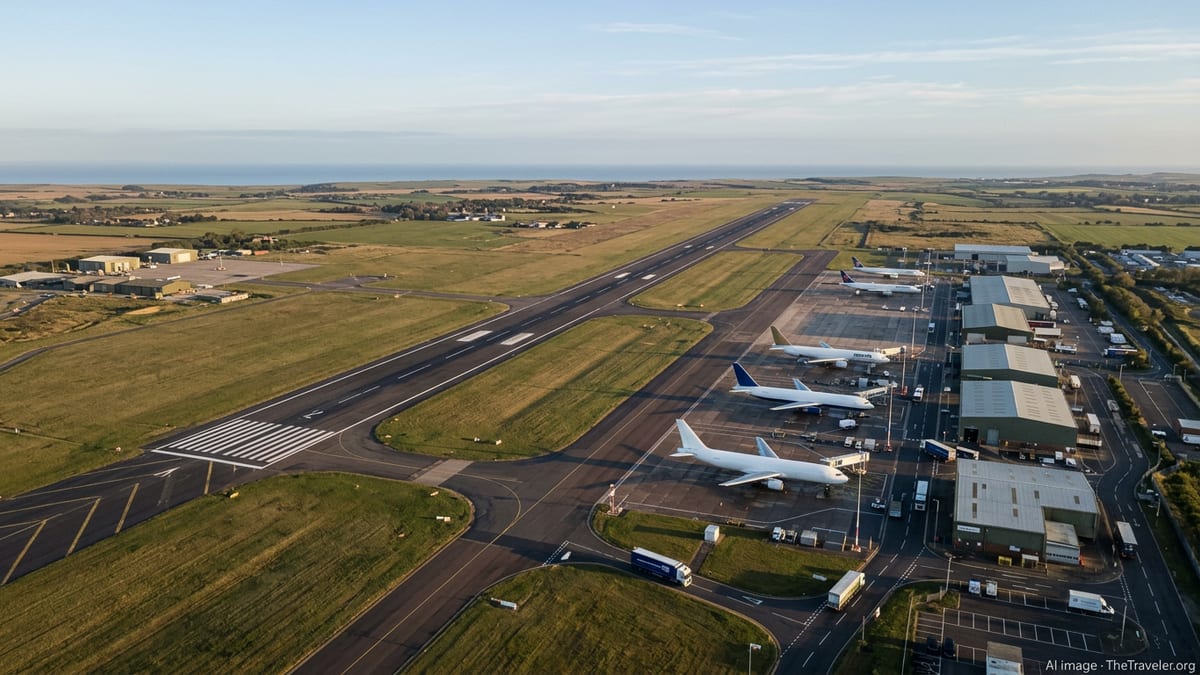
From Closure to Comeback: A Strategic Site Reimagined
Manston Airport, which closed to commercial traffic in May 2014, has spent much of the last 12 years as a symbol of unrealised potential on the edge of the English Channel. The vast airfield on the Isle of Thanet, once RAF Manston and later Kent International Airport, has alternated between lorry park, filming location and political football while its future was fought over in courts and public inquiries.
That future is now becoming clearer. RiverOak Strategic Partners, which acquired the site in 2019, has secured a development consent order from the UK government to reopen Manston as a specialist air cargo hub. The final legal challenge to the scheme was dismissed in 2024, clearing the way for detailed design, airspace work and construction to proceed toward an expected reopening for freight operations around 2028.
Supporters argue that Manston’s attributes are hard to ignore: one of the UK’s longest and widest civilian runways, proximity to major shipping lanes and ports, and direct road links toward London and the Midlands. While passenger services may follow later, the immediate focus is on carving out a niche in a fast-evolving air freight market.
The relaunch comes at a time when traditional cargo gateways around London and the Midlands are operating close to capacity, squeezed by passenger growth, environmental limits and curfew constraints. For policymakers concerned about post-Brexit trade resilience and supply chain shocks, Manston offers an unusually blank canvas.
New Freight Capacity for a Post-Brexit Trading Landscape
The UK’s air cargo system has long relied on a handful of major hubs, particularly Heathrow, East Midlands and Stansted. Much of the country’s freight flies in the bellies of passenger aircraft, leaving dedicated freighter operations to compete for scarce slots. Manston’s backers say an all-cargo model, operating 24 hours with modern noise and emissions controls, can plug a growing capacity gap.
Plans for the revived airport envisage handling in excess of 10,000 air traffic movements a year, with a focus on time-sensitive and high-value goods ranging from pharmaceuticals and electronics to e-commerce parcels and fresh produce. Located less than 20 miles from the Port of Dover and the Channel Tunnel, the site is positioned to integrate with key sea and road corridors serving continental Europe.
Industry groups have framed the project as part of a broader effort to future-proof UK trade. With supply chains reshaped by Brexit, pandemic-era disruptions and geopolitical tensions, having additional runway and warehousing capacity in southeast England is seen as a hedge against congestion or disruption at other gateways.
Crucially, the freight-first model could also help rebalance flows. Rather than trucking consignments to airports hundreds of kilometres away, exporters in Kent and the wider south east could have a local option for long-haul airlift, shortening road legs and cutting journey times for perishable and just-in-time cargo.
Local Jobs, Regional Regeneration and Community Concerns
The prospect of aircraft returning to the skies over Thanet has divided opinion locally, but few dispute that the project could reshape the area’s economy. RiverOak Strategic Partners has promoted estimates of thousands of direct and indirect jobs once the airport is fully operational, spanning ground handling, maintenance, security, logistics, warehousing and ancillary services.
For a district that has wrestled with pockets of deprivation and seasonal employment, year-round work tied to global trade is attractive. Local colleges and training providers are already eyeing partnerships to develop skills pipelines in aviation, engineering and logistics, on the model of other UK freight hubs that have grown into regional employment anchors.
At the same time, campaigners opposed to the reopening warn of increased noise, air pollution and road traffic, particularly for residents under proposed flight paths and along the A299 corridor. Environmental groups also question whether a new air freight airport is compatible with national climate targets, arguing that efficiency gains and modal shifts should take precedence over new runway capacity.
Planners and operators will need to balance those competing pressures as detailed design progresses. Noise quotas, operating restrictions, surface access improvements and community benefit schemes are all expected to be part of the negotiation as the project moves from consent to construction.
Designing a Modern, Low-Carbon Cargo Hub
To answer critics and secure long-term viability, the developers of Manston are pitching the project as a test-bed for greener aviation and next-generation logistics technology. Public statements have highlighted ambitions for a carbon-neutral airfield, drawing on electric ground vehicles, on-site renewables and, in time, hydrogen and sustainable aviation fuels.
Plans include new cargo stands, high-specification warehousing, integrated customs and security facilities, and digital systems to optimise aircraft turnarounds and cargo flows. By building almost from scratch on a cleared airfield, engineers can incorporate the latest standards for energy efficiency, stormwater management and wildlife protection, rather than retrofitting older infrastructure.
There is also scope for co-locating value-added logistics activities on adjacent land, such as temperature-controlled storage, light manufacturing and cross-docking centres feeding e-commerce and retail distribution networks. That clustering effect has transformed the economies around other freight-focused airports and is central to local hopes for Manston’s revival.
Environmental groups remain sceptical that operational efficiencies and greener ground systems can offset the climate impact of additional cargo flights. The eventual choice of airline partners, fleet types and fuel strategies will go a long way to determining whether Manston can credibly claim a lower-carbon profile than rival hubs.
Redrawing the UK’s Air Freight Map
Looking ahead to the proposed 2028 opening date for cargo operations, the key question for the wider industry is how Manston will fit alongside established freight gateways. Rather than displacing capacity at Heathrow or East Midlands, many analysts expect it to capture a mix of new demand and traffic diverted from congested or slot-constrained airports in the southeast.
Manston’s location could make it particularly attractive for carriers serving northern Europe, the Middle East and parts of Asia, as well as for integrators and charter operators seeking flexible night-time operations. The ability to pair air movements with short sea crossings and road-haul links into mainland Europe could underpin new multimodal products for just-in-time supply chains.
If the project delivers on its promises, Kent’s once-quiet airfield may yet evolve into a specialist freight gateway that relieves pressure on larger airports while anchoring new trade-driven industries in the southeast. After years of uncertainty, the runway that went quiet in 2014 is poised to re-enter the UK’s aviation story as a bellwether for how the country handles its cargo future.