

More news on this day
Hundreds of travelers were left stranded at King Khalid International Airport in Riyadh this week after a wave of flight cancellations linked to wider airspace disruptions across the Middle East, creating long queues, overnight waits and mounting uncertainty for passengers trying to reach destinations in Europe, Asia and within the Gulf.
Get the latest news straight to your inbox!
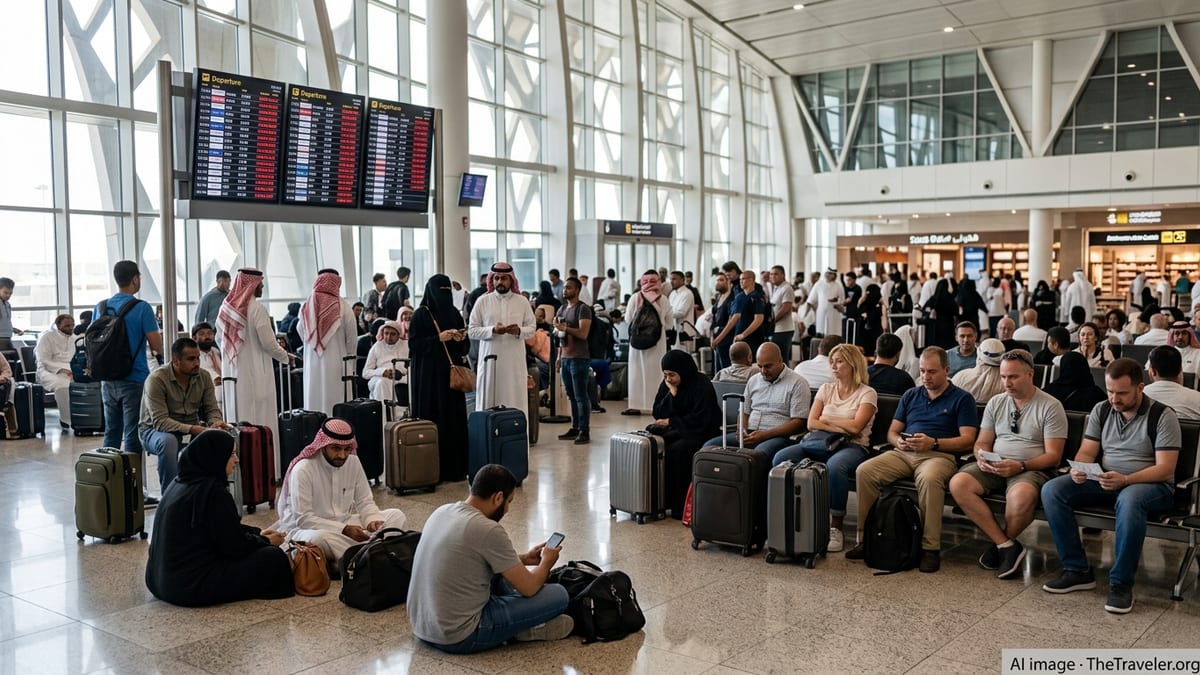
Regional Tensions Trigger New Disruptions in Riyadh
Publicly available aviation data and recent media coverage point to ongoing instability in Middle East airspace following a series of cross-border strikes and security incidents since late February 2026. These events led to large-scale cancellations at major hubs such as Dubai, Abu Dhabi and Kuwait City, and the disruption has increasingly rippled to secondary hubs including Riyadh’s King Khalid International Airport.
Advisories from risk consultancies and industry bulletins describe an “exceptional” period for air traffic control in the region, with carriers rerouting or suspending services as corridors open and close at short notice. While King Khalid International initially continued operating with limited interruptions, the cumulative effect of diversions, crew rotation issues and aircraft positioning has now resulted in clusters of cancellations and extended delays on both regional and long-haul routes.
Flight-tracking snapshots and airline schedule updates for late March indicate that several services to and from Riyadh have been cancelled or heavily delayed on short notice, particularly flights connecting to hubs already under strain. Passengers report learning of cancellations only hours before departure or upon arriving at the terminal, contributing to crowding around check-in and rebooking desks.
Analysts note that the disruption at Riyadh is part of a broader pattern rather than an isolated airport issue. As carriers prioritize limited safe corridors and reposition aircraft, some markets are seeing trimmed frequencies or temporary suspensions, pushing more pressure onto remaining flights and leaving some travelers with few immediate alternatives.
Hundreds Stranded as Airlines Struggle With Capacity
With multiple flights scrubbed over a short period, seating capacity out of Riyadh has tightened sharply, leaving hundreds of passengers dependent on standby lists, last-minute rebookings and indirect routings through less affected airports. Social media posts and traveler forums describe crowded departure halls, long lines at transfer counters and families camping out overnight while they wait for open seats.
Reports indicate that airlines serving King Khalid International are offering a mix of options that can vary widely by carrier and ticket type. Some passengers have been rebooked on later flights from Riyadh or alternative gateways such as Jeddah and Dammam, while others have accepted refunds or open-dated tickets. In several cases, travelers say they were advised to monitor schedules frequently and return to the airport quickly when a seat became available.
The situation is particularly challenging for those with onward connections or expiring visas. Passengers en route to Europe, Southeast Asia or South Asia through Gulf hubs face the risk of missed connections in already congested transit airports. Meanwhile, travelers on short-stay or work visas must navigate the additional complication of legal stay limits if their departures are pushed back by several days.
While some airlines and ground handlers appear to be providing hotel accommodation and meal vouchers where required by local regulations or company policy, accounts from passengers suggest that assistance can be inconsistent, especially during peak disruption periods when staff are overwhelmed and inventory in nearby hotels quickly fills.
What Travelers Using Riyadh Airport Should Expect Now
For travelers scheduled to fly to or from Riyadh in the coming days, publicly available guidance from airlines and travel advisories points to a fluid situation. Schedules remain subject to change at short notice, particularly for flights that cross or rely on affected airspace corridors or congested regional hubs. Even where flights are still operating, extended delays are possible as aircraft and crew recover from earlier disruptions.
Airlines are generally encouraging passengers to check their booking status and flight times repeatedly in the 24 hours before departure, not just once. Same-day adjustments, equipment changes and last-minute consolidations of lightly booked services have all been reported during this disruption period. Travelers with flexible tickets are being advised to consider voluntary date changes if their journeys are not time critical.
At the airport itself, passengers should be prepared for longer than normal processing times. Security and check-in queues can swell quickly when multiple departures are retimed into new slots, and transfer desks may be busy handling missed connections. Those with tight itineraries are being urged in publicly available advisories to build in generous buffers between flights and appointments at their final destination.
Observers note that while King Khalid International Airport continues to function, the operating environment is less predictable than usual. Travelers may see departure boards shift repeatedly over the course of a few hours, and gates can change late as airlines juggle operational constraints.
Passenger Options and Rights When Flights Are Cancelled
In the wake of sudden cancellations at Riyadh, attention has turned to the practical steps passengers can take and the rights they may have under airline policies and applicable regulations. International carriers typically outline their obligations in conditions of carriage published on their websites, including rules for rebooking, refunds and care such as meals and accommodation when disruptions are within the airline’s control.
However, the current wave of cancellations is largely linked to security conditions, airspace closures and operational restrictions, which many airlines classify as extraordinary circumstances. In such cases, policies may prioritize getting passengers to their final destination at the earliest opportunity rather than offering compensation. Travelers are being encouraged in consumer guidance to keep all receipts, document communications and review their specific fare rules, especially for discounted or promotional tickets that may have tighter conditions.
Travel insurance can play a meaningful role for some passengers. Policies that include trip interruption, missed connection and delay benefits may help cover extra hotel nights, meals and alternative transport if claims meet the policy criteria. Insurance industry commentary suggests that coverage for security-related airspace closures can vary, so passengers are urged to read the fine print and contact their insurer for confirmation rather than assuming automatic eligibility.
For those who booked through online travel agencies or corporate travel managers, additional support channels may be available. Some travelers have reported faster rebooking or clearer information when working through these intermediaries, which can access multiple fare inventories and explore creative routings via less affected airports.
Planning Ahead: How to Minimize Disruption Risk
As cancellations at King Khalid International highlight the knock-on effects of regional instability, travel planners are reevaluating strategies for trips in and out of the Gulf. Industry commentary suggests several practical steps for reducing risk, starting with building flexibility into itineraries. Booking longer connection times, choosing fully changeable fares where budgets allow and avoiding last-minute ticket purchases are among the commonly recommended approaches.
Travelers are also being advised to monitor not just their airline’s updates but also broader aviation and security developments in the region. Changes in airspace status or new incidents at neighboring hubs can quickly influence operations in Riyadh, even if local conditions remain calm. Subscribing to airline alerts, enabling notifications in airline apps and checking reputable news outlets on travel days can help passengers react more quickly if schedules shift.
Another emerging recommendation is to consider alternative routings that use a mix of carriers or less congested hubs when possible. While no route is completely immune during a widespread disruption, spreading risk across different corridors and avoiding the most heavily impacted airports may reduce the likelihood of severe delays. Some travel advisors suggest that passengers build in an extra buffer day for critical events, such as business meetings or family gatherings, when traveling through the region in the coming weeks.
Ultimately, the recent wave of cancellations at King Khalid International Airport underscores how interconnected global aviation has become. Even travelers whose journeys begin and end far from conflict zones can experience sudden disruption when key transit corridors are affected, making preparation, flexibility and up-to-date information more important than ever for anyone passing through Riyadh.