

More news on this day
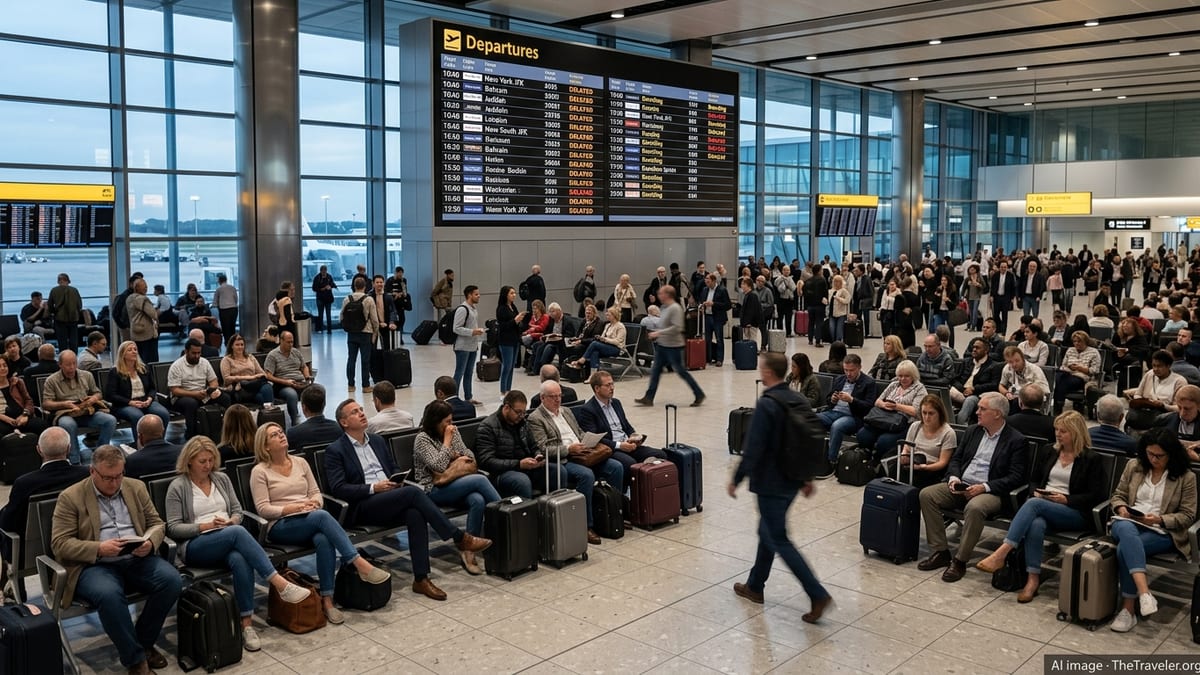
Passengers at major UK hubs serving London and Manchester have faced extensive disruption, with publicly available aviation data indicating 474 delayed flights and seven cancellations in a single trading period, heavily impacting long-haul routes to the United States, Bahrain, Saudi Arabia and other destinations across the Gulf.
Get the latest news straight to your inbox!
Major UK Hubs Struggle With Wave of Delays
Operational data tracked by flight-monitoring platforms shows that airports serving the London system and Manchester have recorded an unusually high concentration of schedule disruption, with 474 flights running late and seven cancelled. The figures relate to a recent 24-hour operational window and highlight how quickly congestion can ripple across the UK’s busiest air corridors when long-haul and transfer-heavy routes are affected.
Reports indicate that the bulk of delays have occurred on services operating at or through London Heathrow, London Gatwick and Manchester Airport, which together handle a significant share of the UK’s transatlantic and Middle East traffic. Even modest timetable disruptions at these hubs can rapidly cascade into missed connections, crew-availability challenges and aircraft-rotation issues.
Publicly available information suggests that weather-related capacity constraints, knock-on effects from earlier disruptions over the Middle East and continued airspace rerouting are among the factors compounding normal peak-period congestion. Industry analysts note that once a critical number of long-haul departures slip behind schedule, recovery can take many hours, particularly when aircraft and crew are tied to complex multi-leg rotations.
Gulf and European Carriers Among Those Affected
According to flight-status boards and tracking portals, services operated by Gulf Air, Wizz Air and Pegasus Airlines are among those affected by the current wave of disruption, alongside a broader mix of European and international carriers. These airlines link UK hubs to destinations in Bahrain, Saudi Arabia, Turkey, Central and Eastern Europe and beyond, meaning delays can extend far down the route network.
Gulf Air’s UK services play a key role in connecting British travellers to Bahrain and onward to other Gulf and South Asian destinations. Any delay or cancellation on these flights can create missed onward connections, particularly for passengers transiting through Bahrain on tightly timed itineraries. Publicly available schedules show selected services experiencing extended ground holds and revised departure times.
Low-cost carrier Wizz Air, which operates a number of leisure and religious-travel routes between the UK and Saudi Arabia, has also seen timetable changes and disruption on certain services, according to online departure boards and passenger reports. In some cases, travellers have described last-minute schedule adjustments and rebookings via alternative airports, reflecting the complexity of operating in a constrained regional airspace environment.
Pegasus Airlines, which runs high-demand links between UK cities and Turkish hubs used for both point-to-point and connecting traffic, is likewise listed among carriers with delayed departures. Industry observers point out that when several airlines operating to overlapping regions are forced to retime their flights, airport stands and peak-time runway capacity can quickly become saturated.
Middle East Tensions Add Pressure to Airspace and Schedules
The latest disruption coincides with a period of heightened tension and military activity across parts of the Middle East, which has triggered recurrent airspace closures, restrictions and rerouting. Publicly available aviation and security briefings describe temporary suspensions of flights to and from certain Gulf destinations earlier in March, as well as revised routings to avoid conflict-affected areas.
Travel-industry analyses note that even when direct services between the UK and affected countries continue to operate, airlines often need to adopt longer flight paths, additional fuel stops or new contingency routings. These measures can extend block times, reduce aircraft utilisation and erode schedule resilience, leaving less margin to absorb further operational issues at busy UK hubs.
Reports from global consultancies monitoring regional air operations describe heavy congestion at alternative hubs across the wider Middle East, including airports handling diverted or retimed services. This congestion can feed back into UK schedules when inbound aircraft arrive outside their planned slots, forcing last-minute adjustments to departure times from London and Manchester.
Industry commentators emphasize that while safety considerations take priority in any routing decision, the resulting operational complexity means that travellers are likely to see a higher volume of last-minute gate changes, rolling delays and schedule updates on routes touching the Gulf region.
Impact on Transatlantic and Connecting Traffic
Transatlantic routes linking the UK to major US gateways have also felt the knock-on impact of the disruption. Flight-tracking data shows select services from London and Manchester to US cities departing behind schedule, as airlines work to absorb delays accumulated earlier in the rotation or during inbound segments affected by rerouting.
Because many long-haul aircraft serving the US are shared across Middle East, Asia and African rotations, delays to one leg can affect the punctuality of flights in entirely different regions. Analysts note that a late-arriving aircraft from a Gulf hub, for example, may be scheduled to operate a subsequent service to North America from London or Manchester, creating a chain reaction of timetable changes.
Passengers with through-tickets connecting in London or Manchester onto US-bound services have reported tighter connection windows and, in some cases, rebooking onto later departures. Travel experts caution that even where minimum connection times are technically met, practical factors such as security queues, terminal transfers and boarding cut-off times can still place pressure on itineraries when the network is under stress.
Airlines are expected to continue prioritising the operation of core long-haul routes, but publicly available information suggests that some secondary services may face ongoing rescheduling as carriers reshape their timetables to restore operational stability.
Advice for Affected Travellers
Consumer bodies and travel advisers recommend that passengers due to fly from London or Manchester in the coming days maintain close contact with their airline or booking provider and monitor flight status up to the time of departure. Many carriers are offering limited-fee or fee-free changes for itineraries involving certain Middle East destinations, particularly where airspace restrictions have forced substantial shifts to flight paths or schedules.
Published guidance from aviation and travel-risk consultancies suggests that travellers build additional buffer time into itineraries involving tight connections, especially when transiting through major hubs in Europe or the Gulf. Where possible, experts advise opting for single-ticket journeys on one carrier or alliance, which can make it easier to secure rebooking or accommodation if significant disruption occurs.
Passengers experiencing delays or cancellations at UK airports are also encouraged to familiarise themselves with applicable compensation and assistance frameworks, including rules that may entitle them to meals, accommodation or partial refunds, depending on the cause and length of the disruption. Specialist consumer organisations publish regularly updated guidance explaining how these frameworks apply in practice.
While the current figures on delays and cancellations highlight the scale of the challenge facing airlines and airports, industry observers underline that conditions remain fluid. Travellers heading to the United States, Bahrain, Saudi Arabia and other affected destinations are being urged, in public-facing advisories, to treat flight times as subject to change and to plan their journeys with additional flexibility in mind.