

More news on this day
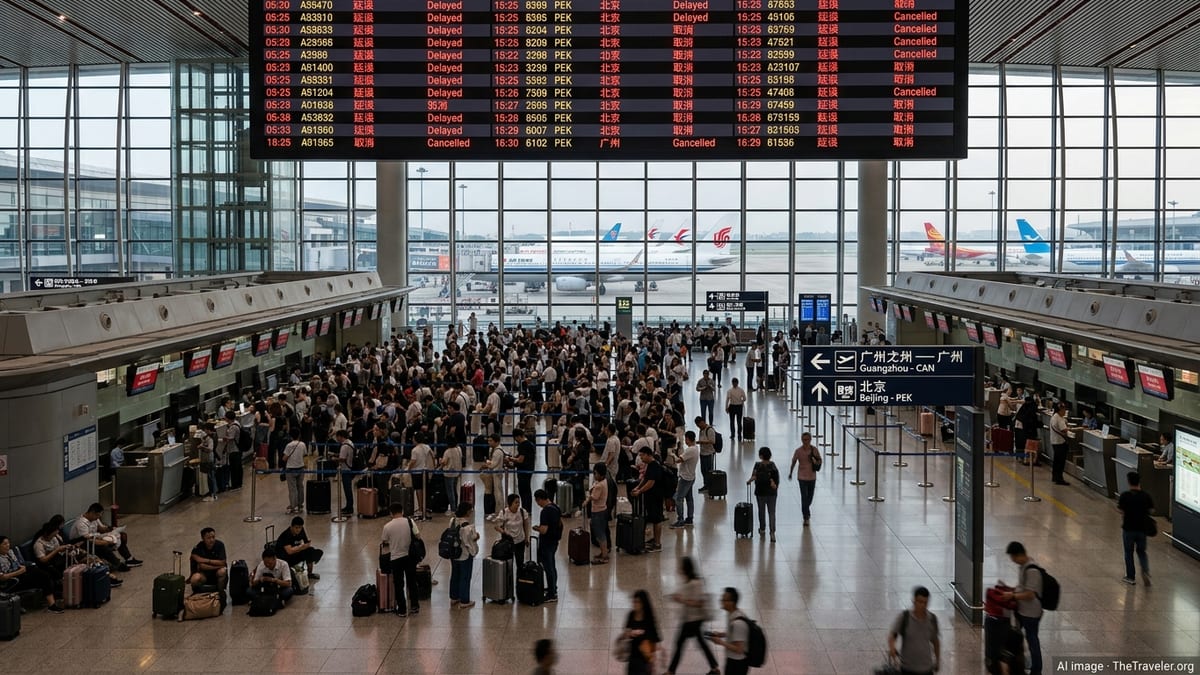
Thousands of travelers across China faced unexpected disruption as more than 2,000 flight delays and 81 cancellations rippled through major hubs including Beijing, Guangzhou, Chengdu and Nanjing, with leading carriers scrambling to realign aircraft and crews to an already stretched domestic network.
Get the latest news straight to your inbox!
Major Hubs See Cascading Operational Disruptions
The latest disruption has concentrated on China’s busiest aviation centers, where Beijing, Guangzhou, Chengdu, Nanjing and several coastal cities have reported dense clusters of delayed and canceled services. Publicly available tracking dashboards show wave after wave of late departures and missed arrival slots, particularly during peak morning and evening banks when aircraft turnaround times are shortest.
Data from flight monitoring platforms indicates that departures tagged as delayed now reach into the thousands, with a smaller but highly disruptive group of 81 cancellations removing entire rotations from the system. For travelers, even a modest percentage of cancellations at these mega-hubs can quickly translate into hours of waiting as airports struggle to rebook passengers on already busy domestic routes.
Beijing’s dual-airport system, Guangzhou’s role as a southern gateway, and Chengdu’s expanding network in the southwest mean that delays in one city can rapidly cascade across the country. A late aircraft leaving the capital may arrive in Chengdu behind schedule, miss its departure slot to Nanjing, and in turn push back an onward sector to a coastal destination, multiplying the ripple effects throughout the day.
Nanjing and secondary hubs such as Xiamen and other coastal airports have also seen noticeable knock-on impacts. While these cities handle fewer passengers than Beijing or Guangzhou, their reliance on tight connections and high aircraft utilization makes them particularly vulnerable when irregular operations stretch into multiple successive rotations.
Flag Carriers Under Pressure to Rebuild Schedules
The disruption has placed intense pressure on Air China, China Eastern, China Southern, Hainan Airlines and Xiamen Airlines, which together carry the majority of domestic passengers. Public schedules and operational feeds show aircraft being reassigned, flights retimed and some rotations consolidated, as carriers attempt to match reduced aircraft availability with high demand.
In practice, schedule “recovery” often means prioritizing trunk routes between the largest cities while trimming or reshuffling thinner services. Observers tracking timetable updates note that flights on heavily traveled corridors such as Beijing to Guangzhou or Beijing to Chengdu tend to be protected as far as possible, while secondary city pairs are more likely to see frequency reductions or aircraft down-gauging.
According to published coverage and historical punctuality analyses, China’s major airlines already operate in a highly constrained airspace environment, especially along the populous eastern seaboard. Even on a normal day, on-time performance in Beijing and Guangzhou can lag behind global averages, and sudden pockets of congestion, weather or technical disruption can quickly push delay statistics higher.
For carriers, the immediate priority is restoring predictability: ensuring aircraft and crew are back in position, reducing rolling delays and avoiding extended overnight misalignments that could compromise operations on subsequent days. Public information suggests that some airlines have been adding reserve aircraft into rotation or tightening turnaround monitoring at key hubs to stabilize performance.
Passengers Confront Long Queues, Tight Connections and Rebooking Challenges
For travelers, the operational complexity behind the scenes is most visible in long queues at check in and customer service counters, congested security lanes and crowded boarding areas. Social media posts and traveler forums highlight passengers stuck in Beijing and Guangzhou for several hours, sometimes missing tight domestic or international connections as rolling delays accumulate.
On busy domestic corridors, some passengers report being rebooked onto later flights on the same day, while others with more complex itineraries have faced overnight stays or significant rerouting. Publicly shared experiences suggest that the impact can be particularly sharp for travelers with early morning departures from regional cities feeding into Beijing or Guangzhou for onward connections, as a delayed first leg may leave limited alternatives the same day.
Observers following these disruptions point out that recent years have seen improvements in operational reliability at some of China’s largest airports, helped by additional runways, new terminals and the opening of Beijing Daxing International Airport. However, the current wave of delays and cancellations underlines how quickly conditions can deteriorate when several pressure points converge at once, especially during busy travel periods.
Travel advice circulating on aviation and consumer platforms recommends that passengers build in longer connection times when transiting through major Chinese hubs, especially in peak seasons. Travelers are also encouraged to monitor airline apps and flight trackers closely, as same-day schedule changes remain common when carriers are working through large backlogs of delayed services.
Domestic Aviation Network Faces Structural Strain
The scale of the current disruption adds to a broader pattern of strain in China’s domestic aviation system. Industry analyses published in recent years have highlighted the challenges of managing fast-growing passenger numbers within limited airspace, particularly in the eastern half of the country where military and civil aviation share crowded corridors.
Beijing, Guangzhou, Chengdu, Nanjing and Xiamen all feature prominently in traffic rankings compiled by Chinese and international aviation bodies. Even in years of relatively smooth operations, studies of punctuality and average delay minutes at Beijing Capital Airport have noted that key Chinese carriers, including Air China, China Southern, Hainan and Xiamen Airlines, face persistent schedule pressures at these hubs.
The recent return of stronger domestic demand after the pandemic era has further intensified these pressures. While capacity has been rebuilt on many routes, experts following the sector describe a network still in the process of rebalancing, with airlines fine tuning frequencies, aircraft types and staffing levels. In that context, a surge of more than 2,000 delays and 81 cancellations in a short period highlights the limited margin for error built into current schedules.
Policy discussions and academic research have frequently pointed to potential remedies, including refinement of air traffic management procedures, infrastructure expansion in inland regions to relieve pressure on coastal hubs, and better integration between high speed rail and aviation for short haul routes. However, such solutions remain long term in nature, and do little to ease the immediate inconvenience faced by travelers caught in the latest disruption.
What Travelers Can Expect in the Coming Days
With airlines working to reposition aircraft and normalize rotations, publicly available flight data suggests that delays may gradually shorten if no further shocks emerge. However, aviation watchers caution that residual disruptions can linger for several days, especially when aircraft and crew are out of their usual patterns and some rotations have been canceled outright.
Passengers traveling soon through Beijing, Guangzhou, Chengdu, Nanjing, Xiamen or other large Chinese airports are likely to see fuller flights, busier terminals and a higher risk of minor schedule changes than usual. Travel specialists advise allowing generous buffers for connections, particularly on itineraries linking domestic Chinese legs with long haul flights to Europe, North America or Southeast Asia.
Travelers are also urged, in publicly shared guidance, to register contact details with their airline or booking platform so that notifications of retimings or cancellations reach them promptly. In many recent cases, rebooking options and accommodation arrangements have been coordinated digitally, reducing the need to queue at airport desks during peak disruption.
For now, the focus for both airlines and passengers is on returning to a steadier operating rhythm. The concentration of delays and cancellations across multiple major hubs has underlined how interconnected China’s aviation network has become, and how quickly conditions for thousands of travelers can change when that network comes under strain.