

More news on this day
Hundreds of travelers were left stranded on Wednesday as extensive flight delays and cancellations rippled across six major airports in mainland China, disrupting journeys to key hubs including Beijing, Guangzhou, Chengdu, and Shenzhen.
Get the latest news straight to your inbox!
Widespread Disruptions Across Key Regional Gateways
Publicly available flight-tracking and airport information on Wednesday indicate that operations at Shanghai Pudong, Nanjing Lukou, Xi’an Xianyang, Harbin Taiping, Taiyuan Wusu, and Hohhot Baita airports were heavily disrupted, with a combined 649 flights delayed and 39 canceled. The pattern of disruption affected both domestic and connecting passengers, stranding travelers in terminals and forcing many to rebook itineraries at short notice.
The affected airports form part of China’s core aviation network, linking provincial capitals and northern and central cities with coastal economic centers. Disruptions at these nodes tend to have an outsized ripple effect, particularly for travelers relying on connections to major hubs such as Beijing Capital, Guangzhou Baiyun, Chengdu Shuangliu, and Shenzhen Bao’an.
Data from flight information boards and aggregators showed rolling delays building through the day, as late-arriving aircraft and congestion led to extended turnaround times. The cumulative effect pushed back departure waves through the afternoon and evening, turning what began as scattered schedule changes into a broad operational challenge for multiple carriers.
While the total number of canceled flights remained relatively limited compared with the volume of delays, travelers reported missed onward connections and extended waits inside terminals, especially where alternative services were fully booked or operating at reduced capacity.
Shanghai Pudong Feels the Strain as National Hub
Shanghai Pudong, one of China’s busiest international and domestic gateways, saw a significant share of the disruptions. As a primary transfer point for both long-haul and regional services, irregular operations at Pudong tend to cascade across the network, affecting passengers well beyond eastern China.
According to airport departure and arrival information, delayed departures at Pudong were particularly pronounced on trunk routes linking Shanghai with Beijing, Guangzhou, Chengdu, and Shenzhen. These corridors carry a heavy mix of business and leisure traffic, amplifying the impact of prolonged delays on meeting schedules, tour plans, and onward international connections.
Congestion at boarding gates and check-in areas developed as rolling delays accumulated. Travelers whose flights were significantly pushed back often remained airside in anticipation of possible changes, creating crowded gate areas around peak departure times. Ground handling staff and airline customer service desks faced sustained demand for assistance with rebooking, meal vouchers, and updated information.
Given Pudong’s role as a central hub, irregular aircraft rotations also meant that delays originating elsewhere in China fed back into the Shanghai schedule. Late inbound aircraft from regional cities reduced the flexibility to absorb further disruption, leaving fewer spare aircraft and crews available to restore normal operations quickly.
Regional Airports Struggle With Knock-On Effects
Beyond Shanghai, regional airports including Nanjing Lukou, Xi’an Xianyang, Harbin Taiping, Taiyuan Wusu, and Hohhot Baita reported elevated levels of delay. These airports serve as important connectors between interior provinces and larger coastal and southwestern hubs, so timetable changes there can significantly affect cross-country itineraries.
At Nanjing Lukou and Xi’an Xianyang, public flight boards showed clusters of delayed services to and from Beijing and Guangzhou, key routes for travelers making same-day business trips or onward international connections. In Harbin, Taiyuan, and Hohhot, delays on flights to Chengdu and Shenzhen complicated travel plans for passengers heading to warmer southern destinations or onto secondary cities in western China.
Operationally, regional airports face added difficulties when disruptions are network-wide. Turnaround times lengthen when aircraft arrive late, ground crews must juggle simultaneous operations at adjacent stands, and slots for takeoff and landing become harder to coordinate with busy airspace sectors. Once delays reach a certain threshold, even small additional schedule changes can prolong recovery efforts into the late evening.
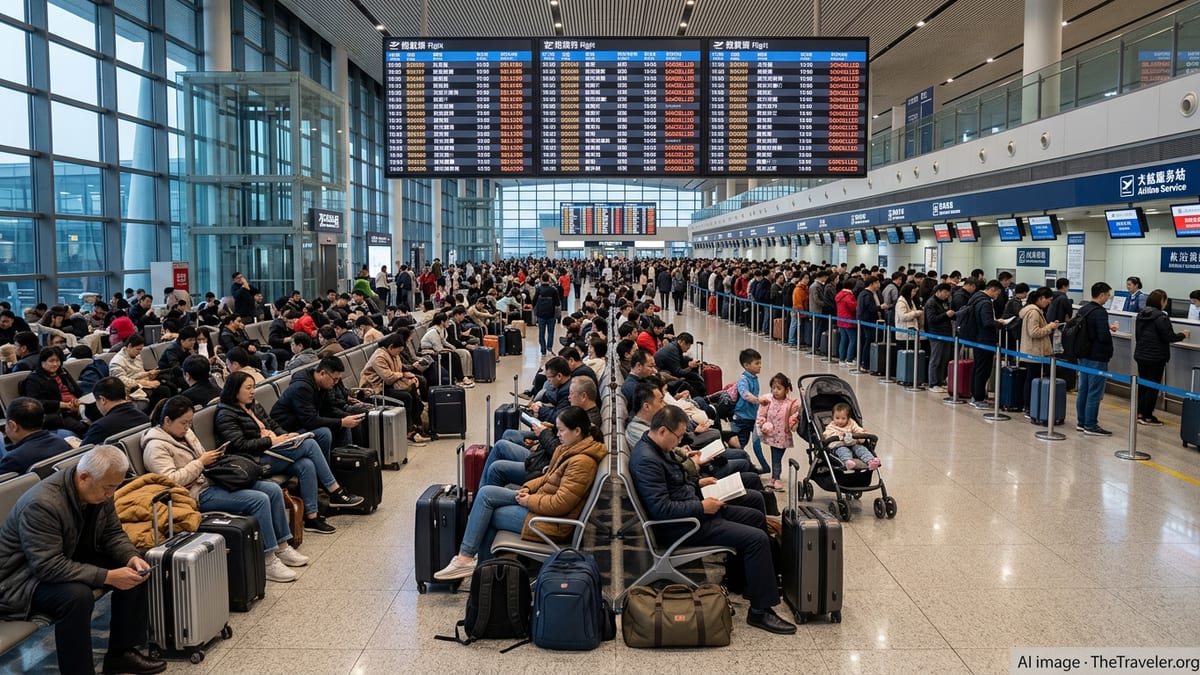
For passengers, the practical impact at these airports was most visible in crowded departure halls and longer queues at check-in, security, and customer service counters. Travelers connecting through multiple hubs often had to adjust entire itineraries, particularly where last flights of the day to Beijing, Guangzhou, Chengdu, or Shenzhen were affected.
Passengers Face Long Waits and Disrupted Itineraries
Travelers caught in the disruption wave encountered classic knock-on problems associated with large-scale delays. Longer-than-expected waits in terminal seating areas, uncertainty over revised departure times, and the risk of missed connections put pressure on families, tour groups, and business travelers alike.
Publicly available images and accounts from social platforms on Wednesday depicted busy terminal scenes at several of the affected airports, with passengers gathered around information screens and queuing at airline counters. Some travelers reported difficulty securing alternative seats on subsequent departures to Beijing, Guangzhou, Chengdu, and Shenzhen, as remaining flights quickly filled with rebooked passengers.
The concentration of delays within a single day also strained accommodation options for those unable to complete their journeys. In cities where hotel capacity near the airport is limited or heavily utilized by airline crews, late-evening cancellations can leave passengers with fewer nearby lodging choices and higher costs for last-minute rooms.
For travelers on tight schedules, such as those connecting to early-morning international departures from Beijing or Guangzhou, even moderate delays on feeder flights from Harbin, Taiyuan, or Hohhot risked undermining entire travel plans. Some passengers opted to adjust to rail or long-distance road transport where practical, particularly on shorter intercity routes.
Ongoing Monitoring as Operations Gradually Normalize
As airlines and airports worked to clear the backlog of delayed flights, publicly accessible flight trackers showed signs of gradual stabilization later in the operating day. However, aircraft and crew displacement meant that knock-on effects were likely to continue for some services into the following rotations, especially early-morning departures from secondary airports.
In such situations, recovery often depends on the availability of spare aircraft, rested crews, and flexible scheduling windows. When multiple airports across a wide geographic area experience disruption simultaneously, restoring normal patterns can be more complex, particularly on routes that already operate near capacity.
Travelers scheduled to pass through Shanghai Pudong, Nanjing Lukou, Xi’an Xianyang, Harbin Taiping, Taiyuan Wusu, or Hohhot Baita in the next operating periods are typically advised, according to publicly available guidance from airlines in similar disruption events, to monitor real-time flight status, allow additional time at the airport, and be prepared for potential gate or schedule changes.
While the day’s operational challenges posed major inconvenience for affected passengers, the pattern of delays and relatively limited number of outright cancellations suggest that airlines were prioritizing completion of as many flights as possible, even with extended departure times. For many travelers, however, the resulting hours spent waiting in crowded terminals became an unplanned and frustrating chapter in their journeys across China’s vast domestic air network.