

More news on this day
Hundreds of passengers were left stranded at Salt Lake City International Airport on Saturday as a wave of operational disruptions rippled across major U.S. and international routes, delaying 96 flights and forcing the cancellation of 13 services operated by Delta Air Lines, American Airlines, United Airlines, Air Canada and their partners.
Storm Systems and Airspace Congestion Trigger Chain Reaction
The disruption at Salt Lake City appeared to be part of a broader pattern of weather and congestion affecting large swaths of the U.S. air network, with winter storms and low clouds slowing traffic along key corridors. Airlines were forced to reduce arrival and departure rates, resulting in rolling delays that cascaded into cancellations as the day progressed.
Operations personnel at the airport said the morning began with relatively modest schedule slippage, but mounting ground holds and rerouted aircraft quickly compounded the problem. Several arrivals into Salt Lake City were diverted or held in airborne stacks, tightening the availability of aircraft and crews for onward flights to destinations across the country and overseas.
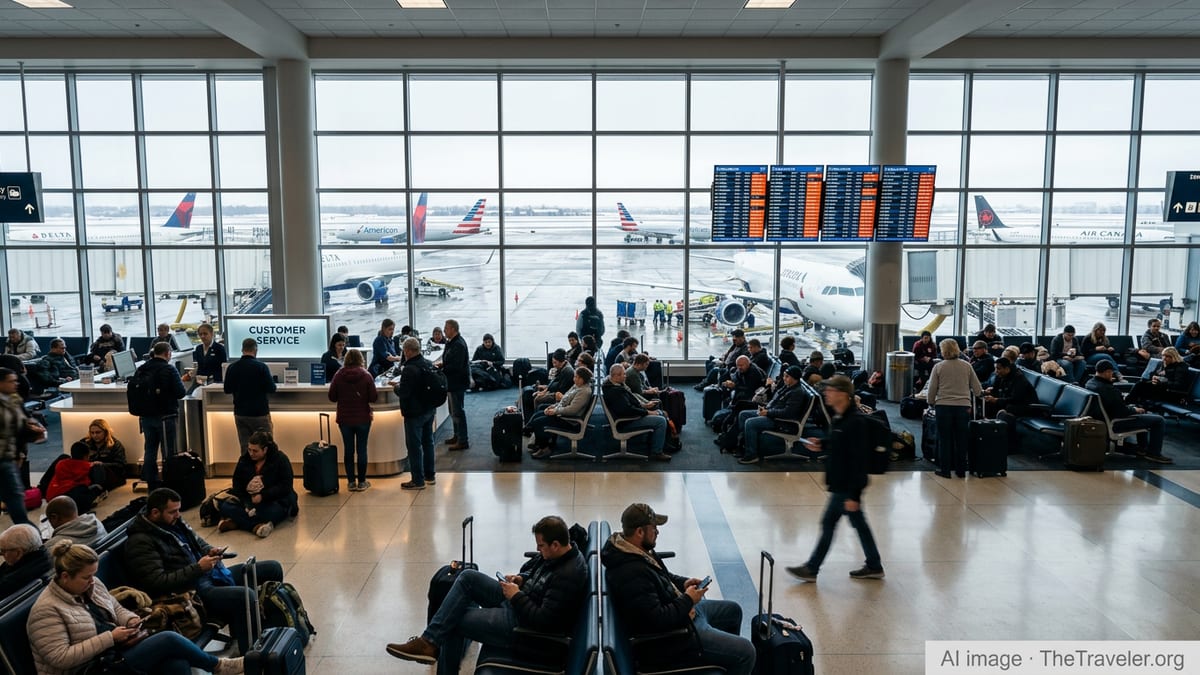
By midday, the departures board in the terminal displayed a growing wall of red and amber alerts as delays stretched from minutes into hours. Flights that had initially been pushed back by short intervals were ultimately scrubbed altogether when aircraft and crews could no longer be repositioned in time to meet duty-hour limits and curfew windows at destination airports.
While Salt Lake City normally ranks among the more reliable major U.S. hubs for on-time performance, the combination of weather impacts in other regions, congested airspace and equipment rotations placed unusual pressure on its schedule, leaving travelers facing lengthy waits with little certainty.
Major Carriers Hit: Delta, American, United and Air Canada
The brunt of Saturday’s disruption fell on the hub operations of Delta, American and United, along with codeshare and alliance services operated in partnership with Air Canada. Delta, which maintains a significant presence at Salt Lake City, saw multiple departures to coastal and Midwest hubs pushed back or canceled as inbound aircraft from affected cities arrived late or were diverted.
American and United likewise reported schedule challenges as flights feeding Salt Lake City from Chicago, Denver, Dallas and other key nodes encountered weather-related flow restrictions and ground-delay programs. Aircraft that did arrive often did so well behind schedule, compressing turn times and forcing operations teams to juggle gates, crews and refueling windows.
Air Canada’s transborder services also felt the strain, particularly flights connecting Salt Lake City with Toronto and other Canadian gateways through alliance partnerships. With tight connections onto onward transatlantic departures, even modest delays were enough to strand passengers in Utah when their international links could not be rebooked the same day.
Across the concourses, airline staff worked to rebook travelers on remaining services, arrange hotel vouchers where required and manage lines at customer service counters that snaked through the terminal. Despite the efforts, many passengers reported holding times of more than an hour to speak with an agent, both at the airport and via call centers.
Key Routes to Los Angeles, New York, London and Paris Affected
High-profile routes were among those hardest hit, with flights between Salt Lake City and Los Angeles, New York, London and Paris facing repeated pushbacks or outright cancellations. Some westbound flights to Southern California were delayed as arriving aircraft from the Midwest and East Coast struggled through weather and routing constraints.
Eastbound services to New York area airports, which were already managing their own congestion and weather challenges, faced additional holding patterns and slot restrictions. This limited the number of movements airlines could make into and out of the region, forcing them to consolidate passengers onto fewer departures and cancel less critical frequencies.
Long-haul passengers bound for London and Paris found themselves particularly vulnerable. Many were traveling on complex itineraries requiring precise connections from domestic legs into evening transatlantic departures. When those domestic legs were delayed or canceled, even by an hour or two, travelers missed their onward flights and were left scrambling for scarce seats on the next day’s services.
Business travelers and families on early-spring holidays described scenes of crowded gate areas and packed seating zones, with travelers camping on the floor near power outlets and information screens as they awaited updated departure times. Children slept across rows of chairs while adults refreshed airline apps in the hope of confirmation that their flights would still depart.
Passengers Face Long Waits, Limited Options and Mounting Costs
For many stranded travelers, the greatest frustration was the uncertainty surrounding when, and how, they would reach their destinations. Some were offered rerouting via alternate hubs such as Denver, Chicago or Dallas, only to find that those airports were also experiencing delays and extended layovers.
Passengers reported mixed experiences with vouchers and assistance. While some airlines provided meal credits and overnight accommodation for those facing long delays or missed connections, others offered only limited support, citing the operational disruptions as outside their direct control. That left some travelers paying out of pocket for hotel rooms and transport while they waited for new itineraries.
Families connecting to cruises, international tours and major events said they were scrambling to rearrange plans and contact tour operators, hotels and car rental agencies. Insurance coverage varied, with some policies providing compensation for missed connections and others excluding weather-related disruptions, adding a financial layer to an already stressful situation.
Airport staff and volunteers moved through the concourses distributing basic information, directing passengers to quieter seating areas and reminding travelers to stay in close contact with their airlines through apps and text alerts. Despite the strain, many travelers acknowledged the efforts of front-line staff attempting to manage the situation with limited resources.
Airlines Urge Travelers to Monitor Flights and Expect Residual Delays
Airlines warned that the knock-on effects from Saturday’s disruptions could be felt for at least another day as aircraft and crews were repositioned and backlogs were cleared. Even passengers with flights scheduled for Sunday were advised to monitor their itineraries closely, as today’s cancellations and diversions could ripple into subsequent rotations.
Operational planners emphasized that once a day’s schedule is heavily disrupted, it can take multiple cycles to fully restore normal operations. Aircraft may end up overnighting in unscheduled locations, and crews can hit federally mandated duty limits, requiring airlines to reshuffle staffing and occasionally cancel flights simply to reset the network.
Travel experts recommended that passengers departing Salt Lake City and connecting through affected hubs arrive early, keep carry-on essentials handy in case of unexpected overnight stays, and remain flexible about routing. Some suggested proactively asking agents to explore alternative routings via less affected airports, even if that adds a stop, in order to avoid the most congested corridors.
With winter still exerting its influence across North America and busy spring travel weeks looming, airlines and airports alike face the ongoing challenge of balancing safety, staffing and schedule resilience. For the hundreds of travelers stranded in Salt Lake City on Saturday, the immediate priority remained straightforward: finding a seat on any flight that would finally carry them out of the crowded terminal and on toward their intended destinations.