

More news on this day
Mexico’s tourism sector was thrown into sudden turmoil this week after the killing of cartel boss Nemesio “El Mencho” Oseguera Cervantes triggered coordinated attacks, highway blockades and airport disruptions across multiple states, leaving at least 62 people dead and thousands of travelers stranded in beach resorts and major cities.
Cartel Kingpin Killed in Jalisco Military Operation
The wave of unrest began on Sunday, February 22, when Mexican special forces moved in on Nemesio Rubén Oseguera Cervantes, known as El Mencho, during a planned operation in the wooded highlands around Tapalpa, Jalisco. Officials said the 59 year old leader of the Jalisco New Generation Cartel was wounded in the clashes and died while being flown to Mexico City, marking the most significant single blow to a Mexican cartel hierarchy in more than a decade.
The Jalisco New Generation Cartel, or CJNG, had grown into one of the hemisphere’s most powerful criminal organizations, trafficking fentanyl, methamphetamine and cocaine and waging bitter turf wars with rival groups. Security analysts noted that El Mencho’s death leaves a volatile leadership vacuum, with several senior commanders vying for control and no clear family successor to impose order within the cartel’s extensive network.
Within hours of the announcement, CJNG gunmen mounted an aggressive response in areas where the group has long exerted influence, using tactics that Mexican residents have come to associate with cartel retaliation: burning vehicles, blocking highways, and attacking convenience stores and fuel stations. Authorities described the pattern as a coordinated show of force designed both to punish the state and to signal that the cartel remains capable of paralyzing large swaths of the country despite its leader’s death.
The federal government has deployed additional army and National Guard units to Jalisco and neighboring states, but officials conceded that restoring full control could take days. President Claudia Sheinbaum’s administration is under pressure to show that removing one of the country’s most wanted fugitives will not simply unleash a new round of fragmentation and violence.
Roadblocks, Fires and Shootouts Spread Across Key States
As news of El Mencho’s death filtered through cartel channels, violence rapidly spread beyond the mountain town where he was killed. In Jalisco’s capital, Guadalajara, burning buses and trucks were used to seal off major arteries, while a firefight reported near the international airport sent passengers running for cover inside the terminals. Charred vehicles still lined key routes into the city on Monday, with authorities working to clear debris under the watch of heavily armed patrols.
Similar scenes were reported in Guanajuato, Michoacán, Colima, Nayarit and Tamaulipas, among other states. Security cameras and mobile phone footage verified by local media showed masked men forcing drivers from their cars at gunpoint before setting the vehicles alight, creating improvised barricades on federal highways. In several cities, including León and Morelia, attackers targeted corner shops and supermarkets, torching storefronts and spreading panic among shoppers attempting to flee.
By Tuesday, preliminary tallies from state authorities and federal security officials pointed to at least 62 deaths linked to the unrest, including suspected cartel members, security personnel and several civilians caught in crossfire or unable to escape burning roadblocks. Hospitals in Guadalajara and Puerto Vallarta reported treating dozens of people for gunshot wounds, smoke inhalation and injuries sustained while trying to evacuate chaotic scenes.
Public transport systems in affected regions operated on reduced schedules or halted service altogether. Some intercity bus lines suspended routes linking central Mexico with Pacific coast destinations, citing the risk of hijackings and blockades. With key corridors severed, trucking associations warned of mounting supply disruptions that could soon affect fuel and food distribution.
Tourists Stranded as Airports Close and Highways Lock Up
For travelers, the timing of the violence could scarcely have been worse. Late February normally brings a surge of visitors from the United States, Canada and Europe seeking warm weather getaways in Jalisco’s Pacific resorts and colonial cities in the country’s center. Instead, many awoke to messages from hotels and consulates urging them not to leave their accommodations and to avoid all nonessential travel within affected states.
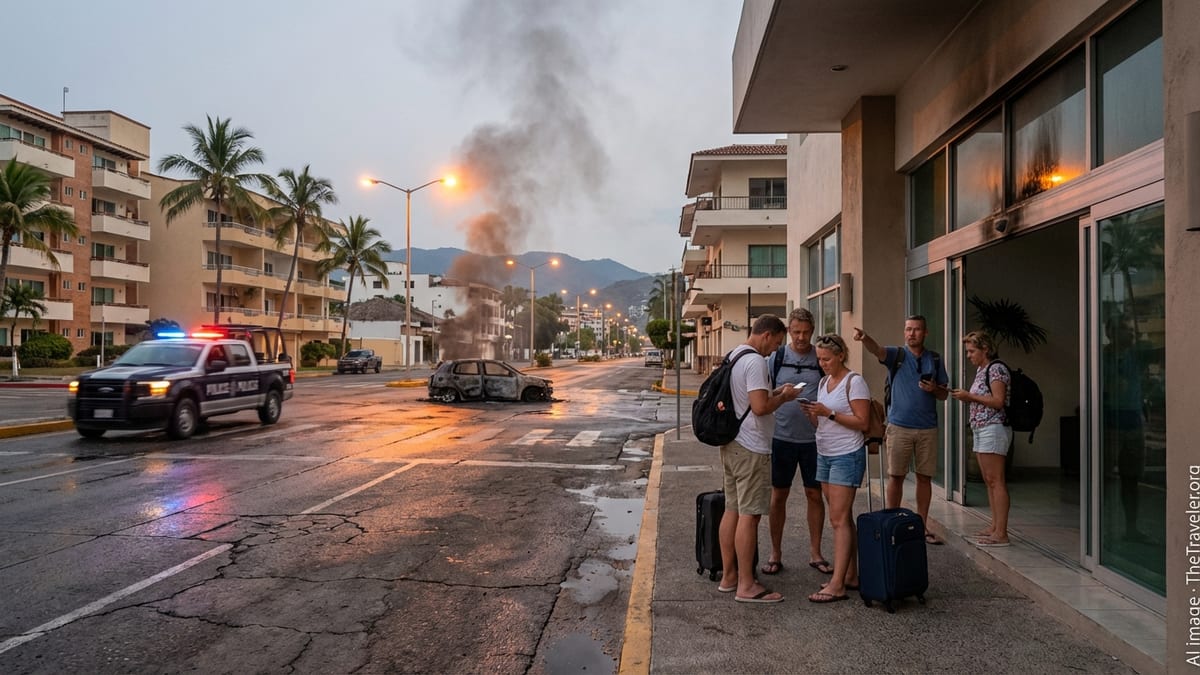
In Puerto Vallarta, one of Mexico’s busiest beach destinations, plumes of black smoke from burning vehicles were visible from hotel balconies along the city’s famous malecón. Tourists reported hearing distant gunfire and explosions as cartel roadblocks cut off the main highway to the international airport. Several airlines from North America and Europe canceled or diverted flights, while others delayed departures for hours as security forces swept access roads and the runway perimeter.
Guadalajara, a major air hub and one of the host cities for the 2026 World Cup, also saw significant disruption. Confused passengers at Miguel Hidalgo y Costilla International Airport described chaotic scenes as security alerts were issued over loudspeakers and some travelers were instructed to shelter away from windows during reports of nearby shootouts. Airlines postponed multiple domestic and regional flights, stranding passengers in terminal waiting areas and airport hotels.
On the ground, foreign visitors faced a complex and shifting security map. Popular road trip routes that link Guadalajara to agave country and the coast were effectively severed by burning barricades. Rental car firms advised clients not to attempt overland departures and in some cases refused to release vehicles, citing insurance and safety concerns. Travel agencies and tour operators scrambled to reroute guests, extend stays or move them to less affected regions by air once flights resumed.
Travel Advisories Updated as Authorities Urge Caution
As images of burning vehicles and shuttered airports circulated, foreign governments moved swiftly to update their travel guidance. The United States embassy in Mexico issued a security alert urging citizens in Jalisco and neighboring states to shelter in place, avoid large gatherings and monitor instructions from local authorities and their hotels. Canadian and European embassies followed with similar notices, warning that road travel remained particularly hazardous in areas where blockades and ambushes had been reported.
Mexico’s federal tourism authorities emphasized that many of the country’s destinations, including parts of the Caribbean coast and southern cultural circuits, remained calm and operational. Still, they acknowledged that the scale of CJNG’s retaliation, and its impact on long trusted gateways such as Guadalajara and Puerto Vallarta, had rattled international confidence just as the industry was counting on a strong high season.
Local tourism boards tried to reassure prospective visitors, highlighting the presence of additional security forces and the gradual reopening of airports and main roads. Yet hotel managers in Jalisco and Guanajuato reported a surge in cancellations and early checkouts, especially among first time visitors unaccustomed to navigating Mexico’s complex security landscape. Some properties quietly advised arriving guests to arrange airport transfers directly through the hotel rather than hailing taxis on the street.
Travel risk consultants said the coming days would be crucial in determining whether the unrest remains a short lived shock tied directly to El Mencho’s killing or evolves into a more prolonged period of instability as rival factions test the cartel’s weakened leadership structure. Until the picture becomes clearer, they recommended that travelers maintain flexible itineraries, stay in close contact with airlines and tour operators, and heed the evolving advisories of their home governments.
A Nation on Edge as Succession Battle Looms
Beyond the immediate disruptions, security experts warned that the fallout from El Mencho’s death could reshape Mexico’s criminal landscape. With his son and presumed heir imprisoned in the United States, CJNG is left without an obvious successor able to command loyalty across its far flung cells. Analysts believe that several powerful lieutenants may now vie for control, raising the risk of internal feuds or regional breakaways that could further destabilize key transit corridors and tourist zones.
In communities already traumatized by years of cartel presence, the sense of foreboding was palpable. Residents in small towns across Jalisco and Michoacán described stocking up on food and fuel, anticipating that clashes between rival factions or new military operations might again cut them off from the outside world. Civil society groups renewed calls for a comprehensive strategy that goes beyond headline grabbing arrests to address corruption, impunity and the deep economic drivers of organized crime.
For Mexico’s tourism industry, the challenge is twofold: managing the immediate crisis while confronting the longer term reputational damage that images of burning buses on resort access roads can inflict. Tour operators and hoteliers stressed that millions of visitors travel safely in Mexico every year, but conceded that high profile episodes like this one reinforce perceptions of risk that can take years to overcome.
As flights gradually resume and highways reopen under military escort, thousands of stranded travelers are expected to make their way home over the coming days. For many, the memories of pristine beaches and vibrant plazas will now be inseparable from the sound of helicopter overflights and the sight of soldiers patrolling hotel zones, a stark reminder of how deeply Mexico’s security battles can reach into its most cherished tourist enclaves.