

Mention long distance buses and many travelers picture cramped seats, unreliable vehicles, and a last resort form of transport. In Mexico, that image is decades out of date. Step into a modern coach run by companies like ADO, Primera Plus, ETN or Tufesa and you enter a world of deep reclining seats, air conditioning, charging ports and quiet, efficient service that rivals or even beats flying between many cities. Mexico’s intercity bus network is one of the most extensive and surprisingly modern on the continent, and for travelers willing to leave old assumptions behind it can be an outstanding way to see the country.
A Nationwide Network Built Around the Bus
Mexico is a country where long distance buses are not a backup to planes, but the backbone of domestic travel. While low cost airlines connect major hubs, buses still carry huge numbers of people each day between state capitals, regional cities, and small towns. From the busy Terminal Central de Autobuses in Puebla to first class stations in Oaxaca, Veracruz, Villahermosa and Coatzacoalcos, major terminals function as transport hubs where multiple companies share platforms, ticket halls and waiting areas. For many routes, especially those that do not involve Mexico City, the bus is the most practical and sometimes the only direct option.
Because buses are so central to everyday mobility, operators have invested steadily in newer vehicles and better infrastructure. Large groups such as Mobility ADO in the southeast, Estrella Blanca in the north and west, and regional brands in Bajío and the Pacific corridor maintain fleets that include standard first class, executive and luxury coaches. Competition between these companies for middle class and business travelers has pushed standards up. On core routes linking Mexico City with Puebla, Querétaro, San Luis Potosí, Oaxaca, Veracruz and beyond, it is now normal to find modern coaches with climate control, onboard restrooms and entertainment systems.
For visitors, that nationwide reach is one of the great advantages of traveling by bus. A traveler can land in Mexico City, transfer to the city’s main long distance terminals, and from there reach colonial towns, beach resorts or highland cities without needing to rent a car or book domestic flights. The same is true across regions such as the Yucatán Peninsula, where long distance and regional buses knit together places like Mérida, Campeche, Valladolid and the Riviera Maya far more thoroughly than the limited number of flights.
Classes of Service That Rival Airlines
One of the biggest surprises for travelers is the range of service classes available on Mexican long distance buses. At the most basic level there are economy services, often labeled económico or segunda, that make frequent stops and have simple, older style seats. These are primarily used by budget conscious locals and for short hops between nearby towns. Above that, the picture changes dramatically. First class and executive services are where Mexico’s bus network feels distinctly more modern than many expect.
First class, often called primera, typically offers reserved seating, air conditioning, reclining seats with generous legroom, luggage stored in a hold, and an onboard restroom. These services operate on fixed timetables with limited stops, and routes can range from a few hours to overnight journeys of 10 hours or more. Brands like ADO, OCC, Tufesa, Estrella de Oro and many others use full size, modern coaches that would not look out of place in Western Europe.
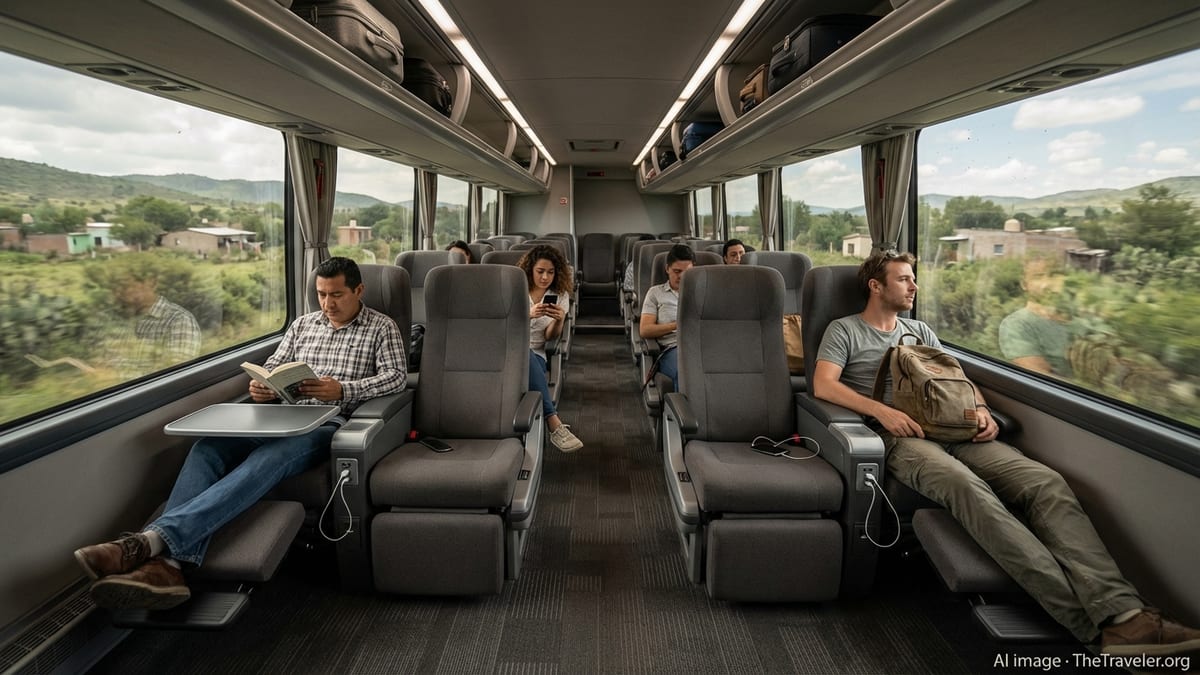
Executive and luxury services take things further. Names vary by company, but labels such as GL, Platino, Ejecutiva or Lujo usually indicate more space and extra amenities. On these buses you are likely to find wider seats in a two plus one configuration across the aisle, deeper recline, individual entertainment screens on some fleets, power outlets or USB charging ports, and quieter cabins. Some luxury lines provide complimentary drinks or light snacks, and a few offer access to calmer, separate waiting rooms at major terminals reserved for passengers on premium services.
These classes have developed partly to attract business travelers and long distance commuters who might otherwise fly. For overnight trips, particularly on popular routes like Mexico City to Oaxaca or Mexico City to the Yucatán Peninsula, many locals prefer executive coaches because they can board after work, sleep in a near lie flat seat, and arrive downtown early the next morning without the airport transfers, security and boarding delays associated with flying.
Onboard Comfort: A Far Cry From “Basic Buses”
Step inside a modern Mexican long distance bus and the first impression is usually how clean and polished the cabin feels. Most first class and executive coaches feature upholstered seats with headrests, footrests, and generous legroom. The recline is usually much deeper than on economy class flights, making it easier to sleep or relax. Overhead racks hold small bags, while main luggage is tagged and stowed beneath the bus, in a process that feels similar to checking a bag on a plane but with usually faster retrieval at the destination.
Climate control is standard on higher end services. Given Mexico’s climate, effective air conditioning is more than a perk; it is essential. On long daytime runs through hotter states such as Veracruz, Tabasco or Chiapas, a cool cabin dramatically improves comfort. Many recent coaches also use improved suspension and sound insulation, which reduces engine noise and road vibration. On premium services, passengers quickly realize they are not dealing with stripped down vehicles but with coaches designed for long distance comfort.
Onboard amenities continue this theme. Restrooms at the rear of the bus are common on first class and executive routes, which helps keep intermediate stops to a minimum. Travelers on newer fleets may find personal entertainment screens or shared monitors playing films, as well as USB or power outlets for keeping phones and laptops charged. Wi Fi is increasingly advertised on higher end services, particularly on major corridors, although coverage can be patchy in rural stretches. Still, for many routes, having at least intermittent connectivity on a bus is more than visitors expect before they arrive.
For overnight journeys, some luxury fleets go even further. Select routes offer semi bed or almost fully reclining seats with leg rests that swing up, creating a cradle like position. Blankets and small pillows are sometimes provided. Curtains on the windows can block light, and cabin lighting is dimmed between stops. While these services do not turn a bus into a sleeper train, the level of comfort makes a full night onboard a much more realistic option compared with classic overnight buses in many other countries.
Modern Terminals That Feel Like Small Airports
The modernization of Mexico’s bus system is not only visible onboard. At the terminal level, many cities have large, well organized stations that resemble compact airports in their layout and services. Facilities like the Terminal Central de Autobuses de Pasajeros in Puebla or the major ADO stations in cities such as Veracruz, Oaxaca, Villahermosa and Coatzacoalcos include multiple waiting halls, separate sections for different service classes, rows of ticket counters, and numerous departure gates serving a mix of first class, executive and luxury lines.
Inside, travelers find seating areas, convenience stores, simple restaurants and fast food counters, luggage storage offices, and often kiosks selling mobile phone credit or snacks for the road. Many terminals have dedicated taxi stands supervised by station staff, which helps new arrivals get into licensed vehicles. Some large stations offer paid parking and clearly signposted pick up and drop off areas, which makes them practical for local families collecting relatives arriving from other parts of the country.
Premium services can extend into the terminal through so called executive lounges. These small rooms, set apart from the main waiting halls, are open to passengers holding tickets for higher tier services such as ADO GL or Platino. The lounges are not lavish but usually offer a calmer environment, more comfortable seating and sometimes complimentary coffee or soft drinks. For travelers waiting for a late night departure, the difference in noise level and crowding compared with the main concourse can be significant.
Outside major cities, infrastructure is more modest but still more structured than many visitors expect. Regional terminals in medium size towns typically provide sheltered platforms, ticket counters for several different companies, basic shops and restrooms. While the experience can be simple and occasionally hectic, the existence of a formal long distance terminal in even smaller cities underlines how central buses are to the way Mexicans move around their country.
Technology, Ticketing and the Move Toward Electric Fleets
Another reason Mexican long distance buses feel more modern than outsiders assume is the rapid evolution of ticketing and fleet technology. Most major carriers allow passengers to buy tickets in person, through third party agencies, via mobile apps or on their own websites. These digital channels are particularly useful for travelers who want to secure specific departure times or premium classes in advance, avoiding long waits at the station. E tickets displayed on phones are increasingly accepted, reducing the need to print paper documents.
On the operational side, companies have renewed parts of their fleets with newer coaches that meet tighter emissions standards and incorporate safety technologies. While the exact specifications vary by route and operator, it is now common on flagship services to find buses equipped with GPS tracking, three point seatbelts, and systems that monitor driver performance and speed. From a passenger perspective this does not always look dramatic, but it reflects a conscious move toward more professional, data informed operations.
In some cities, the shift toward cleaner, more modern buses is even more visible. Mérida in Yucatán, for example, has introduced the Ie Tram system, a bus rapid transit network that uses fully electric buses running along dedicated corridors. Although technically part of an urban transit project rather than the classic intercity system, it shows how bus based mobility in Mexico is moving ahead with electric vehicles and improved passenger infrastructure. Other cities are experimenting with electric or low emission buses on select routes, suggesting that over the coming decade long distance fleets will gradually incorporate more sustainable technologies.
For travelers, the practical impact of these developments is smoother, more predictable journeys. As apps improve and real time information becomes standard, it is becoming easier to check schedules, monitor delays and coordinate connections between buses in different regions. Combined with modern coaches and comfortable terminals, this technological layer reinforces the impression that Mexico’s bus network is not a relic but a living, evolving system.
Safety, Security and What Travelers Should Expect
Any time bus travel is discussed, especially in large countries, safety is top of mind. Mexico is no exception. The reality is nuanced. As in many nations with extensive highway networks, incidents do occur, and conditions can vary significantly by region and time of day. At the same time, long distance bus companies serving first class and executive routes have strong incentives to protect their passengers and reputations. That has translated into a set of common practices that help make travel safer and more orderly than many first time visitors fear.
At major terminals it is routine for luggage to be tagged before being placed in the hold, with passengers receiving corresponding stubs to collect their bags at the destination. On some routes, security staff or drivers may film passengers as they board or check identification against tickets. Many companies avoid picking up passengers on the roadside on their higher end services, choosing instead to stop only at designated terminals or recognized stops. These measures, while not foolproof, contribute to a more controlled environment.
Inside the bus, passengers are often reminded to keep valuables with them rather than in checked luggage, and to use overhead racks only for items they can keep an eye on. On overnight runs, curtains and dimmed lights help people sleep, but it still pays to use common sense, such as keeping phones and passports in a secure bag at your feet. As with any form of travel, being aware of surroundings at terminals, avoiding displays of expensive electronics in crowded areas, and using registered taxis when arriving late at night are wise precautions.
It is also worth noting that many Mexicans who can afford to fly still choose first class and executive buses for routine travel, precisely because they find the service comfortable and accept the level of risk as comparable to other everyday activities. For visitors, paying attention to current local advice, choosing reputable operators, and favoring daytime departures on unfamiliar routes can further reduce exposure to potential problems.
Comparing Buses and Flights for Getting Around Mexico
For travelers used to defaulting to planes at home, it can be tempting to assume that flying is always the best choice inside Mexico. Yet once you factor in the modern quality of many long distance buses, the equation becomes more complex. For routes between cities that are 4 to 10 hours apart by road, especially when both ends of the journey are close to bus terminals, the total time door to door on a first class bus can be surprisingly competitive with flying.
Airports are often located outside city centers, requiring extra time and money to reach them. Passengers must also arrive early for security, boarding and potential delays. In contrast, long distance bus terminals are usually closer to central neighborhoods, with more flexible check in times. On popular corridors with high frequency, showing up 30 to 45 minutes before departure is typically enough. For overnight trips, the bus’s advantage grows: instead of paying for a hotel and losing a day of daylight in transit, travelers can sleep onboard a premium coach and arrive ready to explore.
Cost is another area where buses often win, especially when flights are booked close to departure. First class and even many executive services remain accessible for domestic travelers and visitors, providing a comfortable experience at a fraction of typical last minute airfares. While prices fluctuate by season and operator, travelers commonly find that they can upgrade from a basic bus ticket to a more comfortable class and still pay less than an equivalent flight, especially on secondary routes without intense airline competition.
Of course, flights make sense for very long distances, such as crossing the country from Tijuana to Cancún, or when travelers are short on time. However, dismissing buses out of hand means missing a travel experience that combines comfort and a closer connection to the landscape. From a reclining seat on a modern coach, passengers watch highland valleys, tropical lowlands, and colonial towns roll by in a way that no cloud level airplane window can match.
The Takeaway
The idea that long distance buses in Mexico are outdated or uncomfortable persists mainly among people who have never boarded one. In practice, the country’s intercity coach network is modern, layered and constantly improving. From spacious first class seats and executive lounges to app based ticketing and electric bus corridors in forward looking cities, Mexico is quietly showing how bus travel can be both practical and pleasant.
For visitors, embracing this reality can reshape how an itinerary unfolds. Instead of hopping between airports and missing everything in between, travelers who use buses gain access to a wider map of destinations and a more grounded sense of the country. The experience in a well maintained coach, surrounded by families, students and commuters who rely on the system every day, offers insight into Mexican life that airport lounges cannot provide.
None of this means that every bus, in every region, at every hour, feels equally polished or secure. Infrastructure and service quality still vary. Yet for the main long distance corridors and reputable companies, the standard is far ahead of the battered, uncomfortable stereotype. Travelers willing to update their assumptions will often find that Mexico’s long distance buses are not a compromise, but one of the most modern and rewarding ways to move around the country.
FAQ
Q1. Are long distance buses in Mexico safe for foreign travelers?
Safety levels vary by region and operator, but many foreign travelers use first class and executive buses without incident. Choosing reputable companies, favoring daytime departures on new routes, and following common sense precautions at terminals and onboard helps keep risk comparable to other forms of travel.
Q2. How comfortable are Mexican long distance buses compared with economy class flights?
On most first class and executive routes, seats are wider, legroom is greater and recline is deeper than on typical economy class flights. Overnight luxury services with near lie flat seats can be significantly more comfortable than flying, especially when you factor in less time spent on check in and security procedures.
Q3. Do Mexican buses have Wi Fi and charging outlets?
Many first class and executive buses advertise onboard Wi Fi and USB or power outlets, especially on major routes. Connectivity can be inconsistent in rural areas and not every vehicle in a fleet has identical equipment, so it is wise to download maps and entertainment in advance and treat Wi Fi as a bonus rather than a guarantee.
Q4. Can I buy bus tickets online before arriving in Mexico?
Most large operators allow online bookings through their websites or apps, and some third party platforms also sell tickets. E tickets on a smartphone are increasingly accepted, though in smaller stations staff may still prefer to print a boarding slip at the counter. Purchasing in advance is useful in busy seasons or for popular overnight executive services.
Q5. What is the difference between economy, first class and executive buses?
Economy or second class buses are cheaper and make more stops, with simpler seating and older vehicles. First class buses usually have reserved seats, air conditioning, more legroom and an onboard restroom. Executive or luxury services add wider seats, fewer seats per row, deeper recline, quieter cabins and often extra amenities such as individual screens, snacks or access to calmer waiting areas.
Q6. Is it better to fly or take the bus between major Mexican cities?
The best option depends on distance, timing and budget. For routes of four to ten hours by road, a first class or executive bus can be competitive with flying once you include airport transfers and check in time. Overnight buses are especially efficient because you travel while sleeping. For very long cross country trips or when time is tight, flying is still the faster choice.
Q7. How do I handle luggage on long distance buses?
Large bags are checked into the luggage hold and tagged, with passengers receiving a matching stub to reclaim them on arrival. Small backpacks and valuables should be kept with you inside the cabin. At major terminals, luggage storage offices allow you to leave bags for a few hours if you have a long wait or want to explore nearby areas.
Q8. Are bus stations in Mexico difficult to navigate?
Major terminals can be busy, but they are generally well signposted, with separate areas for ticket sales, arrivals and departures. Screens or noticeboards display departure times and platforms. If you are unsure, staff at company counters are usually the best people to ask. Arriving with extra time before your first departure allows you to get familiar with the layout without rushing.
Q9. Can I travel overnight by bus in Mexico?
Yes, many long distance routes operate overnight services, often using first class or executive coaches. These buses typically have deeper reclining seats, dimmed cabin lighting and fewer stops, making it realistic to sleep for much of the journey. Many travelers find overnight buses a convenient way to save on accommodation and maximize daytime hours at their destination.
Q10. Which companies are known for modern long distance buses in Mexico?
Several major groups run modern fleets, including brands under Mobility ADO in the southeast, as well as Primera Plus, ETN, Tufesa and regional lines in central and northern states. Fleet quality can vary within each brand, but on their main corridors these companies generally offer up to date coaches and a range of service classes oriented toward comfort.