

More news on this day
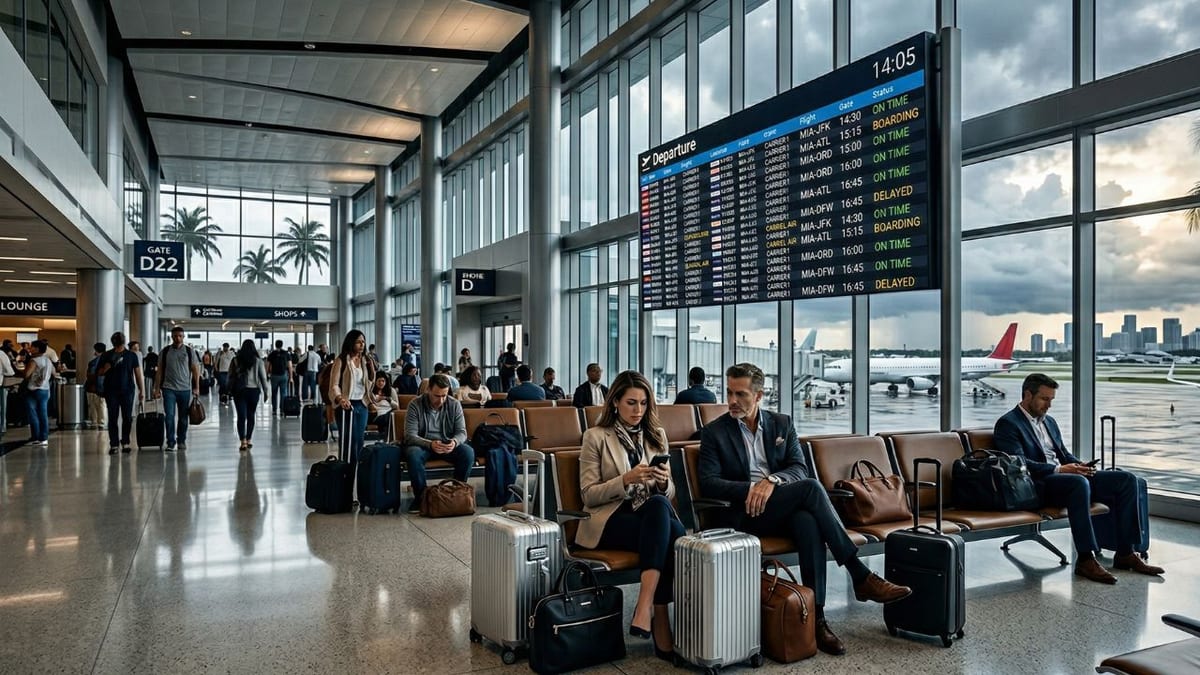
Miami International Airport is experiencing a fresh wave of disruption as hundreds of delayed and cancelled flights cascade across the United States and Caribbean, leaving thousands of travelers stranded from Miami Beach to New York, Chicago, Los Angeles and major island gateways.
Get the latest news straight to your inbox!
Holiday Crowds Collide With System Strain
Publicly available flight-tracking data and recent media coverage indicate that Miami International Airport has recorded about 265 flight delays and dozens of cancellations in a single 24-hour window, placing it among the most disrupted hubs in the country. The spike comes on the heels of a busy spring travel stretch, with Easter and early April vacations pushing passenger volumes close to pre-pandemic highs.
The disruption at Miami is part of a wider pattern of pressure across the U.S. air network. Recent reports on holiday travel show that severe thunderstorms, tight airline schedules and congested airspace have repeatedly pushed operations to a breaking point, with thousands of delayed flights nationwide on peak days. When a major connecting hub like Miami slows down, delays quickly stack up at other airports as crews and aircraft miss their next rotations.
While the raw number of cancellations at Miami remains lower than some winter storm episodes seen in recent years, the ratio of delayed services is especially striking. For travelers, long waits on the tarmac, rolling gate changes and missed connections can prove just as disruptive as an outright cancellation, particularly when customer service desks and call centers are already overwhelmed.
Miami’s role as a key gateway to Latin America and the Caribbean also magnifies the impact. A single late inbound from the Caribbean can delay a bank of departures to New York, Chicago or Los Angeles, creating a ripple effect that strands passengers far from home or their final beach destination.
Shockwaves From Miami to New York, Chicago and Los Angeles
According to recent coverage by aviation and travel outlets that aggregate data from flight boards and tracking platforms, the latest disruption in Miami has reverberated across the domestic network. Flights linking Miami with New York area airports, Chicago O’Hare and Los Angeles International have been among the hardest hit, with stacked delays on already busy routes.
Travel reports describe scenes of crowded concourses and full standby lists on key trunk routes, as airlines attempt to re-accommodate passengers from late or cancelled departures. When a Miami flight to New York runs hours behind schedule, the knock-on effect can reach far beyond those two cities, since the same aircraft and crew may be scheduled for onward flights to Midwest or West Coast destinations.
In Chicago and Los Angeles, publicly available data shows elevated delay counts of their own tied to weather and congestion, further complicating recovery efforts. This creates a feedback loop: aircraft scheduled to arrive from Chicago to operate a Miami departure may themselves be late, and any Miami-based disruption similarly affects departures to the Midwest and West Coast.
For passengers attempting to position through these hubs en route to Miami Beach resorts or Caribbean cruises, even a modest schedule slip can turn into an overnight stay. With hotel inventory around major hubs often tight during peak travel weeks, those misalignments can rapidly escalate into a full-blown travel collapse for individual itineraries.
Caribbean Gateways Jammed as Beach-Bound Travelers Wait
Miami’s role as a primary U.S. launch point for Caribbean vacations has been under particular strain. Travel-industry summaries note that flights from Miami to popular island destinations have faced some of the steepest delays, with departure boards showing rolling pushes as aircraft and crews arrive late from elsewhere in the network.
As delays build on northbound flights into Miami, returning vacationers also feel the impact. Late arrivals from the islands lead to missed same-day connections to New York, Chicago and Los Angeles, forcing travelers to seek last-minute accommodation in Miami or overnight at the connecting hub. For those with nonrefundable hotel bookings or cruise departures, the financial and logistical fallout can be significant.
Reports indicate that smaller Caribbean airports are feeling knock-on effects, with ground handlers and terminal facilities facing abrupt schedule changes and concentrated arrival waves when Miami departures finally get airborne. That can lead to congested arrival halls, long immigration lines and luggage delays at island gateways that are otherwise operating normally.
Tourism boards and local hospitality businesses in the wider Miami and Miami Beach area are watching the situation closely. A prolonged pattern of high-profile disruptions can influence traveler perceptions, particularly for visitors who must rely on tight weekend or holiday windows and may begin to favor alternate gateways perceived as more predictable.
Why the Numbers Matter: 265 Delays and Dozens of Cancellations
On paper, a figure such as 265 delayed flights paired with around 67 cancellations may sound like a single day’s inconvenience. In practice, aviation statistics show that each disrupted flight can affect hundreds of travelers when load factors run high, meaning thousands of people can be caught in the fallout from one turbulent day at a major hub.
Miami’s own traffic reports in recent months document sustained growth in passenger volumes, with many departures operating near capacity. In such an environment, even a small reduction in operational slack amplifies the impact of every delay, as there are fewer spare seats on later flights and limited room in the schedule to slot in recovery operations.
Recent analysis from travel and consumer sites also emphasizes how tightly scheduled many fleets have become, with turnaround times trimmed to accommodate dense timetables. When a ground stop, thunderstorm cell or minor technical issue pushes a flight behind schedule, there is less buffer to absorb the delay before it begins to disrupt subsequent legs.
The imbalance between disruption and recovery capacity is what turns a cluster of delays into a perceived collapse. Once airline operations centers run short on crews within legal duty limits and spare aircraft, options such as rebooking, rerouting or adding extra sections become more constrained, leaving passengers to navigate long waits and complex workarounds.
What Stranded Travelers Are Being Advised to Do
Travel guidance circulating across consumer publications in the wake of the Miami disruptions stresses preparation and flexibility for anyone flying through the region. Passengers are being encouraged to monitor airline apps and flight trackers closely, arrive early at the airport, and build longer connection windows into their itineraries when routing through busy hubs such as Miami, New York, Chicago and Los Angeles.
Consumer advocates writing about recent U.S. travel chaos also highlight the importance of understanding airline policies and federal rules governing delays and cancellations. The Department of Transportation’s online dashboard compares what different carriers provide in terms of meal vouchers, hotel accommodation and rebooking assistance in controllable disruption scenarios, information that can influence both purchasing decisions and day-of-travel negotiations at the gate.
Reports further suggest that travelers consider travel insurance or premium credit cards that offer trip interruption coverage, particularly for itineraries combining domestic segments with long-haul or cruise departures. Such coverage can help offset costs for missed connections, overnight stays and rebooked flights when a chain reaction of delays at an airport like Miami derails onward plans.
For now, forecasts point to continued volatility in U.S. air travel whenever storms, staffing constraints or airspace restrictions converge on major hubs. With Miami International again at the center of a high-profile disruption, travelers heading to or from Miami Beach and the Caribbean are likely to keep a close eye on the departure boards, hoping the next wave of delays and cancellations does not catch their flight in its path.