

More news on this day
Thousands of travelers were left in limbo after a fresh wave of disruptions at Miami International Airport triggered 265 flight delays and dozens of cancellations, rippling across major domestic and Caribbean routes and snarling operations in New York, Chicago and Los Angeles.
Get the latest news straight to your inbox!
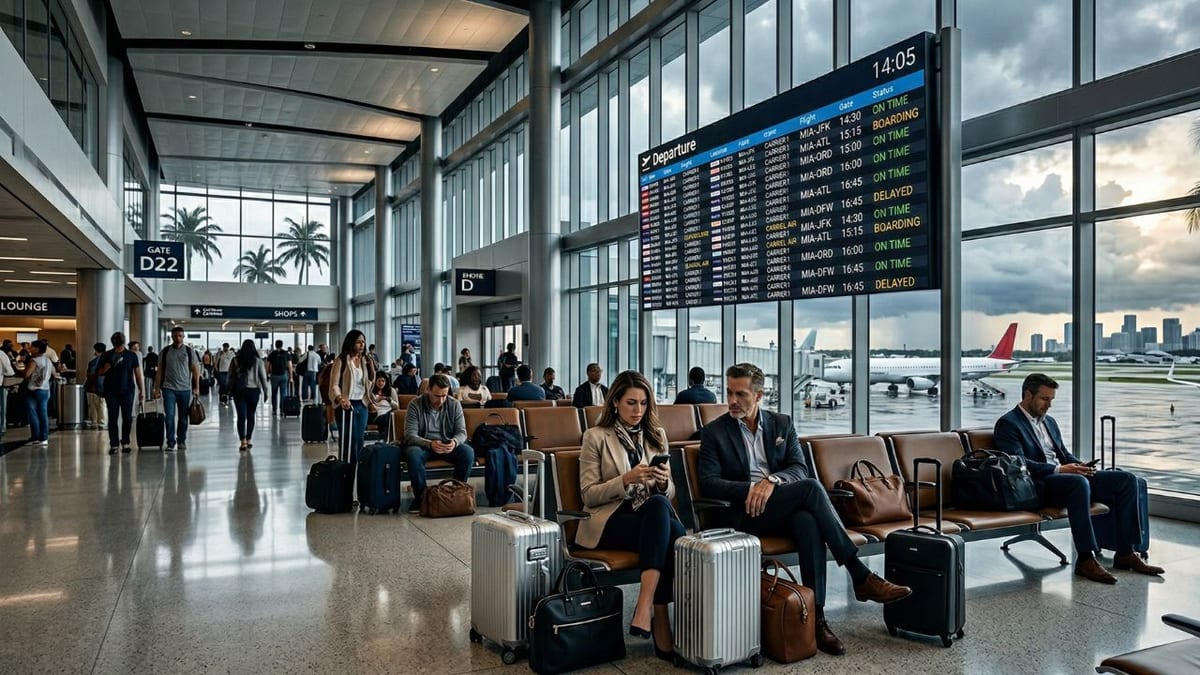
Disruptions Peak as Miami Hit by Record Delay Numbers
Publicly available aviation data and industry coverage indicate that Miami International Airport has emerged as a major pinch point in the U.S. air network, with one recent tally citing 265 delayed flights and 67 cancellations at the hub within a short window. The figures mark one of the most severe operational crunches at the airport in the current travel season, stranding thousands of passengers and triggering a chain reaction across the country.
Travel-focused outlets tracking day-of operations report that the bulk of the impact fell on high-frequency domestic routes linking Miami with New York, Chicago, Los Angeles and key hubs in the Southeast. At the same time, a number of Caribbean services experienced rolling delays, leaving vacationers and cruise passengers facing missed connections and unexpected overnight stays.
The surge follows weeks of elevated congestion and staffing pressures across parts of the U.S. aviation system. Separate coverage in recent days highlighted nearly 200 delays and single-digit cancellations at Miami in another 24-hour period, suggesting that the latest wave pushed the airport to a new short-term peak rather than representing an isolated event.
Ripple Effects Across New York, Chicago, Los Angeles and the Caribbean
Network data show that Miami’s role as a gateway to both the Northeast and Latin America magnified the knock-on effects of the latest disruption. High-demand corridors between Miami and New York area airports, especially John F. Kennedy and LaGuardia, saw late-arriving aircraft and rolling gate holds that rippled into evening departure banks. Passengers connecting onward to Europe from New York reported missed long-haul departures and lengthy rebooking queues.
Chicago O’Hare and Los Angeles International also experienced schedule strain as Miami-originating and Miami-bound flights fell out of rotation. Industry statistics on on-time performance already rank some of these routes among the more delay-prone in the domestic network, and the additional disruption intensified crowding around customer service counters and same-day standby lists.
To the south, Caribbean destinations that depend heavily on Miami for inbound tourism and cruise traffic saw a wave of late arrivals and missed port calls. Travel trade reports describe disrupted services to island hubs where a single delayed narrow-body aircraft can upend hotel check-in patterns, excursion schedules and cruise embarkation times, amplifying the economic and logistical impact well beyond the airport perimeter.
Airlines Struggle to Rebook Amid Limited Spare Capacity
Airlines operating through Miami, including large U.S. carriers and several low-cost and regional operators, were forced to lean on thin reserve capacity. Public tools maintained by the U.S. Department of Transportation emphasize that carriers retain discretion over what assistance they provide in the event of delays and cancellations that are within or outside their control, and recent consumer reports from Miami suggest wide variation in how disrupted passengers were accommodated.
Travel advisories and consumer guides note that when dozens of flights are delayed or canceled in quick succession, every affected passenger competes for the same pool of remaining seats. On busy Miami routes to New York, Chicago and Los Angeles, that pool can be exhausted within minutes, leaving travelers facing multi-day waits for nonstop options or circuitous itineraries through secondary hubs.
In some cases, travelers arriving in Miami for onward Caribbean connections reportedly ended up overnighting in South Florida hotels or airport terminals, as late-evening services to island airports left no margin for missed inbound flights. Passenger accounts shared on social platforms describe long lines at carrier service desks and extended hold times for call centers as customer-care infrastructures strained under the volume.
Structural Strain at a Crowded International Gateway
Miami International Airport’s traffic statistics show that the facility handles tens of millions of passengers annually, with a particularly heavy concentration of international and Caribbean-bound traffic. Recent operations reports from local aviation authorities highlight tightly packed departure and arrival banks, which can leave little slack when weather, staffing or technical issues arise elsewhere in the system.
Earlier this year, an unrelated software problem affecting parking payments at the airport illustrated how even ground-side glitches can reverberate during busy periods. Although that issue was resolved, observers note that it underscored the degree to which Miami operates near capacity across terminals, roadways and support services during peak times.
National analyses of delay patterns from federal and congressional sources have also placed Miami among the large U.S. airports where disruption can spread rapidly through the network. When a hub like Miami suffers a spike in delays and cancellations, aircraft and crews arrive late into other major airports such as Chicago O’Hare and Los Angeles International, extending the operational hangover well beyond the original weather cell or technical fault.
What Travelers Can Do if Miami Is in Their Itinerary
Travel experts responding to the latest wave of Miami disruptions are reiterating several practical steps for passengers. Guidance in recent consumer travel features suggests building longer connection windows when routing through Miami, particularly for itineraries involving New York, Chicago, Los Angeles or Caribbean destinations that rely on tight banked schedules.
Advisories also recommend monitoring flights closely via airline apps and third-party trackers and acting quickly if a delay stretches beyond an hour. Published guidance on air passenger rights stresses that carriers must provide rebooking after cancellations, though compensation and amenities vary by airline and by the cause of the disruption.
For travelers still planning trips that connect through Miami in the coming weeks, industry commentary points to the importance of packing essential medications, chargers and a change of clothes in carry-on luggage in case an unexpected overnight stay becomes unavoidable. With Miami’s latest disruption underscoring how quickly a single hub’s problems can ripple across the wider U.S. and Caribbean network, preparedness is emerging as an essential part of any itinerary touching South Florida’s busiest airport.