

More news on this day
Thousands of travelers faced an abrupt travel standstill as Miami International Airport recorded 265 delayed flights and 67 cancellations across key domestic and Caribbean routes, triggering a wave of disruptions stretching from New York and Chicago to Los Angeles and island gateways.
Get the latest news straight to your inbox!
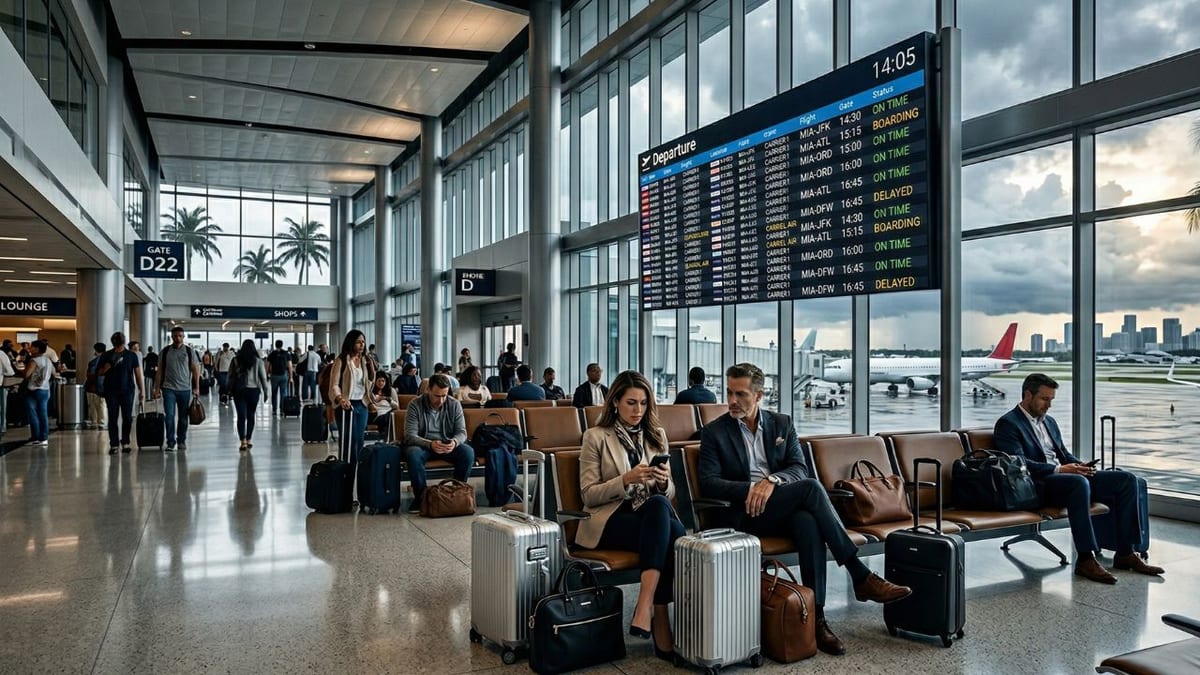
Record Day of Disruption at Miami International
Publicly available flight-tracking data for early April 2026 indicate that Miami International Airport, one of the busiest hubs in the United States, has experienced a particularly severe disruption period, with 265 flights delayed and 67 canceled over a compressed time frame. The disruption has been concentrated on heavily traveled corridors linking Miami with New York, Chicago, Los Angeles and multiple Caribbean destinations, leaving thousands of passengers facing missed connections, overnight airport stays and last-minute itinerary changes.
The disruption level marks one of the most difficult recent operating days for the South Florida hub, which already manages dense schedules for American Airlines and several other major carriers, as well as high volumes of international traffic. Coverage from travel industry outlets describes crowded departure halls, long lines at customer service counters and scarce alternative seats on later flights as airlines attempt to reroute stranded passengers through other hubs.
Operational data suggest that delays significantly outnumber cancellations, a pattern that often results in rolling disruptions throughout the day as aircraft and crew struggle to return to normal rotations. Even when flights eventually depart, extended ground holds and late arrivals can erode onward connections, creating a cascading effect that reaches far beyond Miami.
The situation has been compounded by the hub-and-spoke structure of U.S. airline networks. Miami’s role as a gateway to Latin America and the Caribbean means that a single disrupted departure bank can impact journeys across several countries and time zones, magnifying the overall impact of the travel collapse.
Ripple Effects Across New York, Chicago and Los Angeles
The Miami disruptions have rippled through other major U.S. hubs. Flight-status summaries for New York, Chicago and Los Angeles show elevated levels of delays and select cancellations on routes linked to Miami, particularly at LaGuardia, John F. Kennedy, Newark Liberty, Chicago O’Hare and Los Angeles International Airport. Travel-news coverage points to congested gate areas and lengthening departure boards as aircraft arriving late from Florida struggle to turn around on schedule.
On the New York corridor, where Miami connections are critical for both domestic and Caribbean traffic, delays have stacked up throughout the day. Carriers shuttling between Miami and LaGuardia or JFK have been forced to adjust departure times repeatedly, squeezing schedules at already slot-constrained airports. Passengers arriving late into New York have reported missed onward flights to smaller East Coast and Canadian cities, reflecting how quickly delay patterns can spread beyond the largest hubs.
In Chicago and Los Angeles, the impact has been similarly visible. Miami-bound departures from O’Hare and Los Angeles International have encountered late inbound aircraft and crew reassignments, prompting rolling delays. With both airports also acting as major connection points for transcontinental and international services, even a modest number of Miami-related disruptions has added stress to networks already operating at near-peak capacity.
Aviation analysts note that such ripple effects are a hallmark of a highly interconnected system. A shortage of spare aircraft, tight crew scheduling and full passenger loads leave little room for error, so a spike in disruptions at a single hub like Miami can quickly echo through multiple time zones.
Caribbean Gateways Hit as Miami Hub Falters
Caribbean routes have been among the hardest hit by the Miami travel collapse. Published coverage and airline timetables show that the South Florida hub functions as a crucial bridge between major North American cities and island destinations, with many services operating as tightly timed connections. When Miami’s departure banks fall behind, flights onward to airports in the Bahamas, Jamaica, the Dominican Republic and other island nations can be delayed, retimed or canceled outright.
On the ground across the region, airport departure boards have reflected the turbulence. Travelers departing Caribbean gateways for Miami have faced late arrivals and schedule changes that threaten their same-day connections to U.S. cities such as New York, Chicago and Los Angeles. In some cases, passengers reaching Miami late in the evening have arrived too late to secure onward flights, resulting in unexpected overnight stays and rebookings onto services the following day.
These disruptions are particularly challenging for leisure travelers and cruise passengers, many of whom travel on fixed itineraries. Missed embarkation times, canceled resort transfers and lost vacation days translate into both financial costs and logistical headaches. Travel-insurance providers and consumer advocates have been pointing to such episodes as examples of why policy coverage and clear documentation of delays are increasingly important for long-haul and multi-leg trips.
Regional tourism officials have also been closely watching the performance of key U.S. gateways. While the immediate priority is moving stranded passengers, prolonged or repeated disruption at a major connecting hub can have knock-on effects on booking patterns, with some travelers opting for alternative routings or competing gateways if reliability becomes a recurring concern.
Underlying Pressures: Weather, Congestion and Staffing
While precise causes for each individual delay and cancellation vary from flight to flight, several structural pressures have converged to make Miami and its connected routes particularly vulnerable. Recent months have seen episodes of disruptive weather across the eastern United States and the Caribbean, including strong convective storms that disrupt arrival and departure flows. Even on relatively clear days in South Florida, weather systems elsewhere in the network can ground aircraft or trigger flow-control measures that reach Miami-bound flights.
Chronic congestion has added another layer of complexity. Miami International’s role as a primary gateway for Latin American and Caribbean traffic has driven steady growth in passenger numbers and aircraft movements in recent years. Traffic reports from airport authorities show large volumes of operations concentrated in peak morning and evening banks, which can magnify the impact of even minor schedule disruptions.
Staffing and resource constraints also continue to shape recovery times after irregular operations. Airlines and ground handlers are still working to stabilize crew availability and maintenance capacity after several volatile years for the aviation industry. When crew members reach duty-time limits because of earlier delays, or when maintenance checks cannot be completed within narrow turnaround windows, airlines may have no choice but to delay or cancel flights to remain within regulatory requirements.
Industry observers point out that these pressures interact to create what amounts to systemic fragility. A localized storm cell, a temporary runway closure or a short-term staffing gap can quickly escalate into a day-long disruption cycle, particularly at hubs like Miami that operate with thin buffers between scheduled and actual operations.
What Stranded Travelers Are Facing and How Networks May Recover
For passengers, the immediate effects of the Miami travel collapse are tangible and often stressful. Reports from terminals describe long lines at airline counters, rebooking desks and food outlets, as travelers compete for a shrinking number of available seats on later flights. Families and international travelers face added complications around missed hotel check-ins, visa validity windows and ground-transfer arrangements in both the United States and the Caribbean.
Airlines are responding with a mix of schedule adjustments and limited waivers, allowing some passengers to shift to later departures or alternate routings without change fees, subject to seat availability. However, with many flights already operating near capacity, particularly during peak spring travel periods, securing new itineraries can be challenging, especially for larger groups or those heading to smaller destinations with limited service.
Network recovery typically depends on a combination of improving weather conditions, strategic aircraft repositioning and additional crew resources. If conditions stabilize, carriers may gradually absorb the backlog over 24 to 48 hours by operating extra sections on key routes, upgauging aircraft where possible and prioritizing stranded passengers for open seats. Yet published data from previous disruption episodes show that residual delays can persist for several days on heavily booked routes.
For now, Miami’s latest surge of delays and cancellations highlights the precarious balance underpinning modern air travel. With major hubs like Miami, New York, Chicago and Los Angeles tightly woven into Caribbean and international networks, a single day of severe disruption can strand thousands of travelers and test the resilience of airline operations across an entire region.