

More news on this day
Thousands of airline passengers have been left stranded across the United Arab Emirates, Türkiye, Saudi Arabia, Egypt, Qatar, Bahrain and other Middle Eastern countries after hundreds of flights were suddenly canceled or severely delayed, as regional carriers and international airlines navigate sweeping airspace closures and escalating security risks linked to the ongoing conflict involving Iran.
Get the latest news straight to your inbox!
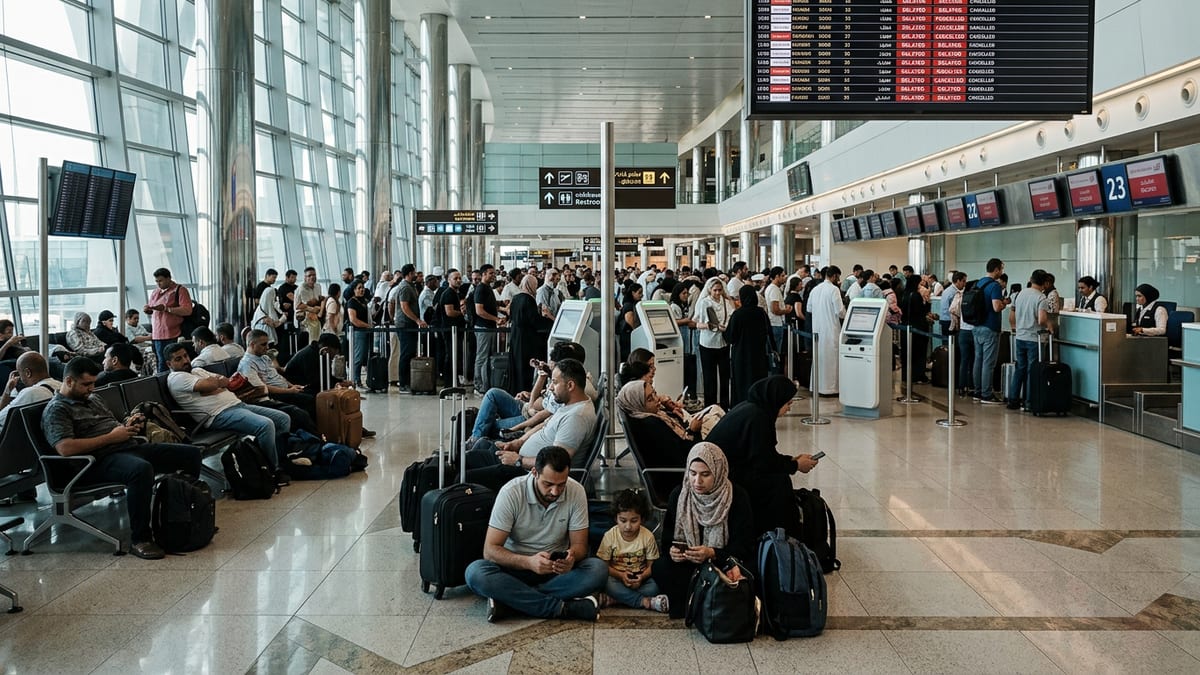
Hundreds of Flights Scrapped Across Major Middle East Gateways
Publicly available aviation data and regional media coverage indicate that at least 752 flights have been canceled and more than 800 delayed across the Middle East in recent days, with disruption centered on the region’s busiest hubs. Operations at Dubai International Airport in the United Arab Emirates, one of the world’s most important connecting points between Europe, Asia and Africa, have been cut to a fraction of normal capacity after nearby airspace closures and reported damage at key facilities forced airlines to pare back schedules.
Reports from regional outlets and flight tracking services show that air traffic has been heavily constrained or completely halted at various times in parts of the UAE, Qatar, Bahrain and neighboring states following US and Israeli strikes on Iran and subsequent Iranian attacks on targets around the Gulf. Airspace closures and military activity have prompted airlines to reroute or suspend flights that would typically cross Iranian, Iraqi, Israeli, Syrian, Kuwaiti or Gulf corridors, effectively severing some of the world’s busiest long-haul routes.
According to multiple data assessments cited in regional newspapers, these measures have translated into thousands of cancellations across several days, with Middle Eastern airspace effectively shut to large segments of commercial traffic. Flight analytics firm Cirium has been quoted in local coverage estimating that tens of thousands of services in and out of the wider conflict zone have been disrupted since late February, underscoring the scale of the upheaval for global aviation.
Emirates, Turkish Airlines, Gulf Air and Saudia Forced to Slash Schedules
Major regional carriers, including Emirates, Turkish Airlines, Gulf Air and Saudia, have been among the hardest hit. Public schedules and airline notices show Emirates, based in Dubai, operating on a sharply reduced timetable, with many services either canceled outright or pushed back repeatedly as crews, aircraft and slots fall out of sync with tightly choreographed networks. Limited departures from Dubai and Abu Dhabi have resumed at times, but mostly on curtailed routes through southern corridors over Saudi Arabia, Oman and the Red Sea.
In Türkiye, publicly available information shows that Turkish Airlines has suspended or rerouted flights linking Istanbul to Gulf destinations such as Dubai, Doha, Bahrain and Dammam, often at short notice as airspace advisories change. This has rippled through Istanbul’s role as a key bridge between Europe and Asia, forcing passengers to seek alternative routings via more southerly or northerly tracks that avoid the central Middle Eastern conflict zone.
Gulf Air, based in Bahrain, and Saudia, serving Saudi Arabia’s major hubs including Riyadh and Jeddah, have likewise made deep cuts to their networks around the Gulf. Travel advisories and booking data suggest that some services are operating as one-off positioning or evacuation flights designed to move stranded travelers out of the region, rather than as part of a regular commercial schedule, further complicating planning for passengers.
Stranded Passengers Crowd Airports From Dubai to Cairo
The operational turmoil has translated into scenes of overcrowded terminals and long queues at check-in desks across the region. Regional and international outlets describe thousands of travelers stuck in Dubai, Riyadh, Istanbul, Cairo, Doha and Manama, many of them sleeping in terminal corridors or waiting in packed departure halls while airlines work through backlogs of rebookings.
Reports from airport arrivals areas in cities such as Dubai, Cairo and Bahrain’s capital Manama describe passengers arriving from secondary hubs, only to discover onward legs canceled or delayed indefinitely. With aircraft and crews out of position and airspace routings changing day by day, many connections are no longer possible on their original itineraries.
Consumer reports and online travel forums indicate that some passengers have been asked to accept rerouting via distant hubs in Europe or South Asia, while others have been unable to secure alternative options at all, particularly those holding tickets on lower-cost or non-alliance airlines. Hotel availability near major airports has tightened as disrupted passengers seek overnight accommodation, sometimes for several days in a row.
Airspace Closures Redraw Global Long-Haul Routes
Beyond the immediate impact on those stranded in the Middle East, the closures are reshaping long-haul flight paths between Europe, Asia and Africa. With Iran, Iraq, Israel, Syria, Kuwait and sections of Gulf airspace restricted at various points, carriers have been forced to send aircraft on longer southern or northern detours that skirt the conflict zone. Aviation analysts quoted in regional coverage note that these extended routes add hours to flight times, drive up fuel costs and reduce the number of rotations aircraft and crews can complete each day.
Dubai, Doha and other Gulf hubs typically handle a substantial share of global connecting traffic, allowing airlines to consolidate passengers from numerous origins onto single long-haul departures. With those hubs operating at sharply reduced capacity, traffic flows are being redistributed to alternative gateways in Saudi Arabia, Oman, Egypt and beyond, straining infrastructure at airports that were not designed to absorb such concentrated demand.
Publicly available information from airline scheduling systems shows that some carriers are temporarily emphasizing point-to-point services into safer corridors while suspending complex multi-leg itineraries through the Gulf. This shift has created opportunities for airlines with more flexible routings via Istanbul, southern Europe or Central Asia, even as they contend with their own constraints and regional advisories.
Governments and Airlines Coordinate Limited Evacuation and Relief Flights
As the disruption drags on, governments and airlines have begun organizing limited relief operations to move citizens and residents out of the affected region. Media reports on repatriation efforts during the current Iran-related conflict describe chartered flights and special services operating from hubs such as Dubai, Abu Dhabi, Doha and Manama to European and Asian destinations, often using indirect routings through Saudi or Omani airspace.
These flights, however, represent only a fraction of the demand. Travel advisories and public statements from several governments highlight the challenges of securing sufficient aircraft and safe corridors amid ongoing military activity and rolling airspace closures. Many travelers are being advised to remain where they are, to monitor airline announcements closely and to avoid traveling to airports without a confirmed booking, as facilities struggle with crowding and logistical bottlenecks.
Industry observers note that the longer the disruption continues, the greater the potential knock-on effects for tourism, trade and labor mobility throughout the Middle East and beyond. With key hubs in the Gulf operating far below normal capacity and major carriers like Emirates, Turkish Airlines, Gulf Air and Saudia forced to repeatedly adjust their schedules, the path back to stable operations is likely to be gradual, even if airspace restrictions begin to ease in the coming days.