

More news on this day
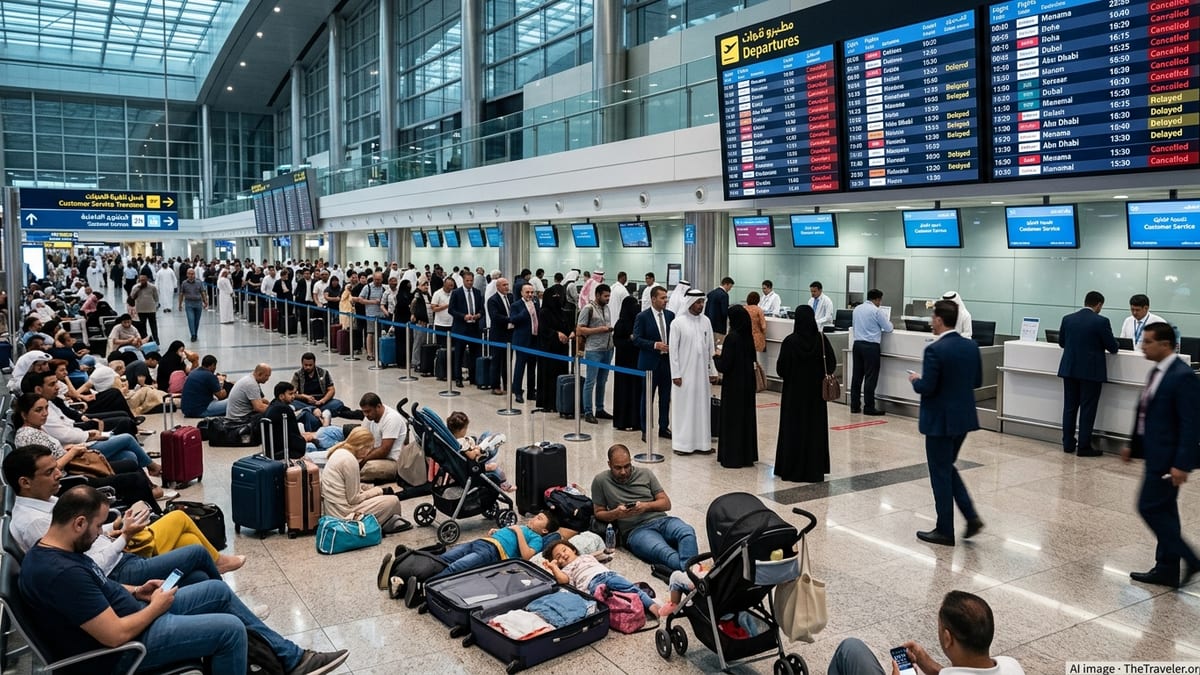
Thousands of travelers across the Middle East have been left stranded after at least 272 flights were reportedly suspended and more than 200 delayed, as carriers including Gulf Air, Qatar Airways, Malaysia Airlines, EgyptAir and flydubai curtailed operations amid ongoing airspace restrictions and regional security concerns.
Regional Airspace Restrictions Trigger Mass Disruptions
Publicly available operational bulletins and travel advisories indicate that airspace closures and restrictions across key parts of the Middle East and North Africa have cascaded into severe disruption for both regional and long-haul traffic. Closures and partial shutdowns over Bahrain, Qatar, the United Arab Emirates, Iraq, Iran and neighboring states have forced airlines to cancel or reroute services at short notice, overwhelming alternative hubs and stranding passengers across the network.
Information from corporate travel alerts and risk briefings issued in early March 2026 describes widespread cancellations affecting major hubs, with thousands of flights disrupted across the wider region over several days. Within this broader turmoil, carriers such as Gulf Air, Qatar Airways, Malaysia Airlines, EgyptAir and flydubai have been among those scaling back or suspending services into affected airspace, contributing to an estimated 272 flight cancellations and more than 200 delays linked specifically to the current Gulf-focused disruption.
Reports from consultancy and security briefings attribute the aviation turmoil to heightened military tensions, including missile and drone activity targeting infrastructure in and around Gulf states. As aviation authorities respond with precautionary airspace closures and stricter routing constraints, airlines are facing a rolling operational challenge, with schedules being redrawn on an hourly basis and previously stable transit corridors suddenly unavailable.
The resulting bottlenecks are particularly acute in the Gulf, where airports such as Dubai, Abu Dhabi, Doha and Manama normally function as high-frequency connectors between Europe, Asia, Africa and Australasia. With several of these hubs forced to curtail or temporarily suspend traffic, the knock-on effects are rippling far beyond the region, affecting itineraries as far afield as Southeast Asia, Europe and North America.
Gulf Hubs From Manama to Dubai Under Strain
In Bahrain, publicly available airline and aviation advisories show that flight operations at Bahrain International Airport remain severely constrained by an ongoing closure of national airspace. Gulf Air, the kingdom’s flag carrier, has been particularly hard hit, with updated passenger notices in early March stating that the airline remains effectively grounded while authorities assess the safety of resuming regular services. This has left Manama’s role as a transfer point largely suspended, compounding pressure on other Gulf hubs.
In the United Arab Emirates, published briefings describe a dynamic and uneven picture. Dubai International and Dubai World Central have alternated between near-total suspension and limited resumption of flights, initially focusing on repatriation and cargo movements. Emirates and flydubai have been running only a fraction of their usual schedules, prioritizing stranded passengers with earlier bookings when small windows of operational capacity open. Dubai Airports has cautioned travelers not to proceed to terminals unless they hold confirmed departure details, underlining the volatility of the situation.
Abu Dhabi’s Zayed International Airport has reported partial resumptions of activity, but advisories note that regular commercial schedules from national carrier Etihad Airways remain paused or significantly reduced for much of the disruption period. Limited repositioning, cargo and specially approved repatriation flights are operating under tight safety and regulatory conditions, leaving many travelers relying on last-minute rebookings or extended hotel stays while they await confirmation of onward travel.
Further up the UAE coastline, Fujairah has also been affected, with reports of infrastructure disruption around its strategic energy and maritime facilities prompting force majeure declarations from local bunker suppliers. While Fujairah International Airport is a smaller passenger facility than Dubai or Abu Dhabi, its role in regional cargo and specialist aviation has meant additional knock-on effects for freight-dependent itineraries and time-sensitive shipments.
Qatar, Egypt and Malaysia Airlines Adjust Networks
Qatar Airways has been forced to contend with closures and restrictions over Qatari airspace following missile activity around Doha and Hamad International Airport. Open-source reporting and aviation notices describe initial shutdowns followed by the gradual introduction of tightly controlled emergency operations, allowing for some evacuation and cargo movements under limited capacity. Standard commercial schedules, however, have faced prolonged suspension, leading to extensive rerouting and rescheduling for passengers with connections through Doha.
In Egypt, government and corporate risk updates state that national airspace remains technically open, yet EgyptAir has suspended flights to multiple Middle Eastern cities in response to the same regional tensions. This has affected services linking Cairo with Gulf destinations such as Abu Dhabi, Dubai and other points in the Arabian Peninsula, narrowing alternatives for travelers seeking to bypass the most heavily impacted hubs.
Long-haul carriers based outside the immediate conflict zone, including Malaysia Airlines, have also been adjusting their schedules. Publicly available timetable revisions and booking engine data suggest that some services crossing the Gulf region have been rerouted, retimed or temporarily withdrawn to avoid closed or high-risk airspace. For passengers originating in Southeast Asia and connecting onward through the Middle East, this has introduced added uncertainty, with itineraries subject to late changes even when origin and destination airports remain open.
Other regional and international airlines have followed similar patterns, trimming frequencies, consolidating flights and, in some cases, deploying larger aircraft on select routes to clear backlogs when corridors reopen. Despite these efforts, seat availability remains tight on many alternate routings, and higher demand has been reported on services through still-operational hubs such as Muscat, which some briefings describe as a key exit gateway while Gulf airspace restrictions persist.
Stranded Passengers Face Logistical and Financial Fallout
For travelers caught in the disruption, the practical impact has been significant. Published news coverage and travel-industry advisories describe scenes of crowded terminals, long queues at airline service desks and hotel lobbies filled with passengers awaiting rebooked flights. With schedules changing rapidly and communications channels under strain, many travelers are relying on airline apps and booking portals for up-to-the-minute status checks, often finding that new departure times are provisional and subject to further delay.
The financial consequences are also mounting. Corporate travel managers and advisory firms have warned clients to anticipate higher incidental costs, including extended accommodation, meals, ground transport and, in some cases, last-minute ticket purchases on alternative carriers. Insurance coverage varies widely, and publicly available guidance suggests that not all policies automatically cover disruptions arising from conflict-related airspace closures, leaving some travelers uncertain about reimbursement.
The disruption is proving especially challenging for those traveling on complex itineraries involving multiple tickets, separate low-cost segments or nonrefundable fares. With major carriers such as Gulf Air, Qatar Airways, EgyptAir and flydubai operating far below normal capacity, the usual flexibility to move passengers between flights has been sharply reduced. Travelers with urgent commitments, including business meetings, medical appointments or family events, have been among the most affected, facing difficult decisions about whether to wait out the disruption or seek entirely new routings through more distant hubs.
Travel-industry analysts note that corporate mobility programs are under pressure to locate and assist staff caught in the affected zone, while leisure travelers are increasingly turning to social media and online forums to share information about schedule changes and ad hoc workarounds. Across the board, publicly available recommendations emphasize the importance of monitoring flight status closely, maintaining direct contact through airline digital channels where possible and allowing considerable flexibility around planned travel dates.
Ongoing Outlook for Middle East Aviation and Travelers
Forecasts from security consultancies and global mobility firms suggest that disruption to aviation across the Gulf is likely to remain elevated in the short term. With military operations and regional tensions still described as fluid, the risk of further missile or drone activity affecting critical infrastructure has not been ruled out, prompting aviation authorities and insurers to maintain a cautious stance on reopening closed corridors or restoring pre-crisis traffic volumes.
Airlines are expected to continue operating limited emergency, repatriation and cargo flights where permissions allow, gradually rebuilding schedules as safety assessments permit. However, analysts caution that even as some hubs like Dubai and Abu Dhabi move from complete shutdown toward partial operations, rolling cancellations, retimings and ad hoc route changes may persist for days or weeks. Recovery is also likely to be uneven between carriers, with some able to redeploy aircraft and crew more quickly than others.
For travelers planning journeys through the region, publicly available guidance from airlines, airports and travel-management companies consistently stresses the need for contingency planning. Recommended measures include booking flexible tickets where possible, allowing additional time for connections, and considering alternative routings via less-affected hubs if travel cannot be postponed. Those already in the region are advised to remain in close contact with their carriers and to follow local airport instructions regarding terminal access, check-in times and security procedures.
While the precise timeline for full normalization remains uncertain, the current wave of cancellations and delays has underscored the vulnerability of global aviation networks to sudden geopolitical shocks. With Gulf hubs playing an outsized role in connecting continents, the ongoing restrictions in cities such as Manama, Doha, Dubai, Abu Dhabi and Fujairah are reverberating far beyond the Middle East, reshaping travel plans and testing the resilience of airlines and passengers alike.