

More news on this day
Australian demand for Europe holidays is colliding with unprecedented turbulence in Middle East airspace, as war-related closures and changing travel advisories turn once-cheap airline deals into an increasingly risky gamble.
Get the latest news straight to your inbox!
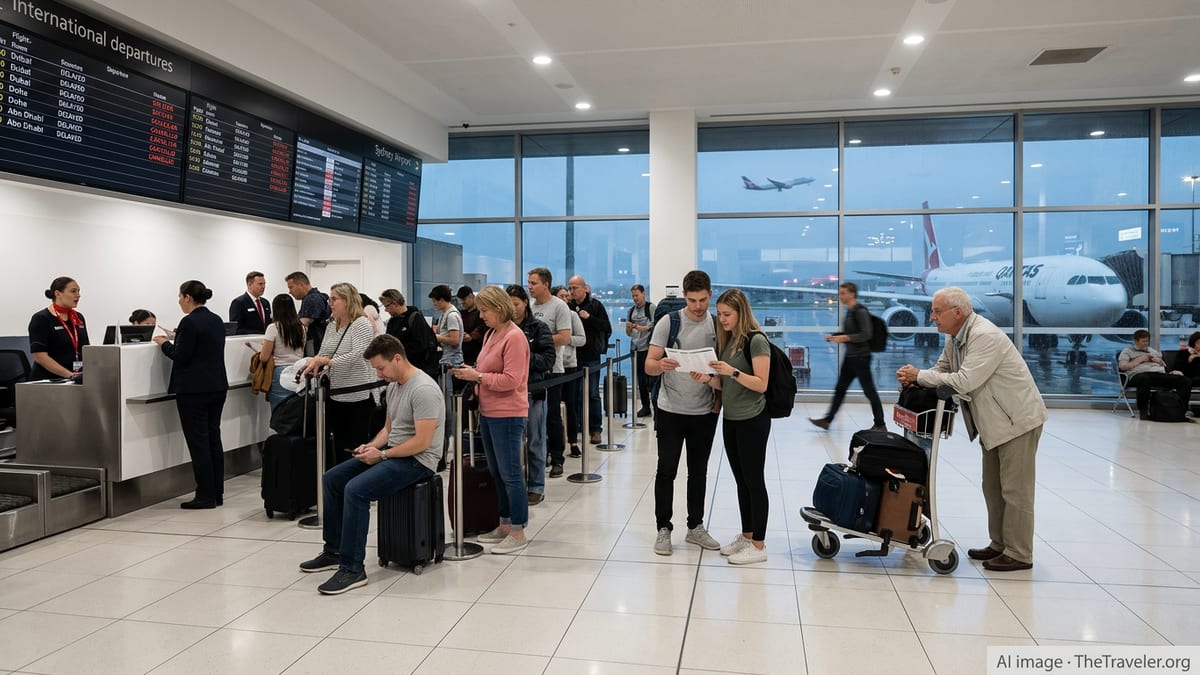
Hub Lockdowns Leave Australia–Europe Corridor Exposed
The latest escalation of conflict involving Iran, Israel and the United States has repeatedly shut or restricted airspace across large parts of the Middle East, snarling the long-haul corridors that link Australia with Europe. Reports indicate that countries including Iran, Iraq, Israel, Kuwait, Bahrain, Syria, Qatar and at times the United Arab Emirates have closed or heavily restricted their skies, forcing airlines to divert or cancel services.
According to published coverage, coordinated strikes in late February triggered widespread airspace closures, temporarily silencing major hubs such as Dubai, Abu Dhabi and Doha. Aviation analytics cited in international news reports suggest thousands of flights have been cancelled or delayed, with hundreds of thousands of passengers stranded, many of them en route between Europe and the Asia-Pacific.
For Australians, the disruption is particularly acute. Publicly available industry data and government travel advice show that a large share of passengers heading from Australia to Europe transit through Gulf hubs on carriers such as Emirates, Qatar Airways and Etihad. When those hubs are disrupted, the effects cascade through the entire network, pushing delays and cancellations onto departures from Sydney, Melbourne, Brisbane and Perth.
Even when flights operate, diversions around conflict zones add significant time and cost. Airlines are routing north over Turkey or south over Saudi Arabia and Egypt rather than directly across Iran and Iraq, increasing flying time, fuel burn and crew costs. Those higher operating expenses are now feeding directly into fares on key Australia–Europe routes.
Airlines Pivot Routes and Schedules, but Prices Climb
Australian flag carrier Qantas has begun reshaping its Europe network in response to the unsettled map. Recent schedule updates reported by local media show the airline lifting capacity on routes that avoid Middle Eastern hubs, with extra services between Australia and Europe via Asian gateways such as Singapore.
Coverage of Qantas’s latest changes indicates that the airline is trimming certain nonstop or near-nonstop links in favour of one-stop routes through Southeast Asia that can skirt closed airspace. The popular Perth to Paris service has been replaced with additional Sydney to Paris flights via Singapore, while seasonal links such as Perth to Rome are being extended or adjusted to capture strong demand without relying on Gulf stopovers.
Competing carriers are making parallel moves. Reports out of Europe and the Gulf show Emirates, Qatar Airways and Etihad diverting large numbers of flights around conflict zones, in some cases suspending services to affected cities and in others adding substantial detours. Each diversion adds fuel and time, and publicly available commentary from airline and insurance sectors suggests those costs are being reflected quickly in ticket prices.
Travel market outlooks for 2026 already flagged rising long-haul fares on routes touching the Middle East, but the war has amplified the trend. Capacity constraints, higher fuel prices and operational uncertainty are combining to erode the value of the sharply discounted Europe deals that many Australians have grown used to finding during sales.
Travel Warnings Turn Cheap Transit Deals into Liability
Alongside aviation disruption, official travel advisories are shifting rapidly across the Middle East, with direct implications for Australians transiting through the region. The federal government’s Smartraveller service has upgraded many destinations, including several major transit hubs, to its highest “do not travel” warning level.
Recent updates highlighted in domestic coverage show that Qatar, the United Arab Emirates, Bahrain and other Gulf states have been added to the “do not travel” list due to the volatile security situation and risk of further strikes. Importantly for travellers, Australian guidance makes clear that such warnings apply not only to stays, but also to transit and layovers in affected countries, even when passengers never leave the airport terminal.
Publicly available policy documents from travel insurers reinforce the stakes. Many policies exclude cover for events that arise from travelling to or through destinations under an official “do not travel” warning. In practice, that can mean Australians who knowingly book cheap tickets via a high-risk hub may find themselves without cover for cancellations, delays or medical emergencies linked to the conflict.
Travel industry bulletins circulating in Australia and New Zealand underline an uncomfortable reality for bargain hunters. A discounted fare that requires transiting a Middle Eastern hub on the “do not travel” list may now carry not only higher disruption risk, but also a significantly weaker safety net if things go wrong.
Insurance Gaps and Fine Print Catch Out Holidaymakers
The conflict is also exposing how complex airline partnerships and code-share arrangements can become when disruption hits. Many Australians purchase tickets on one brand, such as Qantas or Virgin Australia, only to discover that the operating carrier responsible for rebooking and care is a Gulf airline.
Consumer travel sites and aviation analysts report mounting confusion among passengers holding Australia–Europe tickets that route via Dubai, Doha or Abu Dhabi. When airspace closures or missile alerts force mass cancellations, rebooking rules depend on the operating airline’s policies, not the marketing carrier’s, leaving travellers navigating multiple sets of conditions and call centres.
Insurance providers are releasing detailed conflict advisories that spell out coverage limits. Publicly available documents from major insurers stress that many standard policies exclude war and warlike events, and that claims may be refused if travellers ignore government “do not travel” notices. In some cases, cover is limited to additional accommodation and meals for a set period, leaving longer-term strandees paying out of pocket.
Travel law specialists quoted in recent media reports recommend that passengers scrutinise both the fare conditions and the product disclosure statements attached to their insurance. Flexibility that once seemed optional, such as the ability to change destinations or departure dates without heavy penalties, is emerging as a key safeguard in a rapidly shifting risk environment.
Australian Appetite for Europe Remains Strong Despite Turmoil
Despite the mounting challenges, surveys of Australian travellers show that appetite for European holidays remains resilient. A recent holiday barometer found that Australians continue to rank Europe as a top long-haul destination, even as more respondents say they are factoring armed conflict and geopolitical instability into their planning.
Travel demand data compiled by industry bodies suggests that bookings for the northern summer remain robust, particularly to Mediterranean destinations and major cities on classic “grand tour” itineraries. However, booking patterns are evolving. Reports point to growing interest in routings via Asia, including Singapore, Bangkok and Tokyo, as travellers look for alternatives to conflict-adjacent hubs.
Agents and comparison sites in Australia are also tracking a rise in interest for non-stop and one-stop services that avoid the Middle East altogether, even when those itineraries are more expensive. The combination of safety concerns, insurance complications and memories of recent mass strandings is nudging many travellers to pay more for perceived stability.
For now, the traditional Kangaroo Route linking Australia and Europe remains open, but more circuitous and unpredictable than it has been in years. With war in the Middle East showing few signs of rapid resolution, Australians chasing Europe flight bargains are increasingly weighing not just price and convenience, but also a complex web of security assessments, government advisories and fine print that can turn a cheap deal into an expensive risk.