

More news on this day
Hundreds of air travelers across the Middle East faced extended airport waits and missed connections on April 7 as 29 flights were cancelled and 517 delayed across Saudi Arabia, Egypt, the United Arab Emirates, Türkiye, Kuwait and neighboring states, disrupting operations for Emirates, Saudia, Etihad, Pegasus Airlines and several other carriers at major hubs including Dubai, Riyadh, Cairo and Istanbul.
Get the latest news straight to your inbox!
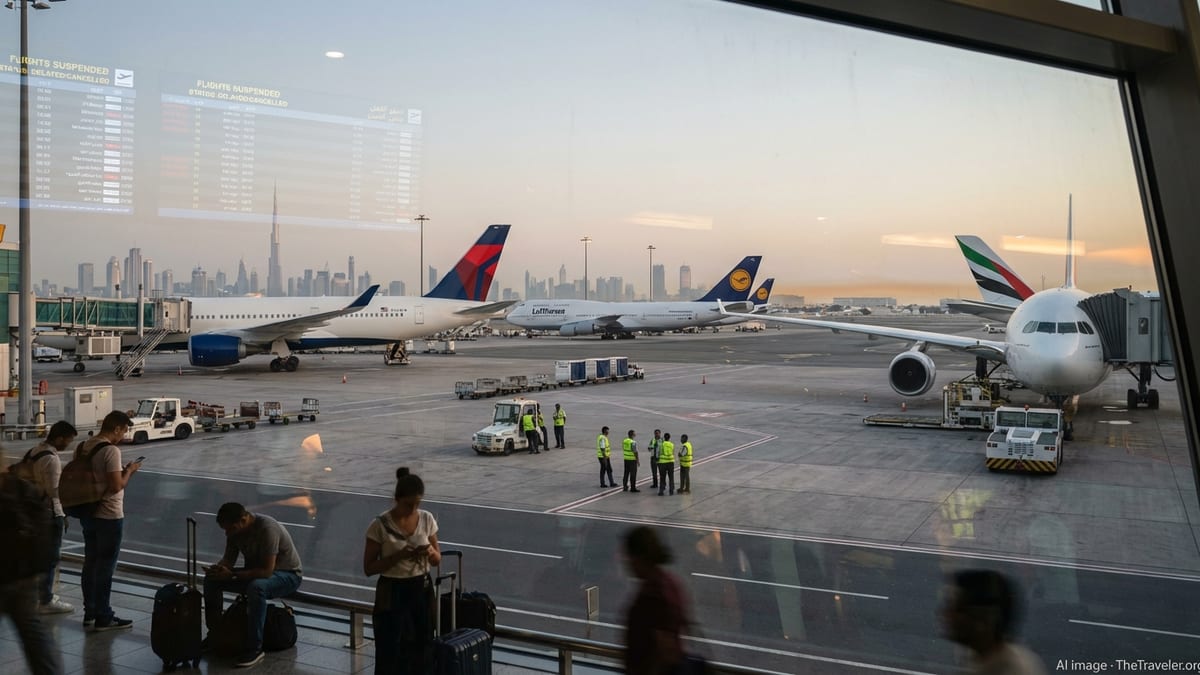
New Wave of Disruptions Hits Key Middle East Gateways
Publicly available operational data and regional media coverage show that the latest day of disruption built on weeks of instability in Middle East aviation. The tally of 29 cancellations and 517 delays reported across Saudi Arabia, Egypt, the UAE, Türkiye and Kuwait reflects widespread knock-on effects from constrained airspace and capacity limits at major hubs.
Dubai International, Riyadh’s King Khalid International, Cairo International and Istanbul’s main airports were among those experiencing rolling delays, with departure banks pushed back by hours and arriving aircraft held on the ground while crews and slots were reassigned. Regional coverage indicates that passengers on both regional and long haul services were affected, including flights to Europe, Asia and North America.
The figures echo a broader pattern tracked by aviation-focused outlets, which have recorded repeated days with several hundred delayed services across the region since early March, as airlines continue to adjust schedules, routings and fleet utilization in response to evolving security conditions and airspace restrictions.
Travel industry reporting also suggests that secondary airports in the Gulf and eastern Mediterranean have been feeling the strain, absorbing diverted or retimed flights and adding to the complexity faced by carriers trying to maintain some level of connectivity through alternative corridors.
Emirates, Saudia, Etihad and Pegasus Among Airlines Most Affected
Emirates, Saudia, Etihad Airways and Türkiye’s Pegasus Airlines feature prominently in the latest wave of disruption, alongside other regional and international operators serving major Middle East hubs. According to published coverage, Emirates and Etihad continue to work with reduced and highly adjusted schedules after previous large-scale suspensions, meaning that even a relatively small number of day-of-operations issues can cascade quickly.
Reports from aviation trackers highlight that Emirates services linking Dubai with Cairo, Istanbul and several Saudi destinations have been particularly exposed, given their role as feeder routes into already constrained long haul networks. Saudia’s operations through Riyadh and Jeddah remain limited by both aircraft availability and route options, while Etihad’s network from Abu Dhabi is operating below normal capacity, amplifying the impact of individual delays.
Pegasus Airlines, which relies heavily on İstanbul as a bridge between Turkey, the Middle East and Europe, has been hit by delays on routes to nearby conflict-affected or restricted airspace markets. Publicly available schedule data for carriers based in Kuwait and Egypt also indicate irregular operations, with some routes suspended and others operating with extended block times to accommodate detours.
Industry analysts cited in regional business media note that airlines are prioritizing core trunk routes and repatriation-style services, cutting back on marginal frequencies and discretionary capacity. This leaves fewer backup options when aircraft or crew become out of position because of long delays, increasing the likelihood that flights will be cancelled outright rather than merely pushed back.
Airspace Closures and Security Fears Continue to Reshape Routes
The immediate backdrop to the latest disruptions is the ongoing regional security crisis, including the war involving Iran and the United States and Israel, which has led to repeated missile and drone attacks and a patchwork of airspace closures or severe restrictions across parts of the Gulf and Levant. Recent advisories and analytical reporting describe entire corridors previously used by long haul carriers as effectively unavailable or only intermittently accessible.
Countries such as Iran, Iraq, Qatar, Bahrain, Kuwait and the UAE have imposed varying degrees of limitations on overflights at different points since late February. Aviation analysts writing in regional outlets explain that airlines have been forced to route many flights further north via Central Asia or south via Egypt and the Red Sea, increasing flight times, fuel burn and crew utilisation and heightening the risk of rotational delays.
Dubai and Abu Dhabi, usually among the most reliable mega-hubs worldwide, have been constrained by both physical damage and operational caution after earlier strikes in the vicinity of key infrastructure. Reports on the economic impact of the conflict note that the major Gulf carriers initially suspended large portions of their schedules and are now attempting a cautious, partial rebuild of services while accepting that day-to-day reliability will remain unpredictable.
Similar constraints are evident in Türkiye and Egypt, where carriers and air traffic control authorities must balance the need to maintain connectivity with the obligation to avoid contested or adjacent airspace. The result is an intricate patchwork of flight paths that can shift at short notice, undermining timetable stability and complicating aircraft and crew planning.
Knock-on Effects for Passengers Across Multiple Continents
The impact of 29 cancellations and 517 delays in a single day is magnified by the role of Middle Eastern hubs as critical junctions for intercontinental travel. According to airline schedule analyses and travel trade reporting, disruptions at Dubai, Riyadh, Cairo and Istanbul quickly ripple outward to Europe, Africa, Asia and Oceania, affecting travelers whose journeys only briefly pass through the region.
Passengers transiting Dubai on routes between Europe and South or Southeast Asia have been among the hardest hit, with some forced into overnight stays or lengthy rebookings after missing onward connections. Cairo and Istanbul, which serve as important connecting points between Africa, the Middle East and Europe, have seen similar scenarios, with otherwise unaffected routes disrupted by late inbound aircraft or crew reaching duty-time limits.
Travel advisories from airlines and corporate travel managers continue to recommend that passengers build in extra connection time, monitor flight status frequently and remain prepared for last-minute gate or timing changes. Some carriers have adjusted their minimum connecting times at key hubs, effectively reducing the number of itineraries that can be sold on a single day without risking misconnects.
There are also growing concerns in the tourism and hospitality sectors of affected countries. Hotels near major airports are reporting elevated occupancy levels from disrupted travelers, while tour operators in destinations reliant on Gulf and Turkish carrier feed are watching booking patterns closely as travelers weigh the risk of transiting the region against alternative routings.
Recovery Prospects Remain Uncertain as Peak Travel Season Nears
Despite some signs of stabilization compared with the early days of the current crisis, forward-looking assessments from aviation consultancies and regional media point to a fragile situation. With many airways still closed or tightly controlled, the system lacks the flexibility needed to absorb additional shocks without triggering fresh waves of cancellations and delays similar to the 29 and 517 recorded in the latest reporting period.
As the northern hemisphere summer travel season approaches, demand for leisure and visiting-friends-and-relatives travel through Middle East hubs would normally climb sharply. Several carriers have tentatively loaded additional frequencies into their timetables, but analysts caution that these plans are contingent on security conditions, the pace of infrastructure repairs and the reopening of key airspace segments.
Airlines continue to offer flexible rebooking and refund policies for passengers booked to, from or via the region, an approach widely documented in their public advisories. However, this flexibility does not eliminate the stress and uncertainty for travelers, many of whom must make difficult decisions about whether to proceed with planned trips or reroute through alternative hubs in Europe, North Africa or South Asia.
For now, the latest figures of 29 cancellations and 517 delays across Saudi Arabia, Egypt, the UAE, Türkiye and Kuwait underscore that Middle East aviation is still operating under exceptional strain. Industry observers suggest that a sustained reduction in security risks and a clearer picture of long term airspace access will be required before reliability at hubs such as Dubai, Riyadh, Cairo and Istanbul can return to levels travelers once took for granted.