

More news on this day
Hundreds of travelers across the Middle East and on key European routes were left stranded or facing long delays as fresh waves of disruption produced at least 289 delayed services and 36 cancellations affecting airports from Doha and Amman to Barcelona and Paris.
Get the latest news straight to your inbox!
Regional Turmoil Keeps Hubs Under Strain
The latest disruption comes amid an already fragile operating environment for Gulf and Levant hubs following weeks of regional tension and intermittent airspace closures. Publicly available aviation and media data show that air traffic across Qatar, the United Arab Emirates, Kuwait and Jordan has been repeatedly reshaped since late February, with suspensions, diversions and rolling schedule changes eroding reliability for connecting passengers.
Reports tracking airport operations indicate that Hamad International in Doha, Dubai International and Abu Dhabi’s Zayed International have been among the hardest hit, with earlier waves of disruption generating hundreds of delays and cancellations in a single day. Similar pressure has been reported at Queen Alia International in Amman and at Kuwait International, where timetable changes and aircraft repositioning have complicated efforts to stabilize schedules.
Analysts note that these airports sit at the crossroads of Europe, Asia and Africa, so even a modest number of local cancellations can ripple outward, affecting flights to secondary cities across the Mediterranean and into Western Europe, including Barcelona and Paris. The result is a pattern in which relatively contained regional shocks translate into widespread missed connections for travelers far from the Gulf.
Major Carriers Face Rolling Operational Headaches
Among the airlines most visibly affected are FlyDubai and Emirates, both closely tied to Dubai’s role as a long-haul super hub. Monitoring of flight status boards and published coverage show repeated clusters of late departures and arrivals on Emirates widebody services linking the Gulf with Europe, South Asia and East Asia, while FlyDubai’s dense regional network has faced knock-on delays whenever aircraft and crews are held up in affected airspace.
Regional full-service and hybrid carriers such as Egypt Air, Royal Jordanian and Kuwait Airways have also been drawn into the disruption, particularly on routes threading through congested corridors over or near conflict-affected zones. Delays on these sectors have in turn complicated onward itineraries to European cities including Paris Charles de Gaulle and Barcelona El Prat, where aircraft arriving from Middle Eastern hubs often serve as feeders for transatlantic or intra-European connections.
European carriers are not immune. Publicly available routing data show that KLM and several other European airlines have continued to adjust flight paths to avoid sensitive airspace, lengthening flight times and narrowing turnaround windows at busy airports. While many of these services are operating, schedule buffers have been eroded, leaving little margin when upstream delays originate in Doha, Amman or Gulf hubs.
Passengers Confront Missed Connections and Night‑Long Waits
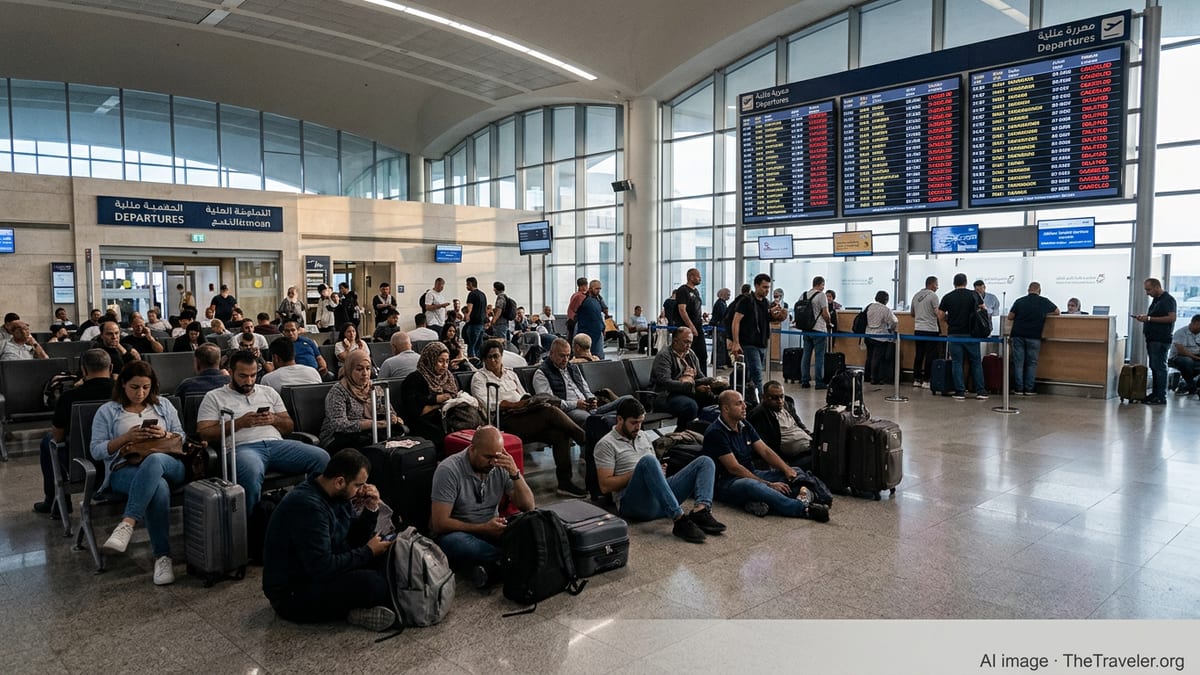
For travelers, the statistical picture of 289 delays and 36 cancellations translates into missed connections, last-minute hotel stays and improvised rebooking strategies. Airport monitoring services and local media across the Middle East describe scenes of crowded transfer areas, long queues at airline service desks and gate areas filled with passengers awaiting clarification on new departure times.
Travel reports from Doha and Amman indicate that passengers on multi-leg itineraries between Asia and Europe have been particularly exposed, as a delay of just a couple of hours on a Middle East sector can easily disrupt tightly timed onward flights to hubs such as Paris or Barcelona. In some cases, rebooked passengers have been routed through alternative European gateways when direct or preferred connections were no longer viable.
Consumer advocates note that many travelers are still adjusting to the reality that timetable changes can cascade for days once disruption takes hold in this region. Even when daily statistics show only a few dozen outright cancellations, the much larger volume of delayed flights often has a greater cumulative impact on itineraries, especially for those relying on one-stop connections through Middle Eastern hubs.
Airlines Adjust Networks as Disruption Persists
In response to the sustained volatility, several carriers have adjusted network plans and frequencies across the Middle East. Industry schedules and airline communications suggest a shift toward more conservative timetables, with some routes trimmed or temporarily suspended and others consolidated on larger aircraft to preserve capacity while reducing the number of individual flights at risk.
Publicly available information on Gulf and Levant operations indicates that some airlines are prioritizing trunk routes linking major hubs over thinner point-to-point services. This approach is intended to keep key corridors functioning while allowing carriers to reallocate aircraft and crews more flexibly when airspace conditions or security assessments change at short notice.
Aviation analysts caution that these network changes, while rational from an operational perspective, can leave certain secondary markets with fewer options or longer journeys. Cities such as Barcelona and Paris remain well connected overall, but passengers originating in or transiting through smaller airports in the Middle East may face longer layovers or additional stops as airlines reconfigure routings.
Uncertain Timeline for a Return to Stability
With no clear timeline for a full normalization of regional airspace and schedules, industry observers expect further days of patchy disruptions of the kind reflected in the latest tally of 289 delays and 36 cancellations. Data from prior weeks suggest that even when operations begin to recover, backlogs in aircraft positioning, crew rest requirements and maintenance slots can keep punctuality below normal levels for some time.
Travel organizations and aviation specialists are advising passengers with upcoming trips through Doha, Dubai, Abu Dhabi, Kuwait City or Amman to monitor flight status closely, build additional buffer time into connections and remain prepared for last-minute adjustments. Recent experience shows that even flights departing from European airports such as Paris and Barcelona can be affected when their inbound aircraft or crews originate in the Middle East.
As airlines, airports and regulators continue to navigate an evolving security and airspace landscape, the prospect of further days marked by concentrated clusters of delays and cancellations across the region remains high. For now, travelers are being urged by publicly available advisories and news coverage to treat schedules as subject to change and to plan accordingly.