

More news on this day
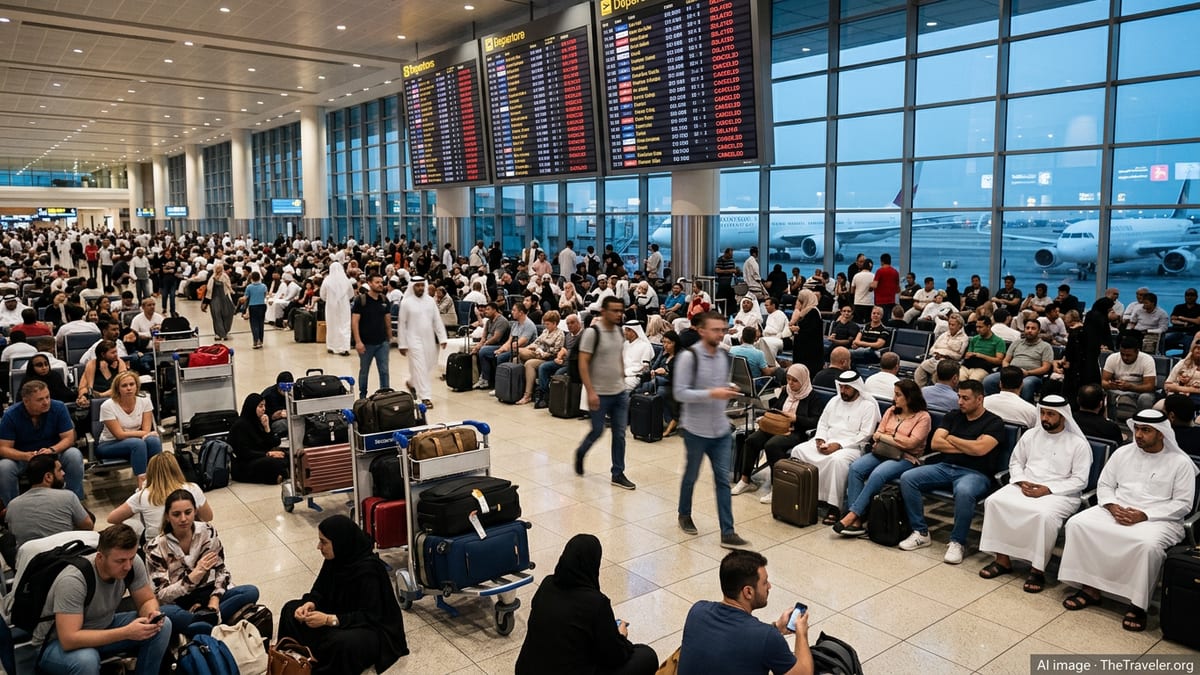
Thousands of travelers connecting through the Middle East were stranded on Thursday as a rolling wave of airspace closures, security restrictions, and operational bottlenecks triggered at least 1,161 flight delays and 1,014 cancellations across Saudi Arabia, the United Arab Emirates, Turkey, Qatar, Jordan, and neighboring states, heavily disrupting marquee carriers such as Emirates, Qatar Airways, Saudia, Gulf Air and others.
Get the latest news straight to your inbox!
Airspace Closures Turn Key Hubs Into Bottlenecks
What began as targeted airspace restrictions late last month has now cascaded into a region-wide aviation crunch, with multiple Gulf and Levant states limiting or temporarily closing sections of their skies to commercial traffic. Authorities in the United Arab Emirates, Qatar, Kuwait, Bahrain and parts of Saudi Arabia have imposed tight controls on overflight and arrivals, citing heightened security risks linked to the ongoing conflict involving Iran and U.S.-Israeli forces.
Dubai International, Hamad International in Doha, Abu Dhabi International, and Istanbul Airport have borne the brunt of these measures, as airlines scramble to reroute or ground services that would normally use Middle East air corridors as the most direct bridge between Europe, Asia, and Africa. Aviation advisories issued over the past ten days describe “controlled and limited” traffic in some Gulf airspaces, with carriers forced into longer diversion routes or, increasingly, outright cancellations.
The result is a staggering operational backlog. Data compiled from regional aviation notices and airport operations indicates that, across key hubs in Saudi Arabia, the UAE, Turkey, Qatar, Jordan and nearby states, at least 1,161 flights have been delayed and 1,014 canceled in recent days, with disruption concentrated on long-haul connections through Dubai, Abu Dhabi, Doha, Istanbul and Jeddah.
Major Carriers Slash Schedules and Operate Emergency Corridors
Flag carriers that have built their business models around Middle Eastern transfer traffic are now operating on skeleton schedules. Emirates has faced hundreds of cancellations and delays across its Dubai hub as it works around reduced UAE airspace and congestion at Dubai International and Al Maktoum airports. The airline says it is gradually restoring capacity but continues to prioritize repatriation and essential travel as it rebuilds its network.
Qatar Airways is running a “limited flight schedule” to and from Doha, using temporary corridors authorized by Qatari regulators to move stranded passengers out of Hamad International. The carrier has urged travelers not to come to the airport without a confirmed ticket and seat, warning that same-day rebooking at the terminal is no longer feasible given security screening and slot constraints.
Saudia, Gulf Air, Royal Jordanian, Etihad, Flydubai and Turkish carriers including Turkish Airlines, Pegasus and SunExpress have all announced varying levels of suspensions or reductions, particularly on routes linking the Gulf with Iraq, Syria, Lebanon and Jordan, as well as intra-Gulf sectors. Several European and Asian airlines, from Lufthansa and Air France to Finnair and Air India, have also extended suspensions to Dubai, Abu Dhabi, Riyadh and Doha, further tightening capacity into the region.
Industry analysts say the cancellation-to-delay ratios at major hubs suggest that some airports are deliberately grounding services rather than risking rolling, multi-hour delays that would cascade into crew and aircraft shortages across their networks.
Passengers Face Days-Long Waits, Patchwork Support
For travelers caught in the middle, the human impact is measured in days spent sleeping on terminal floors, missed connections and fraying travel budgets. At Dubai International and Doha’s Hamad International, passengers have described snaking queues at transfer desks, with some told the next available seats out of the region are several days away. Hotels in airport perimeters are reported to be near capacity, pushing airlines to offer meal vouchers and basic amenities inside the terminals instead.
In Abu Dhabi and Riyadh, limited outbound services have left families and business travelers scrambling to secure spots on any available flights, often at premium last-minute fares. Stranded passengers transiting from Asia have been particularly hard hit, as flights that would normally hop from Dhaka, Mumbai, Kuala Lumpur or Singapore through Gulf hubs to Europe have been delayed, canceled or forced onto lengthy detours that exceed crew duty limits, leading to additional last-minute disruption.
Compensation and care rules vary widely depending on the airline and the jurisdiction. Some carriers are offering flexible rebooking windows, fee waivers and, in select cases, full refunds for trips to and from affected Middle Eastern destinations. Others are classifying the turmoil as an extraordinary security event, limiting their liability under local and international regulations and providing only basic assistance such as re-routing at the earliest opportunity.
Travel rights advocates say passengers should keep all receipts for out-of-pocket expenses related to hotels, meals and ground transport, and document communications with airlines in case they seek reimbursement later, particularly on routes covered by more protective compensation regimes.
Ripple Effects Across Europe and Asia
The disruption is not confined to the Middle East itself. Airports as far afield as Dhaka, Kuala Lumpur, Singapore and major European hubs are experiencing knock-on delays and cancellations as aircraft and crews become stuck on one side of the region’s restricted airspace or another. In Bangladesh, authorities report hundreds of cancellations on flights to Gulf gateways since late February, affecting services operated by Emirates, Qatar Airways, Gulf Air, Air Arabia, Kuwait Airways, Jazeera Airways and flydubai.
European airports are likewise grappling with missed inbound and outbound slots from carriers that rely on Gulf and Turkish hubs for connecting traffic. Lufthansa, Air France and British Airways have pared back or suspended flights to several Middle Eastern cities, prompting further reshuffling of long-haul schedules and contributing to delays felt by travelers who may not even be transiting the region directly.
Beyond passenger inconvenience, cargo flows have also been disrupted. With many widebody passenger jets grounded or rerouted, belly-hold cargo capacity between Europe, Asia and Africa has tightened, potentially impacting supply chains for time-sensitive goods. Freight forwarders are reporting longer transit times and unpredictable routings as airlines try to thread remaining open corridors around restricted zones.
Analysts warn that even a gradual reopening of airspace will not instantly resolve the backlog, as airlines will need days to reposition aircraft and crews, clear maintenance queues and work through stranded passengers holding now-misaligned itineraries.
What Travelers Need to Know Before Flying
With conditions changing by the day, travel experts advise would-be passengers to treat any journey that touches the Middle East, or typically overflies the region, as high risk for disruption in the short term. Even if origin and destination airports appear unaffected, flights may still be delayed or rerouted if their usual paths cross restricted airspace in the Gulf or Levant, adding hours to flight times and complicating tight connections.
Travelers are being urged to monitor airline apps and text alerts frequently, avoid heading to the airport without a confirmed, operating flight, and build in generous buffer time for critical trips. For new bookings, many agents recommend favoring routings that avoid Middle East hubs where possible, or at least selecting fully changeable fares that allow rerouting via alternative gateways in Europe or Asia if conditions deteriorate further.
Those already stranded are advised to stay in close contact with their airline rather than booking separate onward tickets that could inadvertently forfeit their right to assistance. In some cases, embassies and consulates have begun coordinating ad hoc repatriation options and providing guidance on accommodation, especially for citizens stuck in transit zones without valid visas to enter the country.
While there are signs that some carriers are cautiously rebuilding schedules as security assessments evolve, the sheer scale of delays and cancellations logged this week underlines how quickly the Middle East’s role as a global aviation crossroads can become a chokepoint, leaving thousands of travelers dependent on a fragile patchwork of emergency corridors and reduced-capacity flights.