

More news on this day
A fresh wave of geopolitical shocks across West Asia and the Gulf is rapidly reshaping global travel flows, with Egypt, the United Arab Emirates, Thailand, Indonesia and Sri Lanka all reporting sharp slowdowns in arrivals and hotel bookings as flight disruptions and security concerns weigh on holidaymakers.
Get the latest news straight to your inbox!
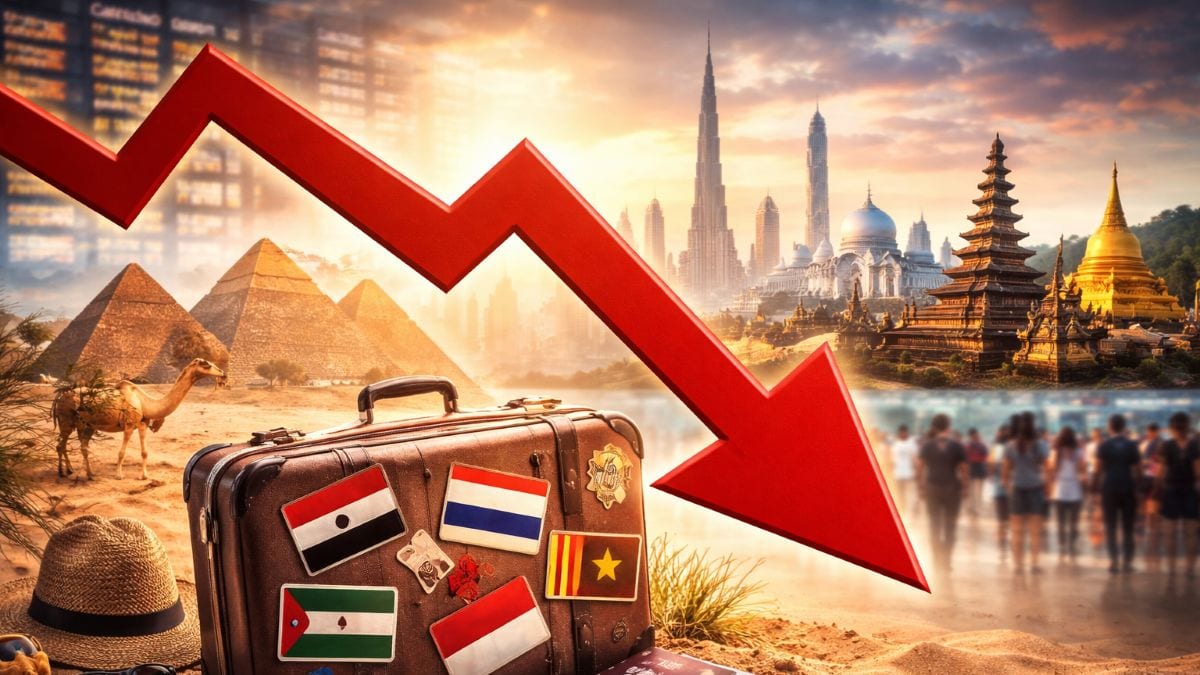
Image by Latest International / Global Travel News, Breaking World Travel News
Egypt’s Tourism Boom Stalls Amid Red Sea Risks
Egypt entered 2026 from a position of strength, having welcomed around 19 million visitors in 2025 and cemented its status as one of the Middle East’s fastest growing tourism markets. That momentum is now under pressure, as the widening West Asia crisis and renewed safety concerns in the Red Sea corridor trigger a wave of cancellations at key resort destinations.
Recent industry updates compiled by travel trade outlets indicate that Red Sea hubs such as Hurghada and Sharm El Sheikh are facing cancellation rates of around 20 to 30 percent for March and April, with some hotels reporting spring bookings down by roughly a third compared with earlier expectations. Market commentary links the downturn directly to heightened perceptions of regional risk and worries about air and sea routes that pass close to conflict zones.
Analysts note that Egypt’s tourism sector had already been grappling with reputational challenges following a series of maritime and diving accidents in the Red Sea in 2024 and 2025, alongside widely reported shark incidents. The latest geopolitical flare up, layered on top of those safety narratives, is now threatening a vital source of foreign currency for a country that relies heavily on visitor spending to support its balance of payments.
Economic forecasts referenced in recent international coverage suggest that Egypt could see tourism revenues fall by 10 to 30 percent this year compared with the previous period if travel disruptions and risk aversion persist. Such a decline would not only strain hotel operators and small tourism businesses, but also complicate broader economic stabilisation efforts.
UAE Travel Hub Status Tested by Missile and Drone Strikes
The United Arab Emirates, long promoted as a safe and efficient gateway between Europe, Asia and Africa, is also confronting unprecedented pressure on its tourism proposition. Since late February, a surge of missile and drone attacks linked to the escalating confrontation between the United States, Israel and Iran has periodically disrupted air operations over Dubai and Abu Dhabi.
International media reports describe debris from intercepted projectiles falling near major visitor landmarks in Dubai and temporarily halting traffic at one of the world’s busiest airports. Flight data providers have counted many thousands of cancellations across Gulf airspace in a matter of days, stranding transit passengers and forcing airlines to reroute or suspend services.
While the latest assessments from multilateral institutions still describe the UAE’s non oil economy, including tourism and real estate, as broadly resilient, the near term impact on visitor sentiment is significant. Travel agencies in key source markets report growing reluctance among leisure travelers to route long haul holidays through Gulf hubs or book luxury stays in cities perceived to be within range of regional hostilities.
Industry observers point out that the UAE’s visitor economy is highly exposed to aviation confidence. Even short lived interruptions in air connectivity tend to reverberate through bookings for conferences, stopover packages and winter sun breaks, raising the risk that the country’s record 2025 arrival figures will be difficult to repeat in the coming high season.
Thailand Confronts Slowing Arrivals as Long Haul Travelers Hesitate
Thailand, which welcomed more than 35 million foreign tourists in 2024 and had been targeting a further recovery in 2025 and 2026, is now seeing fresh volatility in its arrival data. Government statistics cited by local newspapers show that foreign arrivals in early March 2026 were down more than 4 percent year on year, with weekly inflows slipping by double digits as conflict in the Middle East disrupts long haul routes.
Domestic coverage indicates that hundreds of flights to and from Thailand have been canceled or rerouted as airlines avoid contested airspace and key transit hubs in the Gulf. The knock on effect is particularly evident in European and Middle Eastern source markets, where travelers face longer journey times, higher fares and elevated uncertainty about sudden schedule changes.
At the same time, Thailand’s tourism outlook had already begun to cool before the latest crisis, with central bank analysis highlighting softer momentum in 2025 compared with the initial post pandemic rebound. Spending by some segments, particularly price sensitive visitors from parts of East Asia, has become more cautious in the face of currency fluctuations and higher living costs.
Tourism economists now warn that the combination of geopolitical risk and economic headwinds may weigh on Thailand’s goal of regaining pre pandemic levels of high spending, long stay tourists. The kingdom is expected to intensify efforts to diversify its visitor base within Asia and promote secondary destinations in an attempt to cushion the blow from any prolonged decline in long haul arrivals.
Indonesia’s Bali Feels the Strain as Global Uncertainty Hits Demand
Indonesia’s flagship destination of Bali has largely symbolised Southeast Asia’s tourism comeback, with international arrivals surpassing some pre pandemic benchmarks in 2024 and 2025. However, recent data shared by national and local authorities reveal a more fragile picture heading into 2026, particularly for hotel occupancy and domestic travel.
Economic briefings from Jakarta note that overall growth in 2025 was restrained, in part because of weaker domestic tourism across major islands, including Bali. Local industry figures have highlighted a noticeable decline in domestic visitors, citing higher airfares, reduced flight capacity and household budget pressures as key factors dampening demand for leisure trips.
More recently, Indonesia’s tourism ministry has described Bali’s visitor numbers as stable but uneven, with a significant share of hotels in main resort districts operating at occupancies around the low to mid 40 percent range. Operators are increasingly sensitive to swings in international sentiment, as global geopolitical tensions and airline route changes can quickly influence bookings from Australia, Europe and emerging Asian markets.
Policy papers and regional tourism analyses stress that Bali’s dependence on air connectivity leaves it exposed to any broader retrenchment in long haul travel driven by security concerns in the Middle East. If airlines continue to adjust schedules to avoid contested corridors or to reduce capacity in response to higher fuel and insurance costs, Indonesia’s most tourism dependent province could face a more pronounced slowdown.
Sri Lanka’s Fragile Recovery Knocked by Gulf Airspace Closures
Sri Lanka, which has been working to rebuild its visitor economy after the pandemic and a severe domestic economic crisis, is among the countries most directly hit by the latest disruption to Gulf aviation routes. Arrivals data released in early March and cited by Colombo based business outlets show a year on year decline of around 25 percent over the first days of the month.
Industry commentary attributes much of the drop to the temporary closure of airspace and large scale flight cancellations across the Middle East, particularly at Gulf hubs that serve as critical transit points between Europe and South Asia. For Sri Lanka, which relies heavily on connecting traffic from Western Europe via these hubs, the sudden interruption has effectively cut a main artery of inbound tourism.
Local tourism bodies had previously reported steady improvement in 2025, supported by measures such as visa free entry for selected markets and targeted promotional campaigns. The latest setback exposes how dependent the island remains on external aviation and geopolitical conditions, despite efforts to market itself as a comparatively safe and affordable destination in the wider Indian Ocean region.
Analysts following Sri Lanka’s recovery argue that the country may still find opportunities in the current turbulence, as some travelers seek alternatives to higher risk destinations in the Gulf. However, capitalising on that shift will require stable air links, predictable visa rules and continued reassurance on safety, all of which are vulnerable to developments far beyond the island’s control.