

More news on this day
Thousands of travellers have been left stranded across the Middle East as airlines including Gulf Air, Royal Jordanian, Saudia, KLM and EgyptAir cancel or delay scores of flights, with reports indicating at least 167 services grounded and more than 100 delayed on key routes through Bahrain and Saudi Arabia amid ongoing regional conflict and airspace restrictions.
Get the latest news straight to your inbox!
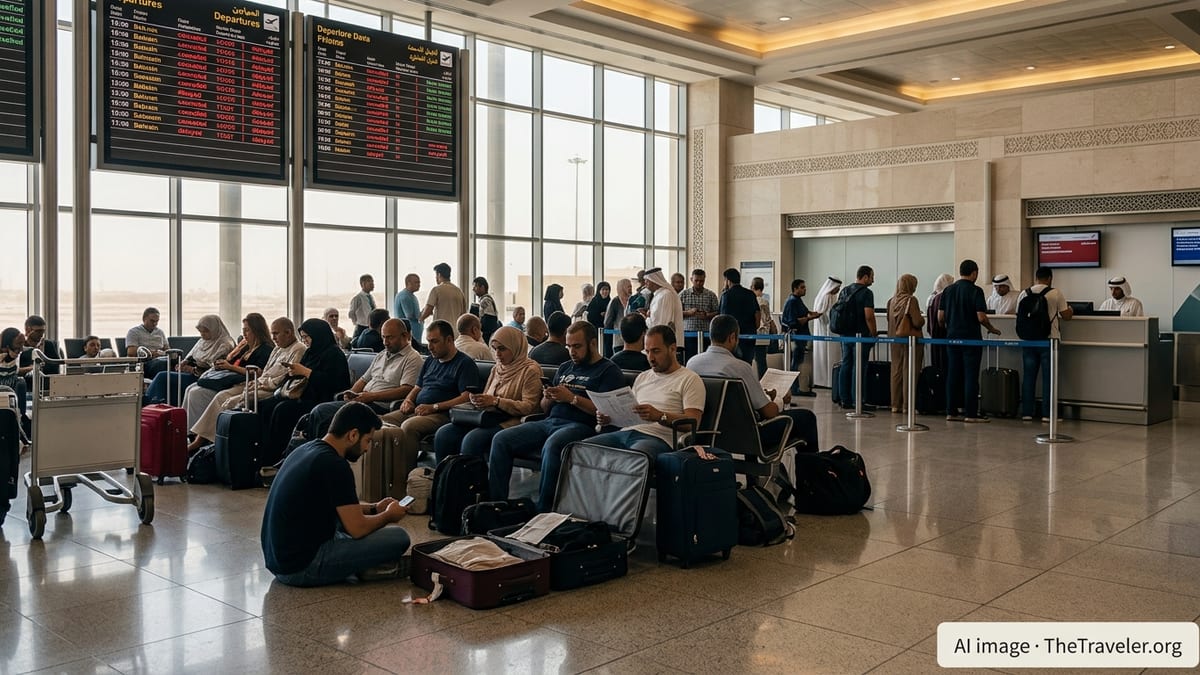
Regional Conflict Triggers Deepening Aviation Disruption
The latest wave of cancellations is closely tied to the wider conflict involving Iran and a series of strikes and security incidents that have rattled Gulf infrastructure and airspace. Publicly available information shows that multiple Gulf states, including Bahrain and Saudi Arabia, have faced repeated missile and drone threats since late February, prompting tighter controls on overflights and takeoffs.
Analysis of open flight-tracking data and airline notices indicates that carriers routing through Bahrain and Saudi hubs have sharply reduced their schedules, particularly on east–west long-haul corridors linking Europe and North America with South and Southeast Asia. The result is a cascade of grounded aircraft and rolling delays that now stretch well beyond the initial days of the crisis.
Industry reports describe the situation as an evolving disruption rather than a short, weather-style interruption. With conflict-related restrictions compounding existing congestion and resource pressures, airlines are struggling to maintain predictable timetables, and travellers are increasingly facing last-minute changes at already crowded terminals.
Bahrain Hub Under Strain as Flights Divert to Saudi Arabia
Bahrain International Airport, a critical connector between Europe, Asia and the Indian subcontinent, has been one of the hardest-hit hubs. Earlier strikes and nearby infrastructure damage led to several phases of schedule cuts and partial suspensions, and publicly available coverage indicates that Bahrain’s national carrier, Gulf Air, relocated portions of its fleet to airports in neighbouring Saudi Arabia to protect aircraft and maintain limited operations from alternative gateways.
As airlines consolidate flights into Saudi airports such as Dammam and Riyadh, capacity through Bahrain has thinned further, contributing to the tally of at least 167 grounded services across the region. Travellers report being advised to make cross-border surface journeys via the King Fahd Causeway to connect with outbound flights from Saudi territory, significantly lengthening total travel times.
Operational data suggests that even where Bahrain’s runways and terminal remain technically open, overall throughput is well below normal. Some carriers have opted to bypass the kingdom entirely for now, re-routing itineraries through Doha, Muscat or European hubs, while others are operating ad hoc “recovery” flights only when security and airspace conditions permit.
Flag Carriers Slash Schedules and Reroute Around Restricted Airspace
Flag carriers across the Middle East and beyond have responded with sweeping schedule revisions. Saudia has adjusted services on multiple regional routes, trimming flights to and from Bahrain and other Gulf points while concentrating capacity on selected Saudi domestic and long-haul links less exposed to contested airspace. Royal Jordanian has also announced suspensions and frequency cuts on certain Middle East routes, including services that typically traverse or connect through Bahrain and Saudi Arabia.
European and North African airlines are making similar moves. Dutch carrier KLM has publicly outlined plans to avoid Iranian, Iraqi and adjacent airspace, lengthening flight times and forcing some cancellations where alternative routings are operationally or commercially unviable. EgyptAir has scaled back services to parts of the Gulf network during the conflict period, reducing options for travellers who once relied on Cairo as a flexible connecting point.
Collectively, these changes have produced a patchwork of cancellations and delays. Data compiled from airline advisories and airport departure boards points to more than 167 flights grounded in recent days across Bahrain- and Saudi-linked routes, alongside over 100 additional services operating with significant delays as aircraft, crews and slots fall out of sync with original schedules.
Travellers Face Long Waits, Involuntary Stopovers and Complex Rebooking
For passengers, the impact is immediate and often chaotic. Reports from regional airports describe long lines at airline counters, with travellers seeking rebooking options on a shrinking pool of available flights. Where same-day alternatives exist, they frequently involve indirect routings through secondary hubs, multiple stopovers, or extended layovers while carriers wait for safe flight windows.
Many travellers with nonrefundable tickets have found themselves relying on special waivers. Several airlines in the region, including Gulf-based carriers, have temporarily expanded fee-free change and cancellation policies through the end of March to accommodate those affected by the disruption. However, publicly available travel guidance notes that such waivers are typically time-limited and may exclude some low-cost or promotional fares.
Accommodation has become a further stress point. When flights are cancelled at short notice, airlines sometimes arrange hotel stays and ground transport, but the sheer volume of disrupted passengers has tested capacity in key transit cities. Travellers sharing their experiences on public forums mention overnight stays in airport hotels, rapid sell-outs of budget options, and difficulty securing visas when rerouted through countries with stricter entry rules.
Economic and Operational Fallout for the Wider Travel Sector
The grounding of more than 160 flights and widespread delays are adding to an already heavy financial burden on the region’s aviation and tourism industries. Trade and tourism bodies estimate that the war and resulting airspace closures are costing Middle East travel markets hundreds of millions of dollars per day in lost revenue, as passenger volumes fall and airlines absorb higher operating costs from longer routes and rising fuel prices.
Airports in Bahrain and Saudi Arabia are also facing operational challenges beyond flight movements. Security measures have been tightened, handling staff are working irregular shifts to accommodate sudden schedule changes, and ground services such as catering and baggage handling are being rescheduled at short notice. These pressures can ripple through to passengers as longer waits for baggage, fewer available amenities and reduced service levels in terminals.
Travel insurers and corporate travel managers are reassessing risk across the region. Public advisories increasingly emphasise the need for flexible booking options, robust contingency plans and close monitoring of airline notifications. With no clear timeline for a full restoration of pre-crisis flight patterns, most industry analyses suggest that disruptions on Bahrain- and Saudi-linked routes are likely to continue in some form, and travellers planning to transit these hubs in the coming weeks are being urged to build in extra time, verify itineraries frequently and prepare for sudden changes.