

More news on this day
Milan Bergamo Airport is preparing for one of its busiest peak seasons yet in summer 2026, as new routes, added capacity and improved ground links position the Lombardy gateway at the center of Europe’s surging tourism rebound.
Get the latest news straight to your inbox!
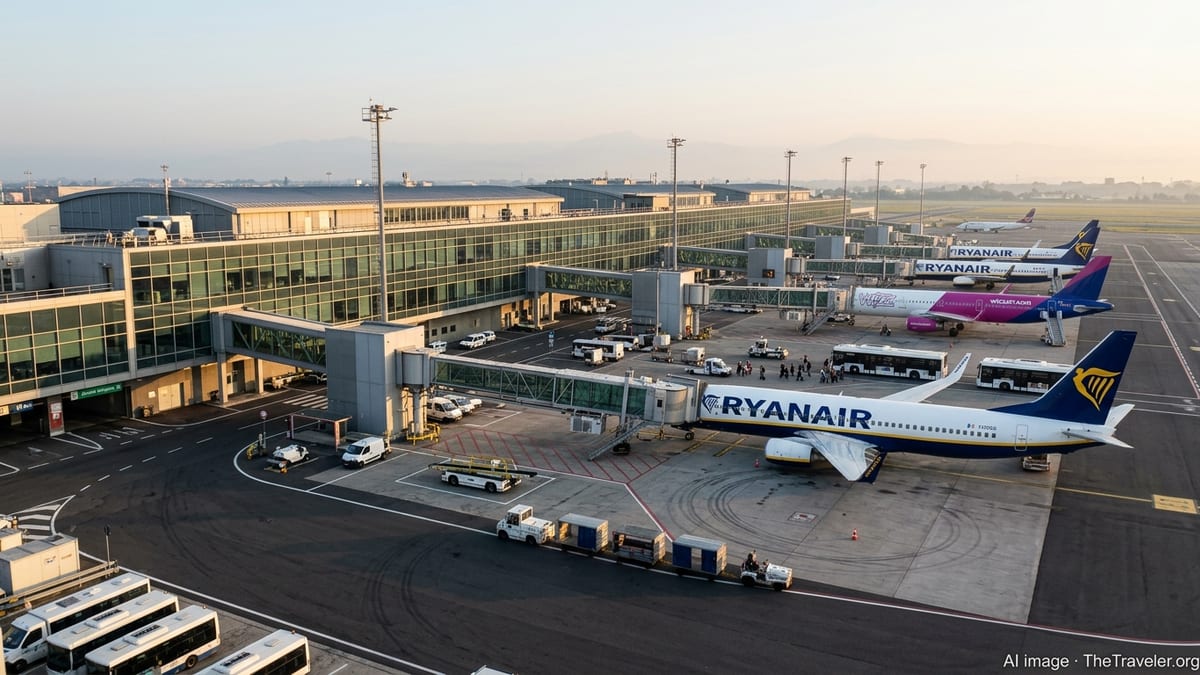
BGY Confirms Role as Italy’s Third-Busiest Gateway
Publicly available traffic data and airport communications indicate that Milan Bergamo Airport is set to retain its status as Italy’s third-busiest passenger airport into 2026, behind Rome Fiumicino and Milan Malpensa. The airport has climbed steadily over the past decade on the strength of point to point low cost traffic and growing appeal as an alternative access point to Milan and northern Italy.
Recent seasonal schedule updates for winter 2025 to 2026 already show a dense network of more than 100 destinations, with low cost carriers accounting for the bulk of operations. Ryanair in particular maintains a large base at Bergamo with more than 20 stationed aircraft in the cold season and a larger fleet typically deployed for the summer peak, underlining the airport’s importance in the airline’s Italian strategy.
As airlines start to load and promote their summer 2026 timetables, Bergamo’s management company is signaling that growth rather than consolidation will define the coming season. The airport is emphasizing its role as a high frequency hub for short haul European and Mediterranean routes, with an offer designed to capture both inbound tourists and Italian residents heading abroad.
Industry observers note that Bergamo’s trajectory mirrors broader Italian aviation trends, with secondary airports in major tourism regions absorbing a growing share of inbound leisure demand. In this context, the airport’s 2026 plans are being watched closely as an indicator of how capacity will be deployed across the wider Milan system.
Ryanair and Wizz Air Anchor an Expanded Summer 2026 Network
The cornerstone of Bergamo’s summer 2026 expansion is the continued buildout of its low cost network, led by Ryanair and Wizz Air. Recent announcements about Ryanair’s summer 2026 programs at other Italian bases, alongside a dedicated preview of its 2026 schedule at Milan Bergamo, point to additional frequencies on existing routes and a reinforced focus on sun and city break destinations across Europe.
Industry and aviation trade coverage describes Milan Bergamo as one of Ryanair’s key pillars in Italy, with the carrier using the airport to funnel capacity into both established tourism markets and newer city pairs. For summer 2026, expectations center on more flights to high demand leisure destinations such as Spain, Greece and southern Italy, as well as to central and eastern European cities that have seen strong outbound and inbound flows in recent years.
Wizz Air is also deepening its presence at Bergamo. In the most recent season it added several new routes and increased frequencies to cities in central and eastern Europe, as well as select Mediterranean destinations. Reports on the airline’s Italian strategy suggest that these additions are intended as a platform for further growth into 2026, with Bergamo serving as a convenient access point for travelers from markets such as Romania, Albania, the Balkans and the Caucasus region heading to Lombardy and beyond.
Timetables and network maps for summer 2026 are still being refined, and not all carriers have published complete schedules. However, the pattern emerging from early releases and airport briefings is one of incremental growth rather than retrenchment, with Milan Bergamo set to offer one of Italy’s broadest portfolios of low cost European connections during the peak holiday period.
Rail Link and Ground Access Upgrades Change the Catchment
Alongside airborne expansion, Milan Bergamo is approaching a step change in ground accessibility that is likely to shape travel patterns in summer 2026. According to infrastructure plans and project updates, a new rail link connecting the airport terminal directly to the Bergamo to Milan railway line is scheduled to open in 2026, integrating BGY into the wider Milan suburban rail network.
The rail project is expected to cut journey times between the airport and central Bergamo to around ten minutes and offer direct or one change services to key nodes such as Milan, Monza and Lecco. For air travelers, this shift from bus dominated access to rail based connectivity should reduce travel time uncertainty and make Bergamo a more attractive arrival point for visitors staying in Milan or using the region’s rail network to continue deeper into northern Italy or the Alps.
Existing coach links between Milan Bergamo and city hubs such as Milan Centrale have already helped extend the airport’s catchment well beyond the immediate province. With the addition of rail, planners anticipate that an even larger share of passengers will treat Bergamo as interchangeable with Milan’s main airports when searching for flights, especially for short city breaks and budget holidays.
For the summer 2026 season, this improved multimodal access coincides with strong capacity growth by low cost carriers, creating a combined effect that could push BGY’s passenger numbers to new highs if demand continues to track recent European trends.
European Tourism Demand Sets the Context for 2026
Milan Bergamo’s network plans are unfolding against a backdrop of robust European tourism growth. Analyses by tourism bodies and economic research organizations show that Europe surpassed its pre pandemic visitor numbers by 2024, with international arrivals modestly above 2019 levels and hotel overnights reaching record highs across the continent.
These trends carried into 2025, with global tourism hitting new records despite some softness in specific long haul markets. For Europe, the dominant narrative has been one of resilient demand for intra European travel, supported by flexible working patterns, strong household appetite for experiences and an expanded network of point to point air connections built up by low cost and hybrid carriers.
Forecasting studies focused on tourism flows into the mid 2020s suggest that this momentum is likely to continue into summer 2026, although at a slower growth rate than during the immediate rebound phase. For destinations like northern Italy, which combine major urban centers with lake and mountain resorts, the expectation is for sustained high occupancy levels across both city break and longer leisure segments.
In practical terms, this environment encourages airports and airlines to prioritize network breadth and frequency on short haul routes, particularly those linking mid sized European cities and secondary hubs. Milan Bergamo’s summer 2026 strategy, with its emphasis on dense low cost connectivity and improved surface access, closely aligns with these demand patterns.
What Summer 2026 Means for Travelers Using Milan Bergamo
For travelers planning European trips in summer 2026, Milan Bergamo’s expanded network offers both opportunities and considerations. On the positive side, an enlarged portfolio of routes and increased frequencies on popular leisure corridors are likely to translate into more choice on dates and departure times, and potentially more competitive fares as carriers vie for price sensitive holiday traffic.
The forthcoming rail connection promises a more predictable and comfortable journey between the airport and Milan or Bergamo, which could make tight itineraries involving early morning departures or late night arrivals more manageable. Travelers who previously preferred Milan Malpensa or Linate for ease of access may find that Bergamo becomes a viable alternative, particularly when combining a city break in Milan with side trips to nearby lakes or alpine areas.
At the same time, passengers should be prepared for busier terminals during peak summer weekends, as capacity growth and wider catchment areas bring more traffic through BGY. Industry commentary on previous peak seasons points to the importance of allowing extra time for security and check in, especially for those unfamiliar with the airport’s layout or using separate point to point tickets without protected connections.
Overall, the combination of a strengthened low cost network, improving ground transport and buoyant European tourism demand positions Milan Bergamo as a key player in summer 2026 travel. For visitors heading to Milan and Lombardy or connecting onward across Europe, it is set to be one of the region’s most dynamic and competitive gateways.