

From the moment the Canadian Museum for Human Rights came into view, its glass tower rising above Winnipeg’s historic Forks, I had the sense that this would be less a traditional museum visit and more a guided journey. By the time I stepped back out into the prairie light hours later, I felt as though I had climbed through layers of history, testimony and hope, leaving with a quieter voice but a louder sense of responsibility.
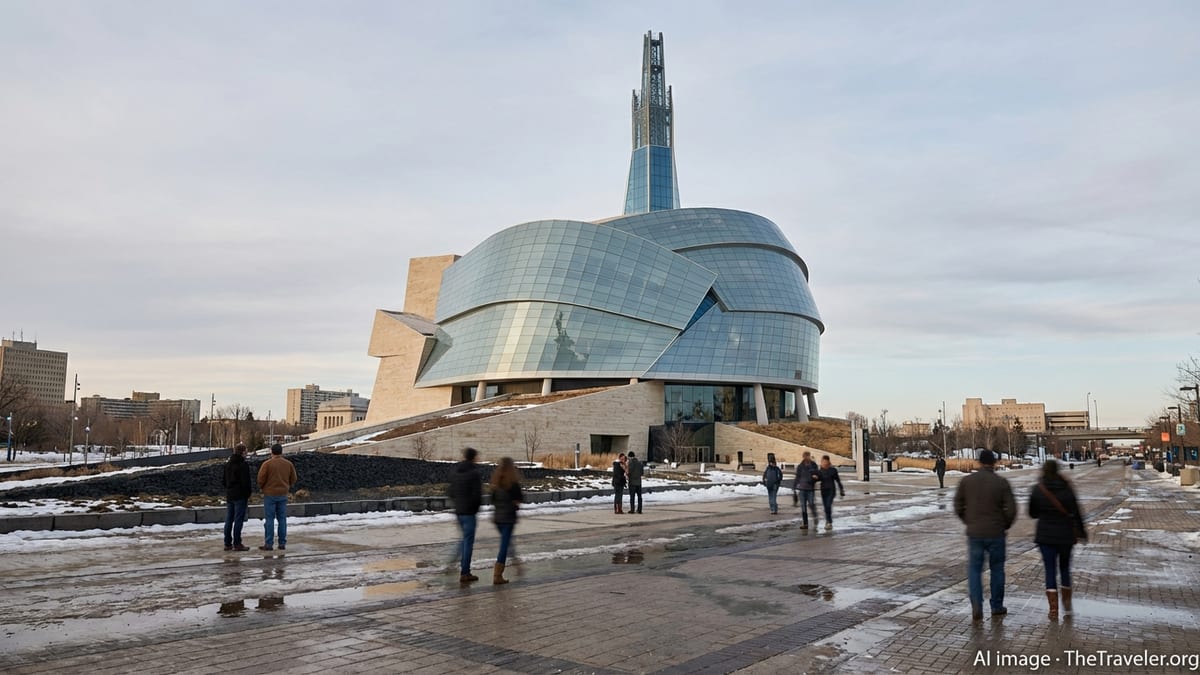
Arriving at The Forks: First Impressions of a Landmark
The museum stands just beyond the confluence of the Red and Assiniboine rivers, a site that has long been a meeting place for Indigenous peoples, traders and newcomers. Approaching on foot, I was struck by how deliberately the building rises from the landscape: a base of rough stone, a sweeping glass “cloud,” and finally the Israel Asper Tower of Hope piercing the sky. It feels rooted yet restless, as if the structure itself is straining upward toward something better.
Designed by architect Antoine Predock, the museum is often described as a stone mountain wrapped in light. Up close, the stone is textured and imperfect, holding fossils and subtle color variations that remind you it is hundreds of millions of years old. Above it, glass panels catch and diffuse the prairie sun, mirroring shifting clouds and weather, so the building’s mood changes throughout the day.
Stepping inside, the bustle of The Forks falls away. The ground floor opens into a spacious, dimmer hall with low, earthy tones. Visitor services, a restaurant and the gift shop are tucked to the side, but your eye is drawn forward and up, to the first glowing alabaster ramp that hints at the journey ahead. Even before you read a single text panel, the architecture begins telling a story of moving from shadow toward light.
Climbing the Alabaster Ramps: Architecture as Narrative
The most striking feature of the museum’s interior is a series of alabaster-clad ramps that link each level of galleries. Lit from within, these creamy stone pathways glow softly, creating warm bands of light that cut through the darker concrete and steel. Walking them feels almost ritualistic. The ramps twist and climb, never quite straight, suggesting that the struggle for human rights is not a direct path but a series of difficult ascents and turns.
Predock has described the building as a journey from the earth into light, and the ramps make that metaphor tangible. In lower levels, where the subject matter is often heavier, the ceilings are lower and the lighting more subdued. As you climb, the spaces open up, the air feels brighter, and glimpses of the outside world appear through slivers of glass. It is a carefully choreographed emotional arc that mirrors the stories being told in the galleries.
What stood out to me was how these ramps also create moments of pause. Between galleries, there are landings where visitors instinctively slow down, lean against the stone and process what they have just seen. Through small windows, you catch sight of Winnipeg’s skyline or the flat expanse of the prairie beyond, a reminder that the injustices on display are not remote abstractions but part of the same world waiting outside.
From a practical standpoint, the ramps also serve accessibility, offering gradual inclines, resting spaces and clear wayfinding. In a museum dedicated to human rights, this attention to how diverse bodies move through space feels especially significant. You sense that inclusion was considered not only in the content but in the very circulation of the building.
Indigenous Perspectives: Beginning the Story on This Land
One of the early galleries I stepped into was “Indigenous Perspectives,” a space that makes it clear the museum’s story begins on the land where it stands. The gallery is dominated by a circular theatre defined by tall wooden slats, some carved and others inlaid with designs that recall Métis beadwork and natural forms. The circular shape, combined with warm wood and low lighting, creates an enveloping feeling, more like being welcomed into a gathering place than entering a traditional exhibition hall.
In the theatre, a 360 degree film unfolds stories of First Nations, Inuit and Métis peoples across generations. Rather than presenting Indigenous communities only through the lens of victimization, the film emphasizes relationships, responsibilities and resilience. Elders, youth and knowledge keepers speak about rights as something embedded in reciprocal responsibilities to each other, to water, to animals and to the land itself.
Beyond the theatre, interpretive panels, artifacts and multimedia displays explore treaties, language suppression, the residential school system and ongoing struggles around land and resource rights. What struck me most is how contemporary these issues are. Timelines lead right up to current court decisions and community actions, underlining that the story of Indigenous rights in Canada is very much alive.
Spending time here early in the visit changed how I experienced the rest of the museum. Subsequent galleries on Canadian law, international declarations and social movements felt different when filtered through Indigenous worldviews that predate modern human rights frameworks by millennia. The gallery gently urges visitors to consider that any conversation about rights on this land must start with the original caretakers.
Canadian Journeys: A Tapestry of Everyday Courage
From Indigenous Perspectives, the path leads into “Canadian Journeys,” the museum’s largest gallery and, for me, one of the most affecting. The space opens wide, lined with portraits and story niches that hold dozens of individual case studies from across the country. Rather than a single sweeping narrative, you encounter a mosaic of struggles and advances in areas such as language rights, disability rights, LGBTQ+ equality, labour protections and immigration.
Some of the stories are well known, like that of Viola Desmond, who challenged racial segregation in a Nova Scotia cinema and later became the face on Canada’s ten dollar bill. Others are quieter accounts of people who confronted discrimination in workplaces, schools or small-town councils. In each niche, multimedia displays allow you to dig deeper, listening to audio testimony or exploring legal documents and personal photographs.
The gallery does not shy away from Canada’s failures. Panels address episodes such as the internment of Japanese Canadians during the Second World War, the Chinese head tax, the forced relocation of Inuit communities and the long struggle to recognize rights for people with disabilities. What impressed me was the balance between acknowledging harm and highlighting agency. Many displays show how affected communities organized, pursued legal challenges or built support networks, framing them not simply as victims but as rights holders and advocates.
Walking through “Canadian Journeys” felt like moving through an expanding understanding of who is included in “we.” The stories are geographically and culturally diverse, reminding visitors that human rights questions arise in big cities, remote communities and everywhere in between. It is difficult to leave this gallery without a deeper appreciation for how legal protections and social norms have been shaped, case by case, by ordinary people insisting on dignity.
Confronting Atrocities: Examining Genocide and Breaking the Silence
As the ramps continue to climb, the museum leads you into some of its most challenging spaces. A set of interconnected galleries examines the Holocaust and other genocides recognized by Canada, including atrocities in Ukraine, Armenia, Rwanda and the former Yugoslavia. The tone here is markedly somber. Lighting is lower, colors more muted, and displays are designed to slow you down.
In the Holocaust gallery, a “broken glass” theatre examines both European antisemitism and Canada’s own history of exclusionary policies. The shattered-glass motif evokes the destruction of lives and communities, but it also reflects the uncomfortable task of looking at one’s own country’s role. Nearby, interactive screens carefully unpack the mechanics of propaganda, dehumanization and bureaucratic violence, asking visitors to reflect on warning signs that can precede mass atrocities.
Another gallery, often framed as “Breaking the Silence,” focuses on the act of naming and recognizing atrocities. It explores how survivors, scholars and activists have fought to have genocides acknowledged in law, education and public memory. This section is heavy with testimony. You hear voices describing loss and survival in plain, measured tones that carry more impact than any theatrical staging could. The museum is careful not to overwhelm with graphic imagery, relying instead on words, documents and objects that hint at the enormity of what cannot fully be represented.
What stayed with me here was the emphasis on responsibility, not just remembrance. Panels pose questions about bystanders, international responses and the obligations of states today when early signs of mass violence appear. By situating these past horrors within a continuum of ongoing risks, the museum nudges visitors to see genocide prevention as an active, present-day concern, not a closed chapter of history.
Rights in Law and in Daily Life: From Declarations to Action
After confronting the darkest chapters of human history, the museum turns toward the mechanisms that seek to prevent their repetition. One gallery delves into the development of modern human rights law, with the Universal Declaration of Human Rights as a central anchor. Large, book-like digital displays invite you to flip through articles of the declaration, compare translations and see how those principles are reflected, or sometimes omitted, in national constitutions and charters.
In spaces focused on “Protecting Rights in Canada,” you encounter installations that bring legal language down to earth. One popular feature is a “living tree” projection that visualizes legal precedents branching and growing as courts interpret rights over time. Another interactive table allows visitors to explore landmark Canadian cases around issues such as freedom of expression, equality rights and indigenous land claims, showing how abstract principles become real through litigation and social pressure.
What stands out here is the museum’s insistence that law is necessary but not sufficient. Exhibits repeatedly highlight the role of social movements, community organizing and cultural work in pushing governments and institutions to live up to legal commitments. Archival footage of protests, campaign materials and oral histories from activists make it clear that rights are rarely handed down from above. They are claimed, argued and defended by people who decide “enough” and act together.
The galleries are careful to frame these struggles in accessible language. Complex topics like constitutional interpretation and international treaties are broken into short, digestible explanations illustrated with vivid case studies. It is an invitation to see human rights not as remote legal doctrine but as something that shapes and is shaped by daily life, from the classroom to the workplace to the ballot box.
The Garden of Contemplation and the Tower of Hope
At a certain point, the museum offers a pause in the form of the Garden of Contemplation. After dense galleries filled with text, testimony and interactive displays, you step into a space defined by still water, dark basalt boulders and filtered light. The pools are shallow and calm, reflecting fragments of stone and sky. Voices fall to whispers here, not because of any posted rule, but because the space naturally invites quiet.
This garden is more than a design flourish. It recognizes that engaging deeply with stories of injustice and resilience is emotionally demanding. The museum allows time to breathe, to sit on a bench, to watch ripples move across the water and to let the weight of the content settle. In my case, it was a moment when specific faces and phrases from earlier galleries resurfaced. The garden created a setting where those impressions could be held with care rather than rushed past.
From the garden, the ramps continue their ascent, leading ultimately to the Israel Asper Tower of Hope. Here, the building’s narrative arc reaches its literal and metaphorical summit. You enter a glass-walled space that opens to panoramic views of Winnipeg and the vast prairie beyond. After hours spent immersed in stories of confinement, oppression and courageous resistance, the sudden expanse of sky feels almost startling.
It would be easy to read this view as a simple symbol of optimism, but the museum’s journey makes it more nuanced. Standing in the tower, you see not only beauty but context: neighborhoods, rail lines, the rivers that carried trade and treaties, and the city that still wrestles with inequalities today. The message is not that the work is finished, but that, armed with a clearer understanding of the past and present, we can look outward and ask what comes next.
Inspiring Change: What I Carried Away
The museum’s upper galleries, often grouped under ideas like “Rights Today” and “Inspiring Change,” shift the focus firmly to the present and the future. Here, stories of contemporary human rights defenders, community organizers and everyday upstanders are front and center. Digital walls highlight campaigns around climate justice, gender equality, refugee protection and accessible education, among many others.
One installation that stayed with me profiled grassroots activists from different regions of the world, each describing the moment they realized they could not remain silent. Their causes varied, but their language shared an undercurrent of determination and humility. Few described themselves as heroes. Most framed their work as a response to a simple realization that “someone has to do something, so why not me.”
Visitors are repeatedly invited to see themselves as potential actors rather than passive observers. Interactive stations invite you to reflect on your own values, choose causes that resonate with you and identify concrete steps you might take, from supporting local organizations to challenging harmful comments in daily conversation. Some exhibits focus on small, practical actions: learning about consent, speaking up for accessible spaces, checking the sources of information before sharing it.
Leaving these galleries, I was aware that the museum had walked a careful line. It did not minimize the scale of global challenges or the persistence of injustice, but it also refused to end on despair. The final message is that human rights are fragile and often contested, yet they are strengthened every time someone chooses to act with empathy and courage, however modest that action may seem.
The Takeaway
What stood out most in my visit to the Canadian Museum for Human Rights was the seamless integration of architecture, storytelling and reflection. From the glowing alabaster ramps to the circular Indigenous theatre, from the difficult genocide galleries to the quiet pools of the Garden of Contemplation, every design choice seems oriented toward an emotional and intellectual journey rather than a simple transfer of information.
Equally powerful is the museum’s refusal to let visitors remain detached. By centering personal stories, survivor voices and everyday Canadian experiences alongside global events, it insists that human rights are neither abstract nor distant. They are intertwined with the choices made in legislatures, classrooms, workplaces and homes, including our own.
As I left the Tower of Hope and stepped back into Winnipeg’s wind, the visit felt unfinished in the best possible way. The museum does not offer closure; it offers questions, tools and a renewed sense of connection to others. Its greatest achievement may be that the real visit begins after you walk out the door, carrying its stories into the wider world.
FAQ
Q1. Where is the Canadian Museum for Human Rights located?
The museum is in downtown Winnipeg, Manitoba, near The Forks, where the Red and Assiniboine rivers meet.
Q2. How much time should I plan for a visit?
Most visitors find that three to four hours allows enough time to explore the major galleries, reflect in the Garden of Contemplation and visit the Tower of Hope.
Q3. Is the museum suitable for children?
The museum welcomes families and offers kid-friendly resources, but some galleries dealing with genocide and mass violence may be intense for younger visitors.
Q4. Does the museum focus only on Canadian stories?
No. While many exhibits highlight Canadian experiences, the museum also covers global human rights issues, international law and stories from around the world.
Q5. How accessible is the museum for visitors with mobility challenges?
The museum was designed with accessibility in mind, featuring ramps, elevators, seating areas and barrier-conscious layouts throughout the visitor route.
Q6. Are guided tours available?
The museum typically offers guided tours and educational programs, and it has also developed virtual and audio tours to help visitors explore the galleries.
Q7. Can I visit the Israel Asper Tower of Hope separately from the exhibits?
Access to the Tower of Hope is usually included with museum admission, and visitors reach it after moving through the galleries via ramps and elevators.
Q8. Are there quiet spaces for reflection if I feel overwhelmed?
Yes. The Garden of Contemplation and several seating areas throughout the museum offer quieter environments for rest and reflection.
Q9. Does the museum change its exhibits?
The core galleries are permanent, but the museum regularly presents temporary exhibitions and special programming on current human rights themes.
Q10. Is photography allowed inside the museum?
Photography is generally permitted in many public areas, though certain exhibits or artifacts may have restrictions, so visitors should follow posted guidelines and staff advice.