

More news on this day
As fuel prices in Myanmar surge to some of their highest levels in years and sporadic shortages ripple across major cities and regional hubs, a quiet shift is underway in how people move around the country. Domestic and foreign travellers who once relied on cheap buses, budget flights and private cars are increasingly turning to the country’s underused rail network, drawn by lower, more predictable fares and the simple fact that trains continue to run even when petrol pumps run dry.
Get the latest news straight to your inbox!
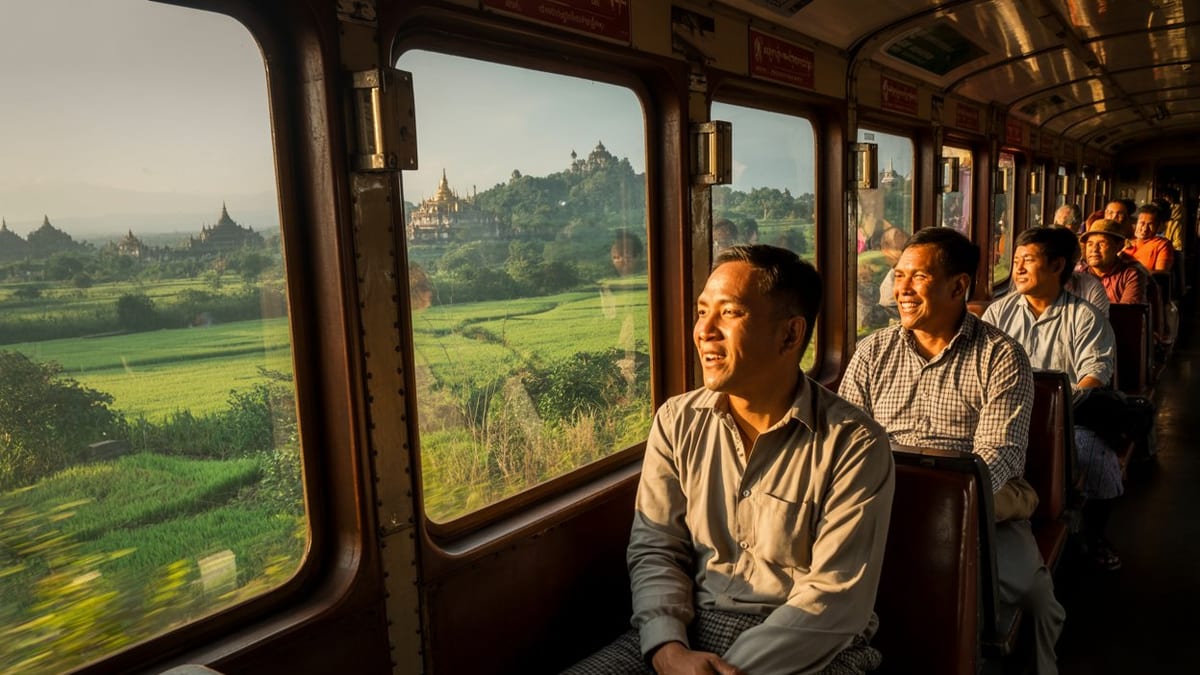
Image by Latest International Railway News, Global Rail Industry News
Fuel Prices Spike, Squeezing Road and Air Travel
Publicly available information shows that fuel prices in Myanmar have climbed dramatically since 2021, driven by currency depreciation, import constraints and conflict-related disruptions. In some townships in late 2024, motorists reported petrol retailing at more than 3,000 kyat per litre, with independent outlets and local media describing queues outside stations and intermittent closures as supplies thinned. In more remote conflict-affected areas, reports indicated motorists paying several times urban pump rates during acute shortages.
By November 2024, coverage from regional outlets described panic buying and rationing in townships such as Kalay, while local media in Kachin State documented petrol selling for around 9,500 to 10,000 kyat per litre at the height of a shortage. Similar spikes were reported in Karenni and border areas, where blockades and security checks pushed prices well above 10,000 kyat per litre. For transport operators dependent on diesel and petrol, these swings have significantly raised operating costs.
These price shocks have filtered directly into the cost of moving people. Intercity bus companies and private car services, which form the backbone of domestic tourism, have had little choice but to pass higher fuel costs on to passengers or cut services on marginal routes. At the same time, domestic airlines have grappled with volatile jet fuel costs and currency controls, leading to schedule cuts, temporary route suspensions and tighter baggage policies that have made flying less predictable and less attractive for price-sensitive travellers.
Combined, these pressures are eroding the long-standing assumption that buses and budget flights are the default way to see Myanmar’s major destinations. With travellers reporting last-minute bus cancellations and fluctuating fares, the comparative stability of rail pricing has started to look more appealing, even when trains take longer.
Flat Rail Fares Stand Out Against Volatile Fuel Costs
Myanmar’s rail network has long been seen as slow and outdated, but it has one distinct advantage in the current fuel environment: ticket prices that are set centrally and adjusted far less frequently than retail fuel. Myanmar Railways’ official fare tables for foreigners, updated on its own channels, list upper-class tickets on flagship routes such as Yangon to Mandalay in the low tens of thousands of kyat, even for overnight journeys spanning hundreds of kilometres.
On newly introduced diesel multiple unit services, including upgraded routes linking Yangon, Nay Pyi Taw and Mandalay, published fares for air-conditioned first and upper classes also remain relatively modest in kyat terms when compared with the cost of a similar distance by domestic flight or a chartered car once fuel and driver fees are factored in. Travellers evaluating transport options report that, in many cases, a rail ticket undercuts both a discounted flight and a seat on a premium express bus, particularly when last-minute surcharges linked to fuel spikes are considered.
Crucially, rail fares have been more predictable. While roadside fuel prices in some regions have swung from around 3,000 kyat to well over 10,000 kyat per litre within months, rail prices published for major routes have changed relatively slowly. For independent travellers trying to build itineraries around fixed budgets, that price stability has become a key part of the calculation.
Budget-conscious visitors, including backpackers returning to Myanmar as regional travel resumes, have noticed the gap. With cash access, currency volatility and safety all weighing on planning, the ability to book a sleeper berth at a fixed price days in advance has started to outweigh the perceived inconvenience of older rolling stock and slower schedules.
Fuel Shortages Expose Vulnerabilities in Road and Air Networks
The recent fuel crunch has not only made travel more expensive; it has highlighted structural vulnerabilities in Myanmar’s reliance on road transport. Local labour and transport news sites have chronicled the strain on taxi drivers and bus operators, who often purchase petrol at market rates well above official reference prices when supplies tighten. In some cases, drivers have simply parked their vehicles, reducing the availability of shared taxis and minivans that connect airports, bus terminals and tourist towns.
Accounts shared on travel forums in early 2026 describe travellers in Mandalay and other cities struggling to secure last-minute bus seats when operators reduced frequencies because of fuel uncertainty. Others reported that itineraries built around domestic flights required reworking when airlines altered schedules or temporarily cut baggage allowances to offset higher operating costs linked to fuel.
Myanmar’s airlines, which operate in a challenging regulatory and economic environment, are particularly exposed when global oil price shocks coincide with local currency weakness. Recent disputes over baggage policies and fare conditions highlight how quickly cost pressures can spill over into the passenger experience. For visitors hoping to link Yangon, Bagan, Mandalay and beach destinations within a short holiday window, this volatility acts as a deterrent.
By contrast, while Myanmar’s railways are not immune to fuel supply issues, the network has continued to run core passenger services during recent spikes. Reports of train cancellations have been less frequent than bus disruptions, and rail operators have promoted new or refurbished services as a reliable option between key cities. In practice, this has underscored a perception that trains are a safer bet for crossing long distances when the road network is strained by fuel scarcity.
Old Tracks, New Appeal for Cost Conscious Travellers
For years, guides and blogs portrayed Myanmar’s trains as an experience for enthusiasts rather than a practical transport choice. Swaying carriages, slow average speeds and rudimentary facilities discouraged many short-stay visitors from booking rail tickets except on scenic segments such as the Goteik Viaduct. Rising fuel prices are subtly changing that equation, rebranding trains as the budget backbone of domestic travel rather than just a novelty.
The rollout of modern diesel multiple units on selected corridors has helped. Travellers on the upgraded Yangon to Nay Pyi Taw and Mandalay routes report cleaner, air-conditioned coaches and more reliable timetables compared with older locomotives. While not matching the standards of high-speed rail in neighbouring countries, these services represent a tangible improvement at a time when other parts of the transport system are under strain.
At the same time, the very slowness once seen as a drawback is attracting a different kind of visitor. With overland routes by bus subject to change at short notice and fuel-related checkpoints adding time and uncertainty, an overnight train offers a predictable, if lengthy, journey that doubles as accommodation. For budget travellers trying to stretch cash in a high-inflation environment, combining transport and lodging into one fare is a practical advantage.
Domestic travellers are making similar calculations. Anecdotal accounts from residents describe shifting from intercity buses back to trains on regular work and family routes when bus tickets climbed faster than salaries. While car ownership remains aspirational for many households, the cost of filling a tank during a price surge has pushed more people toward public rail services whenever schedules align with their needs.
A Hidden Trend With Big Implications for Myanmar Tourism
This gradual shift toward rail travel remains largely under the radar, overshadowed by wider concerns about security, politics and economic hardship. Yet it carries important implications for how any revival in Myanmar’s tourism sector might unfold in the coming years. If fuel prices remain elevated and volatile, the traditional model built on fleets of tourist coaches and multiple short domestic flights may give way to itineraries that follow the tracks instead of the highways.
Travel planners monitoring conditions in Myanmar are already adjusting sample routes, suggesting night trains between Yangon, Nay Pyi Taw and Mandalay as a hedge against bus cancellations, and highlighting circular commuter lines in Yangon and Mandalay as low-cost ways to experience daily life when taxi fares spike. For visitors determined to travel responsibly and on a budget, rail is starting to look less like a compromise and more like a feature.
For Myanmar Railways, the trend presents both an opportunity and a test. Increased demand from domestic and international travellers could bolster revenue and justify further investment in rolling stock and track upgrades. However, higher passenger volumes will also magnify long-standing issues around maintenance, punctuality and onboard comfort. If the network fails to keep pace, the newfound confidence in trains could prove fragile.
For now, as fuel costs climb and road and air networks adjust, Myanmar’s railways are quietly gaining ground. The country’s travellers are rediscovering a mode of transport that predates the modern fuel economy, and in the process reshaping how journeys across one of Southeast Asia’s most complex landscapes are planned and experienced.