

More news on this day
Travelers passing through Nashville International Airport on March 14 are facing significant disruption, with reports indicating 111 delayed flights and 11 cancellations affecting major domestic routes on Delta Air Lines, Southwest Airlines, and American Airlines.
Get the latest news straight to your inbox!
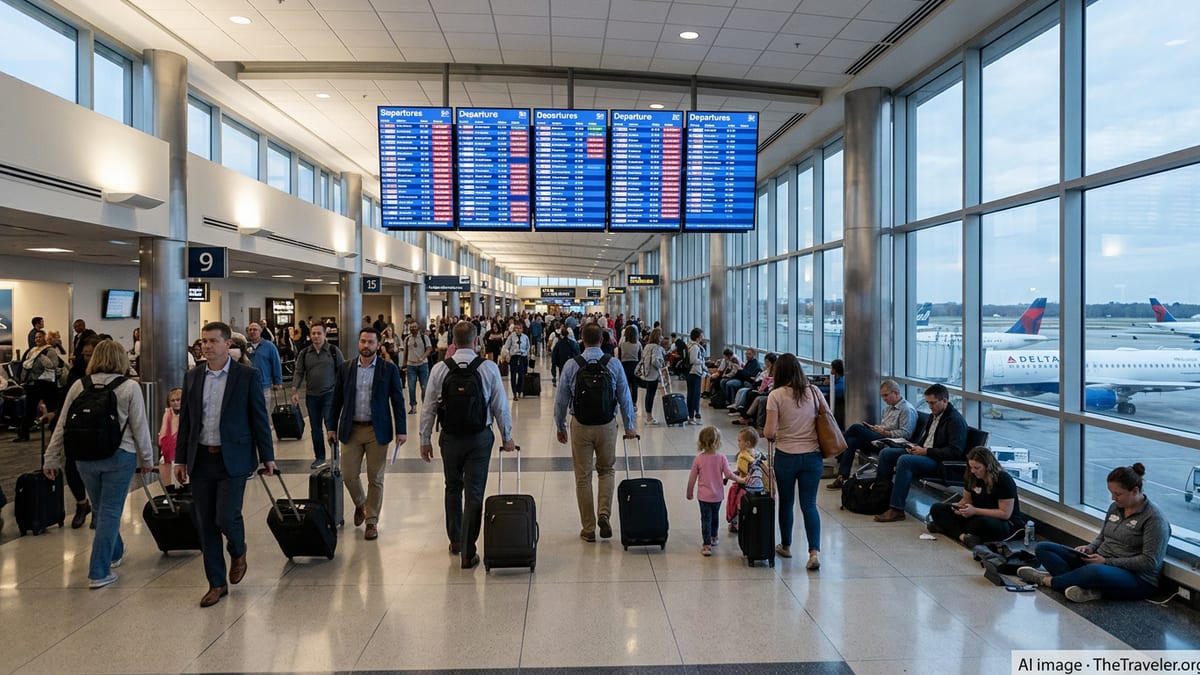
Operations at Nashville International Airport Under Strain
Publicly available flight-tracking dashboards for Saturday show a sharp spike in schedule changes at Nashville International Airport, with more than one hundred departures and arrivals running behind schedule. The disruption is concentrated in the domestic network, where Nashville serves as a key connection point between the Southeast, Midwest, and Northeast.
The cluster of 111 delays and 11 cancellations represents a notable operational challenge for an airport of Nashville’s size on a single day. While some irregular operations are common at busy hubs, the breadth of today’s impact has created rolling knock-on effects throughout the morning and afternoon travel peaks.
Departures and arrivals serving some of the country’s busiest corridors, including flights to and from Atlanta, Chicago, and New York, appear among the affected services. These routes typically carry a mix of business travelers, leisure passengers, and connecting traffic, magnifying the ripple effect when schedules slip.
Industry data and recent coverage of airline performance suggest that a mix of factors often contributes to such a spike in disruptions, including weather along flight paths, tight aircraft turnarounds, and air traffic control flow programs in various regions of the country.
Major U.S. Carriers See Network Ripple Effects
Delta Air Lines, Southwest Airlines, and American Airlines are among the carriers most visibly affected at Nashville today, according to real-time flight status boards and tracking services. All three airlines maintain significant schedules at the airport, linking Nashville with their primary hubs and key business markets.
Flights to and from Atlanta, a cornerstone Delta hub, are showing prolonged delays, with late-arriving aircraft pushing back subsequent departures. Similar patterns are visible on Chicago routes, where both American and Southwest connect Nashville to major Midwestern hubs, and on New York services that feed high-demand markets such as LaGuardia and other New York–area airports.
When delays accumulate on hub-to-spoke flights, aircraft and crew availability can quickly become constrained. Operational analysis published in recent weeks on airline performance explains that a late inbound aircraft in one city can cascade into a series of later departures and, in some cases, same-day cancellations elsewhere in the network as airlines work to reset their schedules and stay within crew duty-time limits.
Today’s disruptions in Nashville therefore extend beyond Tennessee, touching travelers who may never set foot in the airport but are relying on aircraft and crews routed through BNA as part of multi-leg itineraries across the United States.
Weather, Airspace Management, and Staffing Pressures
While immediate, localized weather over Nashville has not always been the sole driver of past disruptions, reports covering recent air traffic events highlight how conditions along flight paths, storms at key hubs, and broader airspace management decisions can all contribute to delays at a downline airport such as BNA. Reroutes to avoid convective weather, holding patterns near congested hubs, and ground delay programs can each slow the flow of arrivals and departures.
In recent months, publicly available commentary from aviation observers has also drawn attention to staffing challenges in portions of the national air traffic control system, including at or near Nashville. When fewer controllers are available, federal traffic managers may impose spacing requirements, speed reductions, or ground delays that lengthen the time it takes to move flights into and out of affected airspace.
Operational analyses published by industry experts further note that even on days of relatively calm weather, airlines can see mounting delays when tight turn times, maintenance checks, and crew scheduling intersect. A brief hold for a safety inspection or a shift in crew duty schedules can propagate through the day, particularly at airports where rapid turnarounds are used to maximize aircraft utilization.
Today’s elevated disruption numbers at Nashville appear consistent with this broader pattern, where multiple operational stresses converge to create a cumulative impact, rather than a single, easily identifiable cause.
Impacts on Travelers and What Passengers Can Expect
The immediate effect of the 111 delays and 11 cancellations is visible in crowded gate areas, longer lines at customer service counters, and passengers reworking connections across the domestic network. Travelers with tight layovers in cities such as Atlanta, Chicago, and New York are particularly vulnerable to missed connections when their Nashville departure slips, even by a relatively short interval.
Recent consumer travel guidance emphasizes that passengers facing irregular operations should rely first on airline apps and official flight-status tools, which typically update more quickly than third-party platforms. Same-day rebooking options, standby lists, and, in some cases, hotel or meal arrangements may be managed digitally, reducing the need to queue at service desks during peak disruption periods.
Published advice from airline and travel analysts also encourages passengers to monitor conditions not only at their origin and destination, but also at hub airports through which their aircraft and crew may be routed earlier in the day. When storms or traffic management initiatives are in effect at a carrier’s major hub, downstream cities such as Nashville can experience delayed inbound aircraft and compressed departure banks hours later.
On a day with widespread schedule changes, travelers departing Nashville are likely to encounter changed boarding times, aircraft swaps, and revised gate assignments. Allowing additional time at the airport, packing essential medications and personal items in carry-on bags, and keeping contact details updated in airline profiles can help reduce some of the stress associated with last-minute disruption.
Looking Ahead for Nashville’s Busy Spring Travel Period
The current wave of delays and cancellations at Nashville International Airport arrives as airlines prepare for a busy spring travel period, when leisure demand typically rises and schedules grow denser across U.S. domestic routes. Nashville’s role as both a growing leisure destination and a key connecting point means that operational reliability at BNA will be closely watched by travelers and industry observers alike.
Recent federal air travel consumer reports and airline punctuality rankings show that carriers have been working to improve on-time performance after several years of heightened disruption. However, they also underscore that weather volatility, air traffic control staffing, and infrastructure constraints remain persistent challenges for large segments of the U.S. aviation system.
The situation in Nashville today serves as a reminder of how quickly conditions can shift at a single airport and how those changes can reverberate through the wider network of flights linking major American cities. For passengers planning upcoming trips through BNA, monitoring flight status early and often, avoiding ultra-tight connections where possible, and building contingency time into itineraries may offer the best protection against similar episodes of disruption.