

More news on this day
Intensifying wet seasons and increasingly volatile storms are raising the risk of flight disruptions for college teams and fans, and recent NCAA travel guidance highlights how fragile championship logistics have become when air travel meets extreme weather.
Get the latest news straight to your inbox!
Weather Turbulence Converges With Peak College Sports Travel
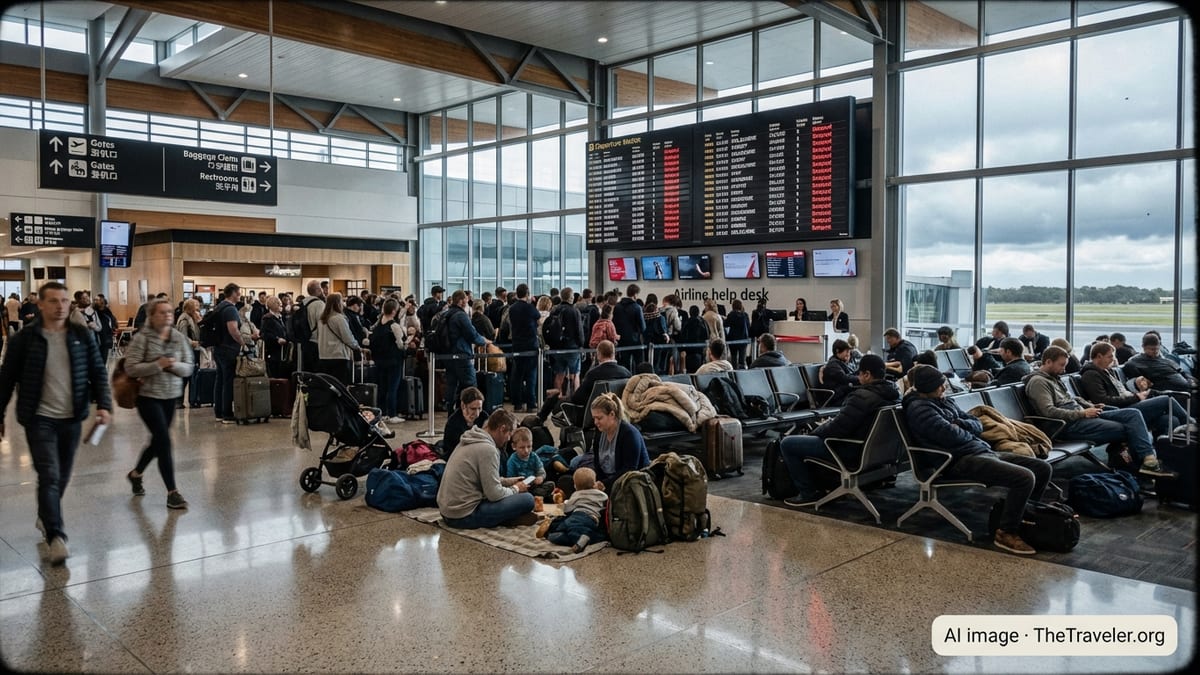
Recent tournament periods have coincided with major weather systems that strained the U.S. aviation network just as college teams and supporters took to the skies. In mid March 2026, powerful storms sweeping the Midwest and East triggered thousands of flight delays and cancellations across the country, according to national broadcast and wire-service coverage, at the same time that arenas were filling for the NCAA men’s and women’s basketball tournaments. Crowded terminals, long security lines and rolling schedule changes left many travelers trying to rebook at short notice or racing to make tipoff.
Data compiled by aviation trackers and summarized in industry and travel reports for early April 2026 also show repeated spikes in delays tied to storm clusters over major hubs such as Dallas Fort Worth, Chicago O’Hare and Atlanta. These are airports that regularly host charters and commercial connections for college programs moving between regions for postseason play. When thunderstorms, low clouds or heavy rain reduce arrival rates, those hubs quickly become choke points that can derail carefully staged tournament itineraries.
The NCAA’s expanding national footprint for marquee sports has amplified those risks. Conference realignment has stretched leagues across four time zones, sending teams on longer routes that often require connections through weather prone hubs. Publicly available reporting on travel patterns in leagues such as the Big Ten and Atlantic Coast Conference shows programs now logging tens of thousands of air miles in a single regular season, multiplying the number of flights that can be affected when wet-season storms flare.
Travel coverage indicates that the impact is not limited to basketball. Baseball, softball, soccer and other sports that rely on spring travel windows must navigate the same unsettled patterns, with regional tournaments staged during months when convective storms, early tropical systems and lingering winter fronts can each disrupt aviation.
NCAA Guidance Puts New Emphasis on Weather and Flight Reliability
In response to a more unstable climate and repeated travel disruptions, the NCAA has been refining its public guidance around inclement and hazardous weather. A standing statement from its Committee on Competitive Safeguards and Medical Aspects of Sports outlines how severe conditions can affect athletics operations, from training and competition to travel logistics. The document highlights winter storms, heavy rain and other hazards as factors that require contingency planning by member schools.
More recent championship materials underscore how weather has become a central variable in flight planning. A February 2025 travel memorandum for the Division I women’s basketball championship, posted on official NCAA channels, explicitly notes that weather and airline operational constraints have narrowed preferred departure windows and made it harder to accommodate every team’s ideal schedule. The memo explains that flight availability is influenced by factors such as staffing, supply and demand and conditions at connecting airports, signaling to schools that flexibility is now part of tournament travel.
Venue safety and security best-practice documents updated for the 2024–25 season further frame weather as a core risk category alongside security and crowd management. The materials reference winter conditions and environmental factors such as air quality, urging venues and host institutions to coordinate with transportation partners and maintain robust emergency and delay protocols. The emphasis reflects recognition that a single storm can ripple through aviation networks, altering tipoff times and even forcing relocations.
While the NCAA does not operate aircraft, its published guidance places responsibility on schools and local organizers to monitor forecasts, understand airline constraints and build backup options into their travel plans. This can include earlier departures, use of alternate airports, or booking patterns that avoid late-night arrivals vulnerable to cascading delays.
Stormier Winters and Wetter Springs Push Aviation to the Edge
Climate research and recent weather seasons point to trends that are shaping the backdrop for NCAA travel. Federal climate assessments and academic studies, widely cited in national media, document an increase in the intensity of heavy rainfall events across large parts of the United States. At the same time, winter systems have delivered disruptive snow and ice far beyond traditional snow belts, from the Deep South to mid Atlantic cities, with several of the 2024–25 and 2025–26 storms responsible for thousands of U.S. flight cancellations in single multi day episodes.
Specific storms have illustrated how quickly conditions can overwhelm aviation during busy sports periods. Reporting on a January 2025 winter storm that pushed into Texas, Oklahoma and the Southeast described hundreds of flight cancellations and delays at Atlanta’s main airport, one of the primary hubs for college teams connecting to tournaments and road games. Separate summaries of the 2024–25 and 2025–26 winter seasons show repeated instances where major snow and mixed precipitation events produced some of the highest daily delay totals since the previous summer’s thunderstorm disruptions.
Summer and early autumn have also become more problematic for flight reliability. The Federal Aviation Administration’s operational forecasts, covered by travel outlets in 2025, warned of recurring thunderstorms across the Southeast, Midwest and Rockies that forced departure and arrival rate reductions at airports such as Atlanta, Charlotte, Chicago, Denver and Houston. These same hubs support charter and commercial traffic for college football, soccer and volleyball programs that increasingly travel long distances within enlarged conferences.
Separate from storms, extreme heat and air quality events are emerging as additional stressors during late summer preseason and early fall competition windows. Meteorological analyses published in 2024 highlighted that school districts and athletic departments are turning to new metrics such as wet bulb globe temperature to make safety decisions. When temperatures or smoke levels push conditions into unsafe ranges, travel and practice schedules can shift rapidly, sometimes in conflict with already constrained flight options.
Teams, Fans and Airlines Adjust Game Plans
Public reporting on recent college seasons indicates that teams and their travel partners are experimenting with new strategies to cope with wetter and more unpredictable seasons. Some programs have shifted to earlier outbound flights for key games, trading an extra night on the road for a larger buffer against thunderstorms or surprise winter systems. Others are building in additional connection options or tapping secondary airports to reduce the risk of being stranded by a single hub shutdown.
Examples in local and national sports coverage describe teams that have routed around severe weather by flying into alternate cities and then completing trips by bus, or by splitting travel parties across different flights to ensure that at least a core roster arrives in time to compete. Coaches and players have also described longer travel days and reduced recovery time when delays compress postgame returns and preparation for the next opponent.
Fans following their schools to championships and bowl games face similar challenges. Consumer travel reports for the 2026 spring break and March tournament window describe crowded concourses, tight seating inventories and limited options when severe weather or staffing problems result in mass cancellations. Advisories from airlines and travel agencies increasingly encourage flexible booking, travel insurance and early departures, particularly for high demand events where missing a single game can mean losing the point of the trip.
Aviation industry disclosures and airport climate adaptation plans suggest that operators are investing in drainage upgrades, deicing capacity and runway improvements to manage heavier rainfall and more frequent freeze-thaw cycles. Yet these projects take time, and during peak college sports periods the system often has little slack. Even modest storms can trigger a cascade of delays when schedules are full and spare aircraft and crews are tightly allocated.
Pressure Builds for Longer-Term Climate and Scheduling Solutions
The rising collision between wet-season volatility and NCAA travel is fueling broader debates about how college sports should adapt. Commentaries in national newspapers and business outlets have questioned whether realignment-fueled cross-country schedules are sustainable in a climate where long-haul flights face growing disruption risks and contribute additional emissions that in turn shape future weather extremes.
Some universities and conferences have begun to discuss regional scheduling pods, more neutral-site events within driving distance and greater use of ground transportation for shorter trips as ways to cut both emissions and exposure to flight delays. Others are exploring sustainability initiatives such as emissions measurement for team travel, voluntary offsets and coordination with airlines that are testing lower-carbon fuels, according to public climate and athletics reporting.
For now, publicly available NCAA guidance centers on practical risk management: earlier bookings, clearer communication with travel partners and detailed contingency plans for everything from delayed arrivals to venue changes. As storms grow wetter and more erratic across multiple seasons, those plans are likely to become as integral to a championship run as practice schedules and game film, shaping how teams, fans and the wider college sports ecosystem navigate an aviation system under increasing climate pressure.