

More news on this day
Fresh Iranian drone and missile strikes near major Gulf aviation and energy hubs on Wednesday have rattled a fragile restart of limited flights in the United Arab Emirates, Qatar, Bahrain and Saudi Arabia, with new incidents reported around Dubai International Airport, Doha, Manama, Ruwais, Shaybah and Tehran as the regional conflict escalates.
Get the latest news straight to your inbox!
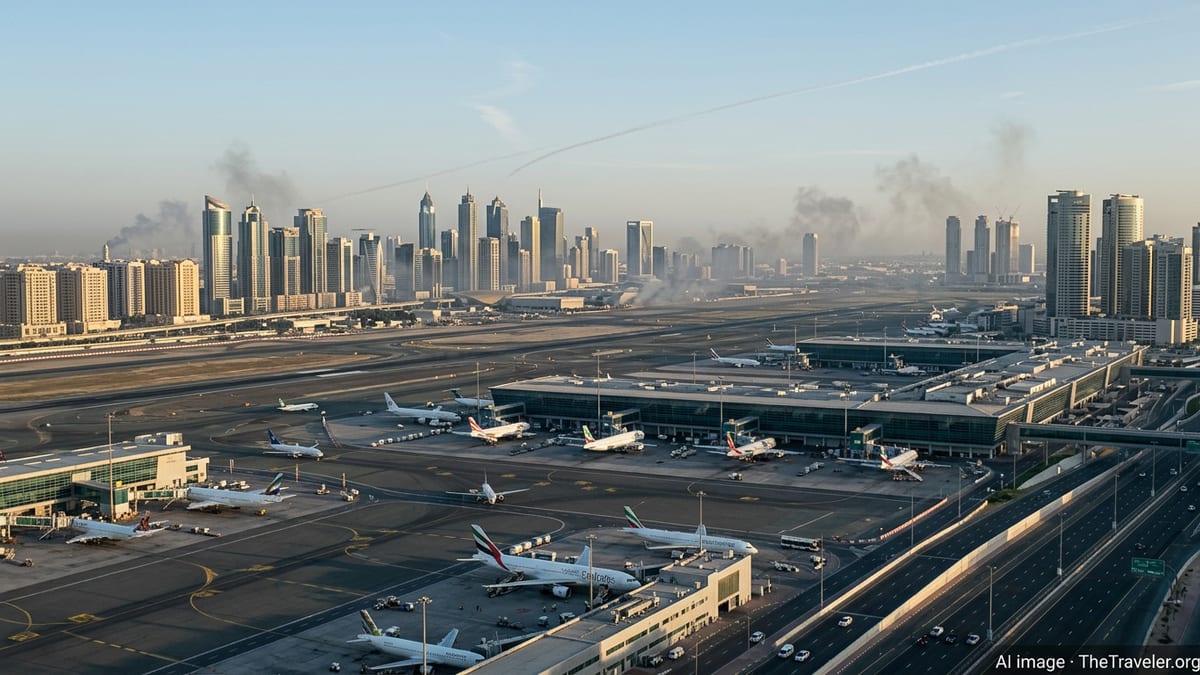
New Wave of Strikes Near Gulf Gateways
Regional officials and local media reported that two Iranian drones fell in the vicinity of Dubai International Airport on Wednesday morning, the latest in a series of attacks that have repeatedly disrupted operations at the world’s busiest hub for international travel. Authorities in Dubai said the incident caused minor damage and renewed brief suspensions of movements on already skeletal schedules as air defenses responded to further threats overhead.
In Doha, residents reported loud booms and smoke trails in the sky as Qatar’s military said it had intercepted a fresh missile barrage aimed at the capital. Explosions were heard across several districts, though the government stressed that the incoming projectiles were destroyed in flight and that critical infrastructure, including Hamad International Airport, remained operational under heightened security conditions.
Across the Gulf in Bahrain, emergency services were again deployed around Manama and nearby industrial areas following additional Iranian attacks. Recent days have seen drones and missiles strike residential neighborhoods and energy facilities in and around the capital, leaving dozens injured and reinforcing the perception that no Gulf city hosting Western military assets is fully insulated from the widening confrontation.
The renewed bombardment comes as Tehran continues to absorb heavy US and Israeli strikes on its own territory, including in and around the capital. Iranian state media and regional outlets reported new explosions in Tehran overnight, even as Iran’s Revolutionary Guards pressed ahead with cross-border launches targeting what they describe as hostile military and economic sites across the region.
Fragile Resumption of Limited Flights Undermined
The latest attacks landed just days after Gulf authorities cautiously reopened portions of their airspace following near-total shutdowns that began when the conflict erupted on 28 February. Aviation regulators in Qatar, the UAE, Bahrain and Saudi Arabia had allowed only tightly controlled, limited-capacity flights, often focused on repatriating stranded travelers and maintaining critical links to key global hubs.
Qatar’s civil aviation officials recently announced that flights would operate along designated contingency corridors under military protection, with Qatar Airways resuming a reduced schedule from Doha to select destinations in Europe and Asia. Those operations continued on Wednesday but under renewed strain as air defense activity around the capital prompted further in-flight diversions and delays.
In the UAE, where Emirates and Etihad had been slowly rebuilding essential routes from Dubai and Abu Dhabi, the fresh drone incident near Dubai International added new uncertainty. Airlines have been operating on sharply curtailed timetables, often announcing updates only 24 to 48 hours in advance as they react to evolving security assessments and the shifting pattern of strikes.
Saudi Arabia and Bahrain have followed similar paths, reopening specific corridors and airports while keeping large portions of their airspace restricted. Industry analysts say the combination of rolling closures, intermittent alarms and sudden interceptions has turned flight planning across the Gulf into a day-by-day exercise, complicating the return of transit passengers and tourists who typically pass through the region’s mega-hubs in huge numbers.
Oil and Industrial Targets in Ruwais and Shaybah
Alongside aviation infrastructure, Iranian drones and missiles have continued to seek out critical energy and industrial sites. In Abu Dhabi’s Al Ruwais Industrial City, one of the UAE’s most important oil and petrochemical complexes, authorities confirmed a fire at a facility after a drone strike earlier in the campaign. On Wednesday, security was further tightened across the complex as fresh intercepts were reported above the wider region and operators remained on high alert for additional attacks.
In Saudi Arabia, the kingdom’s Defence Ministry said its air defense systems recently intercepted several drones heading toward the Shaybah oil field in the vast Rub al Khali desert near the UAE border. Shaybah, a major production center for Saudi Aramco, has already been the target of multiple Iranian strikes since the conflict began, underscoring the vulnerability of remote but strategically vital infrastructure.
The repeated targeting of Ruwais and Shaybah has amplified concerns in global energy markets already rattled by missile and drone activity near shipping lanes in the Strait of Hormuz. Traders and analysts warn that even limited physical damage, when combined with persistent security alerts and higher insurance premiums, could constrain export flows and inject fresh volatility into oil prices.
For Gulf governments, protecting energy installations and export routes has become as urgent as safeguarding airports. Officials in Abu Dhabi, Riyadh and Doha have all emphasized that their air and missile defense networks, bolstered by US and European support, are intercepting the majority of incoming threats. Yet images of fires at refineries and industrial plants have highlighted how even isolated strikes can reverberate through economies heavily reliant on hydrocarbon revenues.
Tourists and Residents Navigate Sirens, Shelters and Delays
For travelers and local residents, the renewed wave of attacks has turned daily life in some of the region’s most-visited cities into a succession of alerts, diversions and improvised safety routines. In Dubai, overnight patrols by fighter jets and repeated air-raid messages sent to mobile phones have become familiar, even as malls, hotels and beachfront districts attempt to maintain a semblance of normality under the threat of further strikes.
In Doha and Manama, foreign visitors have described being woken by sirens and instructed by hotel staff to move away from windows or into internal corridors while interceptions take place overhead. Travel advisories from European and Asian governments have urged citizens to reconsider nonessential journeys to the Gulf, to monitor official channels for sudden airport closures and to keep flexible onward plans in case of prolonged disruptions.
Airlines serving the region have responded by waiving many change fees, expanding rebooking options and, in some cases, chartering additional flights when short-lived lulls in attacks allow. However, the highly dynamic situation has left many passengers facing extended layovers, last-minute cancellations or unexpected overnights, particularly in secondary Gulf cities whose airports can be quickly closed by a single nearby intercept.
Travel risk consultancies report surging demand from corporate clients seeking real-time assessments of threats to staff and operations across the UAE, Qatar, Bahrain and Saudi Arabia. Analysts say that while major carriers and luxury hotels have robust contingency plans, independent travelers and smaller businesses may find it difficult to navigate the patchwork of restrictions and advisories now governing movements across the Gulf.
Tehran Under Fire as Diplomatic Pressure Mounts
The latest barrages around Dubai, Doha, Manama, Ruwais and Shaybah are unfolding against a backdrop of intense bombardment inside Iran itself. In recent days, US and Israeli forces have struck targets across the country, including air bases, missile sites and critical infrastructure around Tehran, in an attempt to degrade Iran’s capacity to sustain long-range attacks on neighboring states.
Iranian officials insist that the cross-border strikes on Gulf countries are a legitimate response to what they describe as aggression on their territory. They have dismissed growing calls from the United Nations and the Gulf Cooperation Council for an immediate halt to attacks on civilian and economic targets, arguing that Washington and its allies bear ultimate responsibility for the conflict.
Diplomatic efforts to de-escalate have so far made little visible progress. The UN Security Council is preparing to vote on a resolution urging an end to Iranian strikes on its neighbors, but negotiators acknowledge that any text acceptable to all permanent members will likely be watered down. Gulf capitals, meanwhile, are pressing both Western governments and Iran to agree at least to time-limited pauses that could allow broader evacuation flights and more predictable airspace corridors.
For now, however, the operational reality on the ground and in the skies remains one of rolling risk. With Iran signaling no intention of scaling back its campaign and Gulf states determined to keep at least minimal passenger and cargo traffic flowing, travelers transiting key hubs like Dubai, Doha and Manama are likely to face further days of uncertainty, sirens and rapidly changing schedules.