

More news on this day
A proposed cross-border railway linking Panama City with Costa Rica’s southern border region is emerging as one of Central America’s most closely watched transport projects, promising to reshape how travelers and cargo move across the isthmus.
Get the latest news straight to your inbox!
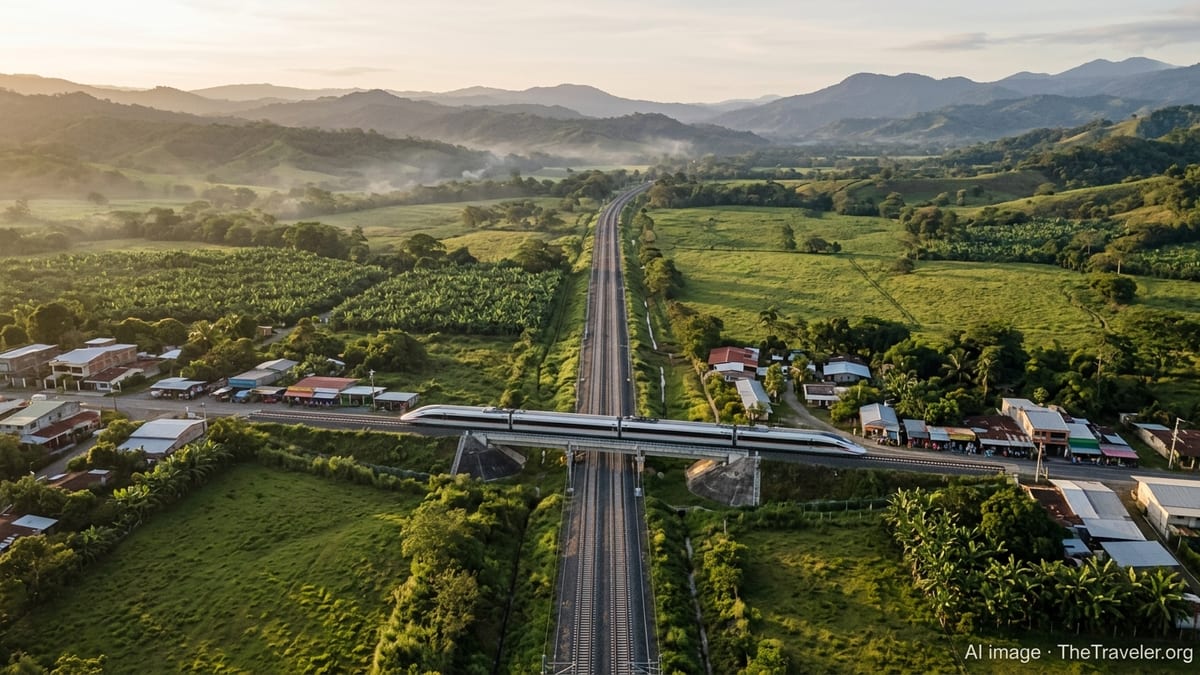
Ambitious Cross-Border Vision Gains Momentum
Publicly available project documentation shows that Panama is advancing plans for a 475 kilometer railway from Panama City to Paso Canoas, the main land crossing on the border with Costa Rica. The line is conceived as a mixed passenger and freight corridor, with high-speed services linking the capital to the western province of Chiriquí and ultimately to the frontier.
According to recent coverage of the initiative, trains on the route are being designed to reach passenger speeds of up to 180 kilometers per hour and cargo speeds around 100 kilometers per hour. At that pace, the journey between Panama City and the border town of Paso Canoas could be cut to roughly three hours, a fraction of the time required on the often congested Pan-American Highway.
Earlier studies sponsored by Panama in cooperation with international partners examined the feasibility of a rail connection toward Costa Rica, including potential extensions that would carry the line beyond Paso Canoas into Costa Rican territory. Reports indicate that the current concept keeps the cross-border option firmly on the table, positioning the project as a future binational corridor rather than a purely domestic route.
Regional observers note that, while the project remains in the planning and early design stage, recent budget approvals and technical contracts signal a shift from long-standing proposals to concrete preparatory work. The initiative is increasingly framed as a strategic complement to existing maritime and road infrastructure, rather than a standalone showcase project.
Route, Stations and Travel Experience
Details released through government briefings and specialist transport coverage describe a route that broadly follows the Inter-American Highway westward from Panama City. The planned alignment connects major population centers and logistics hubs before reaching Paso Canoas on the Costa Rica border, where cross-border customs and migration facilities already serve heavy road traffic.
The line is expected to feature around 14 stations, from an origin at Albrook in Panama City to intermediate stops in rapidly growing suburban areas and agricultural regions, and on to David and other cities in Chiriquí province. This station pattern is designed to serve both long distance travelers and residents making shorter regional trips, with the potential for park-and-ride hubs and feeder bus networks.
For passengers, the proposed high-speed services would mark a step change in comfort and reliability compared with long bus journeys along the highway. Coverage of the project highlights expectations of modern rolling stock, air conditioned carriages and digital ticketing, aimed at attracting both business travelers moving between the capital and western Panama, and international visitors heading toward Costa Rica or the Pacific and highland destinations near the border.
Freight operations are planned alongside passenger services, using dedicated capacity on the same corridor. Analysts point out that a double focus on passengers and cargo aligns the new line with global trends in intercity rail, where mixed-use infrastructure increases utilization and can help justify the substantial upfront investment required.
Tourism and Cross-Border Travel Potential
Travel and tourism commentators in the region increasingly view the Panama–Paso Canoas railway as a game-changing backbone for new multi-country itineraries. Public discussions in Panama emphasize the potential for visitors to land in Panama City, spend time in the capital, then board a high-speed train toward the cooler highlands of Chiriquí or onward by road into Costa Rica.
Recent analysis in regional media underscores how the project could link Panama’s beach resorts, mountain towns and coffee routes with Costa Rica’s established tourism circuits in the Southern Zone. Paso Canoas already functions as a busy commercial crossing; with rail, it could evolve into a more traveler-friendly gateway, enabling smoother onward connections toward Costa Rican destinations such as Golfito, the Osa Peninsula and the central valley.
Tour operators are beginning to explore scenarios in which rail timetables connect with hotel check-in windows, local shuttles and nature excursions on both sides of the border. A fast, predictable rail spine would make it easier to market twin-country trips that combine urban culture, canal-side experiences and indigenous communities in Panama with Costa Rica’s national parks and coastal retreats.
The project also dovetails with Central America’s broader push for regional integration. By complementing existing air links and cross-border buses, the railway could encourage travelers to see the isthmus as a single, easily navigable destination rather than a series of disconnected national markets.
Logistics Corridor and Trade Advantages
Beyond tourism, the proposed railway is being framed as a logistics corridor with the potential to accelerate cargo flows between ports, production zones and neighboring markets. Publicly available information on the project outlines freight capabilities geared toward agricultural products, manufactured goods and containerized cargo currently moved primarily by truck.
The line would run parallel to major farming areas in central and western Panama, giving producers a more direct, time efficient route to processing centers, wholesale markets and export terminals near the capital. Commentaries from economic analysts suggest that shifting even a portion of long haul freight from road to rail could reduce congestion and road maintenance costs along the Inter-American Highway, while also lowering emissions per ton of cargo.
At the border, the railway is envisioned as a future gateway for cross-border trade with Costa Rica and, by extension, the rest of Central America. If Costa Rica proceeds with its own connecting infrastructure, the result could be a continuous rail chain linking ports on both sides of the isthmus to inland logistics parks and free zones, opening new routes for regional and extra-regional trade.
Financial institutions and development agencies have pointed to the project as part of a wider trend toward multimodal corridors in the region. A functioning Panama–Costa Rica rail link would complement initiatives in ports, highways and power interconnection, potentially strengthening Central America’s role in global supply chains that seek alternatives or additions to traditional maritime chokepoints.
Timelines, Financing and Open Questions
While political backing for the railway has grown more visible over the past year, key questions remain around timelines and binational integration. Reports from Panama indicate that budget allocations have been approved for feasibility studies, environmental assessments and preliminary engineering, with authorities previously signaling an ambition to start main construction works around 2026.
Cost estimates circulated in public discussions place the investment in the multi billion dollar range, reflecting the complexity of building a long-distance, electrified or partially electrified line across varied terrain. Analysts note that the final financing structure is likely to involve a mix of public funds, multilateral lending and private participation, potentially through concession models for operations, maintenance or specific segments.
On the Costa Rican side of the border, the national railway institute has publicly acknowledged interest in exploring a connection from San José to the Paso Canoas area, although concrete project definitions and funding commitments remain at an earlier stage than in Panama. As of early 2026, no unified, fully financed binational rail plan has been announced, meaning that cross-border services will depend on how quickly Costa Rican infrastructure can catch up.
Specialists following the project caution that large rail initiatives in the region have often faced delays related to land acquisition, environmental permitting and community consultation. Even so, many see the steady progress on Panama’s side and the clear strategic logic of a Panama–Costa Rica corridor as indicators that the concept has moved beyond speculative proposals and into a more tangible planning phase. For travelers, tourism businesses and logistics operators, the coming years will reveal whether Central America’s next transport game-changer can deliver on its ambitious promise.