

More news on this day
European Sleeper’s new Paris–Berlin night train is reshaping overnight travel across Western Europe, with Belgium’s Liège and Mons emerging as unexpected winners along a revived cross-border route.
Get the latest news straight to your inbox!
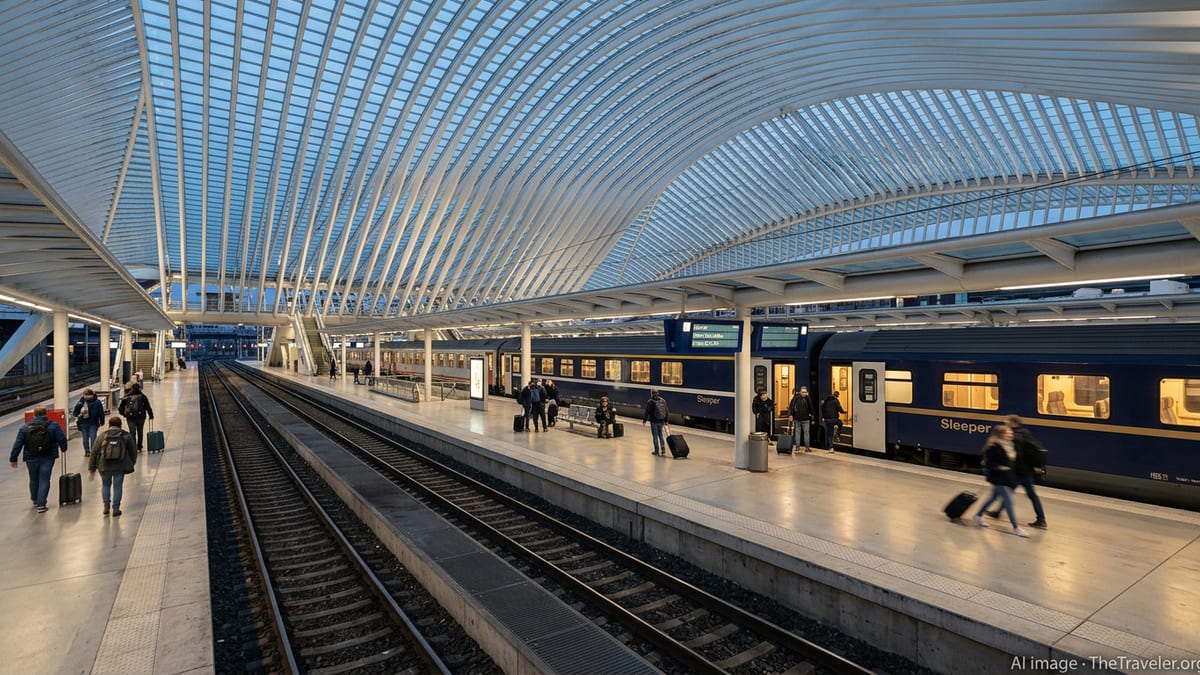
A Revival of the Paris–Berlin Sleeper, With a New Route
The Paris–Berlin night train is returning in 2026 under the banner of European Sleeper, the cooperative operator already known for its Brussels–Berlin–Prague overnight service. The launch follows the decision by SNCF Voyageurs and ÖBB to phase out their Nightjet connection between the French and German capitals, leaving a gap for rail travelers who prefer to move while they sleep.
From March 26, 2026, the new overnight service will depart Paris Gare du Nord three times a week, initially running Paris–Brussels–Berlin. European Sleeper is positioning the train as a practical alternative to flying, with passengers boarding in the early evening and arriving in Berlin the following morning, effectively reclaiming the historic sleeper corridor between the two capitals.
The route has been carefully drawn to build on existing high-speed and mainline infrastructure between France, Belgium, and Germany, but with a distinctly different geography from the former Nightjet. Rather than cutting across eastern France, the new train traces a northerly arc, bringing Belgium to the forefront of one of Europe’s most high-profile rail stories.
Liège and Mons Step Into the European Spotlight
The real surprise in the final route map is the prominence of Liège and Mons. Alongside Brussels Midi, the train will call at both Belgian cities, giving them a direct overnight link to Paris and Berlin on the same train. For Liège, already a key node on the high-speed corridor between Germany and France, the stop cements its status as a strategic interchange for long-distance rail.
Mons, by contrast, is a relative newcomer to the European night train map. The inclusion of the Hainaut city connects a broader swathe of francophone Belgium to a marquee international route, without the need to double back through Brussels. Local tourism authorities are already eyeing opportunities to package city-break itineraries that pair Mons with Berlin, Paris, or even intermediate destinations along the line.
Both cities stand to benefit from incidental tourism generated by the schedule itself. Early evening departures and morning arrivals mean passengers may opt to spend extra time in departure or arrival cities, especially when making onward daytime connections. For Liège and Mons, that could translate into more overnight stays, restaurant visits, and cultural spending by travelers who previously would have bypassed Belgium altogether when flying between France and Germany.
Timetables, Comfort and the New Overnight Experience
European Sleeper’s Paris–Berlin train is planned to leave Gare du Nord early in the evening, calling at Aulnoye-Aymeries in northern France before crossing into Belgium and stopping at Mons, Brussels Midi, and Liège-Guillemins. After an overnight run through Germany, the train is scheduled to arrive at Berlin Hauptbahnhof the following morning, with journey times of around 16 hours end to end including intermediate stops.
On board, passengers can expect the mix of seating, couchettes, and sleeper compartments already familiar from European Sleeper’s existing routes. Fares for couchette berths are expected to begin in the low hundred-euro range, with standard seats coming in lower, making the service competitive once travelers factor in the savings on a hotel night. Simple breakfast offerings and basic onboard services are designed to keep the atmosphere comfortable but unpretentious.
The timetable will initially run three round trips per week, a frequency that mirrors the former Nightjet pattern. From July 2026, the operator plans to extend the service northward to Hamburg Harburg on selected days, giving Belgian passengers from Liège, Brussels, and Mons a direct overnight path into northern Germany as well. For rail enthusiasts, the evolving timetable signals a growing network rather than a one-off flagship route.
Belgium’s Strategic Role in Europe’s Night Train Comeback
The choice to run the revived Paris–Berlin night train through Belgium is not purely symbolic. Belgian rail infrastructure, anchored by Brussels Midi and the high-speed link to the French border, allows operators to connect multiple major markets with a single overnight service. By adding Liège and Mons, European Sleeper is effectively using Belgium as a bridge between northern France, the Benelux region, and Germany.
For the Belgian national operator SNCB, which will haul the service on Belgian tracks, the project dovetails with broader ambitions to position the country as a core hub in the continent’s rebounding night train network. With Nightjet services already linking Brussels to Vienna and Berlin and European Sleeper running to Prague, the new Paris–Berlin line further densifies the overnight grid.
Regional authorities in Wallonia are also quick to highlight the symbolic value. Mons gaining a stop on a Paris–Berlin night train is a tangible example of how secondary cities can be plugged into trans-European corridors when operators choose routes that serve more than just capital-to-capital flows. It strengthens arguments that expanding night trains can support more balanced tourism and economic development, rather than concentrating benefits solely in Europe’s largest hubs.
Greener Travel and New Itineraries for Rail Tourists
The Paris–Berlin night train’s relaunch comes as European travelers increasingly look for lower-carbon alternatives to short-haul flights. By bundling what would otherwise be two or more daytime legs into a single overnight journey, the service offers a practical way to cut emissions without sacrificing convenience. For many passengers, the appeal is as much about the experience as the environmental footprint.
For Liège and Mons, that shift in mindset could be transformative. The new stops position both cities as organic waypoints on longer rail-based holidays, where travelers mix overnight segments with slower daytime legs. A traveler might, for example, travel by day from London or Amsterdam to Liège, spend an evening there, then board the night train to wake up in Berlin. Or they might depart Paris, enjoy an early dinner in Mons’s historic center, and then continue overnight to Germany.
Tourism boards across Belgium, France, and Germany are expected to seize on these possibilities with coordinated marketing campaigns once the route is fully operational. If the train proves popular, it will strengthen the case for further overnight links threading through Belgium, cementing Liège and Mons not only as beneficiaries of a single new train, but as lasting fixtures on Europe’s renewed night rail map.