

More news on this day
Hundreds of passengers at Newark Liberty International Airport faced hours of uncertainty as 365 flight delays and 51 cancellations by Spirit, United, Delta, American and other carriers disrupted travel to New York, Boston, Chicago, Miami, San Francisco and multiple U.S. cities.
Get the latest news straight to your inbox!
Major Disruptions Across Key Domestic Routes
Flight-tracking data for Monday indicated that Newark Liberty International Airport was among the most severely affected hubs in the country, with a combined 365 delayed departures and arrivals and 51 outright cancellations across multiple carriers. The disruption centered on heavily traveled domestic corridors linking New Jersey with major metropolitan areas, including New York-area connections, Boston, Chicago, Miami and San Francisco.
Publicly available information from flight boards and aviation tracking platforms showed that Spirit Airlines, United Airlines, Delta Air Lines and American Airlines all contributed significant numbers of affected flights. The knock-on impact extended throughout the day as missed connections and rolling crew and aircraft imbalances compounded early delays, making it increasingly difficult for airlines to restore normal schedules.
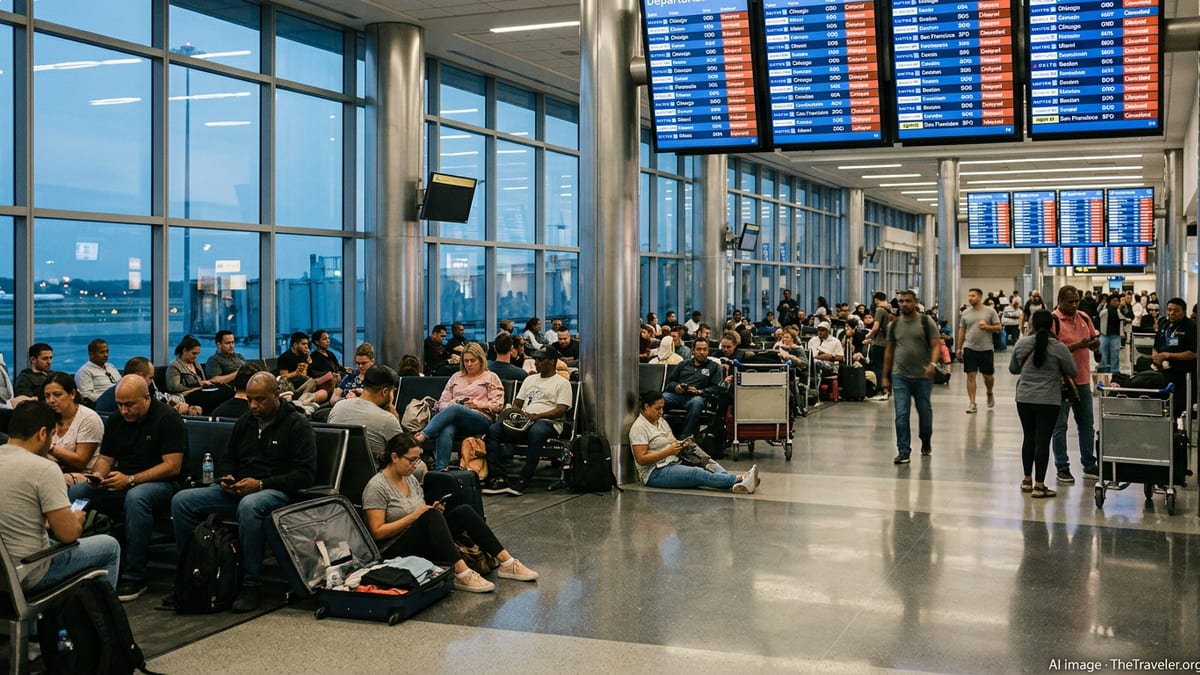
Travelers reported long lines at customer service counters, crowded gate areas and difficulty securing same-day alternatives as available seats to major cities quickly disappeared. With many flights operating behind schedule rather than being canceled outright, passengers faced extended waits inside the terminal as aircraft repositioning and crew availability lagged behind published timetables.
Weather, Congestion and System Strain at a Busy Hub
Newark Liberty has long been one of the country’s most delay-prone airports, in part because of dense traffic in the New York airspace and its role as a major connecting hub. Industry analyses and federal performance reports have repeatedly highlighted how modest weather disruptions or airspace constraints in this region can cascade quickly, affecting flights far beyond the immediate area.
On the day of the current disruption, a combination of poor visibility, low cloud ceilings and congestion in the Northeast air corridor contributed to extended spacing between arrivals and departures. Aviation advisories pointed to ground delay programs and flow-control measures that reduced the number of flights that could land or take off each hour, forcing airlines to push back departure times or cancel selected services.
Operational data from the U.S. Department of Transportation show that carriers such as United, American, Delta and Spirit routinely cite a mix of weather, air traffic control constraints and airline-controlled factors, such as maintenance or crew positioning, in explaining day-to-day performance variations. At a capacity-constrained airport like Newark, even short-lived weather or traffic restrictions can create backlogs that last well into the evening peak.
Airlines Struggle With Cascading Operational Challenges
While weather and airspace limitations contributed to the slowdown, airline operations also came under pressure as the day progressed. Once early flights slipped behind schedule, aircraft and crew scheduled for later departures often arrived late into Newark, setting off a chain reaction of missed turns and narrowed recovery options.
Public schedules showed that affected flights were not limited to a single airline or route type. Legacy network carriers such as United, Delta and American saw disruptions on transcontinental services to cities like San Francisco as well as on shorter-haul routes to Boston, Chicago and nearby New York-area airports. Ultra-low-cost carrier Spirit, which relies on high aircraft utilization, also recorded multiple delayed and canceled services, magnifying the impact on leisure travelers.
Aviation performance records illustrate how tightly airline networks are run, especially during peak travel periods. When irregular operations develop at a major hub, spare aircraft and reserve crews can be quickly exhausted. As a result, carriers may opt to cancel select flights entirely in order to preserve a more reliable, if reduced, schedule for the remainder of the day.
Stranded Passengers Face Rebooking and Compensation Hurdles
For travelers caught in the disruption at Newark Liberty, the practical consequences were immediate: missed business meetings, disrupted vacations and unplanned overnight stays. With major routes to cities such as Chicago and Miami heavily booked, same-day rebooking options were limited, and many passengers were directed to later departures or alternative connecting itineraries.
Publicly available airline policies indicate that assistance for delayed or stranded passengers varies depending on the cause of the disruption and the carrier involved. In cases where delays are attributed to factors outside an airline’s control, such as weather or air-traffic restrictions, travelers may find that options are focused on rebooking rather than hotel or meal coverage. When delays are considered within an airline’s control, customers may have broader access to vouchers, overnight accommodations or additional support.
Consumer advocates often advise travelers to monitor flight status regularly, use airline mobile apps to seek earlier rebooking options and document expenses incurred during extended delays. At congested hubs like Newark, where queues at staffed service counters can grow quickly during irregular operations, digital tools and self-service kiosks may provide faster access to alternative routings when they are available.
Broader Concerns Over U.S. Flight Reliability
The latest wave of delays and cancellations at Newark Liberty feeds into a broader national conversation about the reliability of U.S. air travel. Federal performance statistics over recent years show periods of elevated disruption, with weather, air traffic control staffing, infrastructure constraints and airline scheduling practices all playing a role.
Industry observers note that major hubs such as Newark, which handle large volumes of connecting traffic, are particularly vulnerable to systemic stress. When one airport experiences significant disruption, the effects can ripple outward across an airline’s entire network, impacting flights and passengers in distant cities who have never passed through the affected hub.
For travelers, the episode serves as a reminder of the importance of contingency planning, especially when booking tight connections through busy airports or relying on last flights of the day to reach critical events. Travel planners often recommend building additional buffer time into itineraries, considering earlier departures where possible and reviewing ticket conditions in advance to understand what support may be available if schedules unravel.