

More news on this day
Thousands of airline passengers across the United States are facing cascading disruption on Monday as a powerful Nor’easter batters the Northeast and a fresh wave of cancellations and delays from Orlando International Airport compounds nationwide travel chaos, snarling operations at major hubs including Newark, Boston and Philadelphia.
Orlando Flight Meltdown Adds New Turbulence to National Gridlock
After a weekend of mounting disruption driven by a fast-developing winter storm in the Northeast, Orlando International Airport became a fresh flashpoint on Monday as airlines scrubbed more than 200 additional departures and pushed scores of others into delay. Data from aviation analytics firms and airline status boards indicated that at least 248 new flights were canceled and 88 delayed at Orlando alone, trapping thousands of vacationers, business travelers and connecting passengers who had hoped to skirt the worst of the Nor’easter farther north.
The new wave of cancellations affected virtually every major U.S. carrier serving central Florida. Delta Air Lines, American Airlines, United Airlines, JetBlue, Spirit, Frontier and several regional partners all pulled flights from schedules as they struggled to reposition aircraft, rotate crews and maintain safety margins in the face of weather-related ground stops and air traffic control constraints up the East Coast. What began as a storm-centered crisis in New York and New England quickly evolved into a broader network shock, with Orlando emerging as a key choke point.
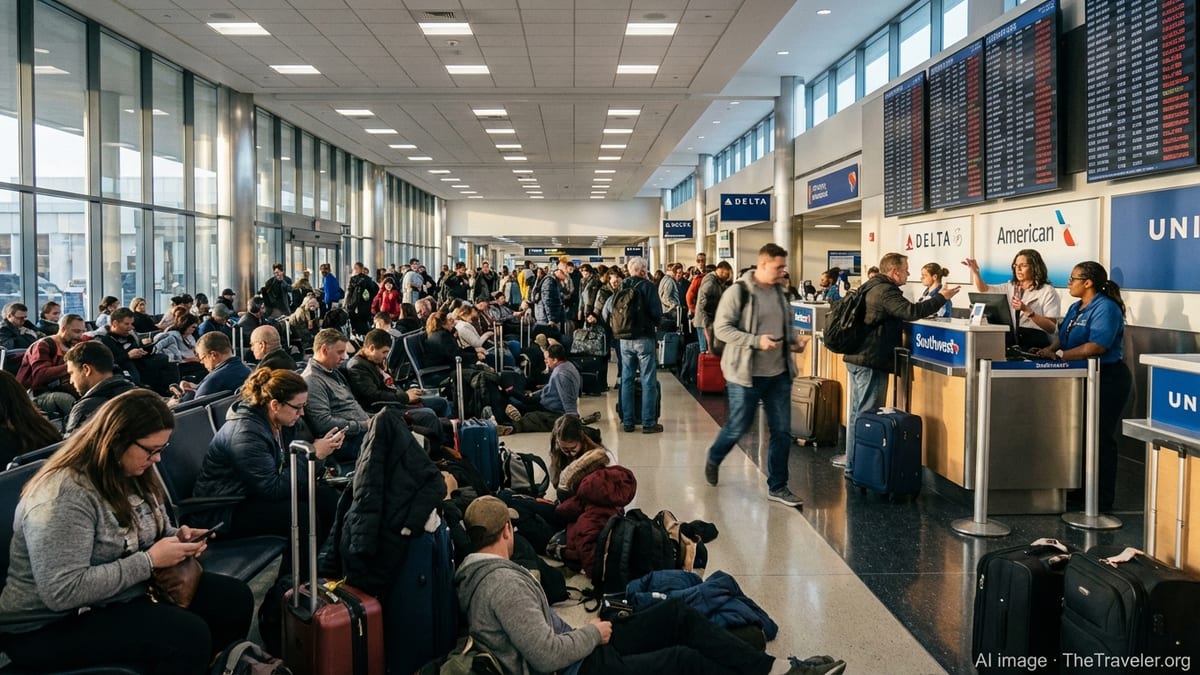
Airport officials described crowded terminals and lengthening customer service lines as travelers learned that aircraft needed for their flights were either out of position or stuck behind weather holds at other hubs. Many passengers were told that the next available seats out of Orlando could be days away, particularly on nonstop routes to heavily impacted Northeast cities where local operations have been reduced to minimal or essential-only service.
The timing could hardly be worse for Orlando, one of the nation’s busiest leisure gateways and a linchpin in the winter travel market. With school breaks underway in several states and international tourism still rebounding, the airport had been expecting heavy volumes. Instead, families bound for home and conference attendees headed to work found themselves sleeping in terminal chairs or scrambling to secure scarce hotel rooms across the metro area.
Nor’easter Grounds Thousands of Flights Across the Northeast
The fresh disruption in Florida comes against the backdrop of an historically severe Nor’easter that has paralyzed air travel from Washington, D.C., to New England. By early Monday, flight-tracking services reported more than 5,300 cancellations within, into or out of the United States, alongside hundreds of additional delays, as the storm’s snow, wind and low visibility made operations unsafe at many airports in the region.
New York City’s three major airports have borne the brunt of the onslaught. Nearly all departures from John F. Kennedy International, LaGuardia and Newark Liberty were canceled Monday morning after airlines and air traffic officials concluded that runway conditions, crosswinds and visibility thresholds did not support sustained commercial operations. In some cases, carriers preemptively scrubbed entire day-long schedules to avoid stranding aircraft and crews on the tarmac.
Boston Logan International Airport and Philadelphia International Airport, critical hubs for both domestic and transatlantic traffic, also reported extraordinarily high levels of disruption. Industry data showed that roughly 80 to 90 percent of flights at those airports had been canceled or suspended at various points since Sunday evening, leaving aircraft parked wingtip to wingtip and passengers facing long waits for rebooking, meal vouchers and hotel accommodation where available.
Meteorologists said the storm intensified rapidly into a powerful bomb cyclone late Sunday, bringing near hurricane-force gusts and heavy banded snowfall that overwhelmed plowing operations at some airports. Bands of snow exceeding two inches per hour, combined with crosswinds above typical aircraft limits, sharply reduced runway capacity and triggered multiple Federal Aviation Administration ground stops and flow control measures across the Northeast corridor.
National Carrier Networks Buckle Under Strain
For the big U.S. airlines, the Nor’easter hit at some of their most strategically important hubs, where a single day of near-total shutdown can reverberate through networks for much of the week. United, Delta, American and JetBlue have all faced widespread cancellations tied to the storm, while low-cost rivals Spirit and Frontier have also pulled large portions of their East Coast flying due to the same conditions and knock-on effects.
In the New York area, LaGuardia and JFK are critical for Delta, American and JetBlue, which rely on those airports for lucrative business markets and international feed. Newark serves as a major hub for United, and Philadelphia is one of American’s key connecting complexes. As those hubs wound down to skeleton operations or halted altogether, carriers were forced to cancel not only local flights but also downstream legs that relied on aircraft and crews cycling through the Northeast.
Operational planners attempted to preserve a limited number of long-haul and hub-critical flights, particularly those linking unaffected regions or international gateways, while cutting the bulk of short-haul feeder services more susceptible to weather interruptions. The result has been severe disruption on regional routes and high-frequency business corridors, even where local conditions outside the storm zone remain relatively benign.
Spillover from the Northeast shutdown has cascaded into Florida, the Midwest and parts of the West Coast. Aircraft that were due to operate early morning departures from Orlando, Miami, Chicago or Denver, for example, may still be parked at de-icing pads in Boston or waiting out a ground delay at Newark. Crews bumping up against federal duty time limits after long weather holds have further constrained the ability of airlines to restart schedules once windows of better weather open.
Impact on Orlando Travelers and Connections to the Northeast
For stranded Orlando passengers, the storm raging more than a thousand miles away can seem abstract, but its effects are palpable every time a departure board flips from "on time" to "canceled". Many of the 248 newly canceled flights at Orlando on Monday included services to or from heavily impacted Northeastern hubs such as Newark, Boston and Philadelphia, where local authorities and airport operators have curtailed operations to essential-only levels.
Nonstop flights from Orlando to those cities were among the first to be pulled as airlines acknowledged there would be no available arrival slots or that crews and aircraft would not arrive from the north in time. In some cases, carriers proactively canceled return legs out of Orlando because the corresponding inbound aircraft was scrubbed higher up the network. Travelers hoping to connect through Orlando between the Midwest and the Caribbean, or between Latin America and Boston or New York, also found their itineraries unraveling.
Long lines formed at airline counters as stranded passengers sought earlier rebooking options, only to be told that seats on remaining services were heavily overbooked. Some travelers were offered circuitous routings via alternate hubs that remained operational, such as Atlanta, Charlotte or Dallas, but those options depended on fast-changing weather forecasts and airport capacity constraints in the wider system.
For families at the end of theme-park vacations, confusion and fatigue were evident. Many had already checked out of hotels and returned rental cars before learning of their canceled flights. With Florida hotels filling up quickly and ride-share wait times increasing, airport officials advised travelers to communicate directly with their airline before heading to the terminal and to expect that re-accommodation might mean a departure several days later than planned.
Storm’s Wider Effects: Ground Transport, Power Outages and Emergency Declarations
The Nor’easter’s impact has not been limited to aviation. As the storm swept across the Mid-Atlantic and New England on Sunday and Monday, state and local officials recorded widespread power outages, hazardous road conditions and multiple weather-related emergencies. Utility companies in New York, New Jersey and Massachusetts reported hundreds of thousands of customers without electricity at the height of the storm, complicating both airport operations and passenger logistics.
Governors and mayors across the affected region declared states of emergency, imposed temporary travel bans on nonessential vehicles and urged residents to stay off the roads. Those directives hampered the ability of crews and passengers to reach airports even when a small number of flights were technically able to operate. Public transit in several metropolitan areas, including bus and commuter rail systems, scaled back or suspended service entirely during the worst conditions.
For airports like Newark, Boston and Philadelphia, the combination of runway contamination, visibility constraints and limited access roads created a layered challenge. Snowplows and de-icing trucks struggled to keep up with accumulation on taxiways and aprons. Airport hotels quickly filled with stranded passengers, airline crews and ground staff who could not safely commute home.
In coastal areas, forecasters warned of potential flooding and storm surge, which added another variable for airport managers weighing whether to continue operations. With more heavy snow and high winds expected in some locales into Tuesday, officials cautioned that even once the rate of cancellations slows, it could take days to fully clear backlogs and reposition aircraft and crews to their assigned routes.
How Airlines Are Responding for Stranded Passengers
Most major U.S. carriers activated weather waivers for the Nor’easter over the weekend, allowing customers to change travel dates without typical change fees, though fare differences still applied on many routes. As cancellations mounted on Monday, airlines also increased the use of automated rebooking tools via their mobile apps and websites, redirecting passengers to whatever seats remained on future flights.
Customer-service teams at Orlando and in the Northeast were reinforced with additional staff, but staffing was challenged by the same road and transit disruptions facing passengers. Long hold times on customer-service phone lines persisted, and many travelers turned to airline social media channels seeking faster assistance, with mixed success given the scale of the disruption.
Airlines have generally offered full refunds for flights that were canceled outright or that experienced significant schedule changes, particularly where alternative options were unavailable within a reasonable timeframe. Some carriers arranged hotel and meal vouchers on a case-by-case basis, especially for passengers stranded overnight far from home, though policies varied by airline and by whether the disruption was deemed weather-related or operational.
At Orlando, airport volunteers and airline agents handed out bottled water and snack kits in gate areas where delays were longest. Some terminals opened quiet rooms for families with young children, while airport chaplaincy and customer-experience teams checked on elderly and medically vulnerable passengers. Still, images from the concourses showed rows of travelers sleeping on the floor, underscoring the scale of the challenge.
What Travelers Should Expect in the Coming Days
With weather models indicating that the Nor’easter will continue to affect parts of New England and Atlantic Canada through at least Tuesday, airlines and airport authorities warned that further cancellations and delays are likely, even as snow intensity gradually tapers. Schedules for the remainder of the week are expected to be thinner than usual as carriers work to untangle aircraft and crew rotations and ensure that maintenance obligations are met on jets that have spent extended time on the ground.
Passengers currently in Orlando or holding tickets for travel to or through the city were urged to monitor their flight status frequently and to be prepared for sudden changes as airline operations adjust to conditions in the Northeast. Travelers connecting through Newark, Boston or Philadelphia were advised to consider whether same-day re-routing through alternative hubs is feasible, though such options are expected to be limited and may involve longer journey times and layovers.
Industry analysts said it could take several days for normal operations to resume fully, particularly at congested hubs where runways, gates and airspace are already in high demand under normal conditions. They noted that the storm struck during a period of strong demand and relatively tight airline staffing, factors that reduce the system’s resilience when irregular operations occur.
For now, both airlines and airports are focused on stabilizing the operation, moving stranded passengers as quickly as conditions allow and preparing for a return to more typical schedules later in the week. But with winter still in full swing and the busy spring break period approaching, Monday’s events serve as a stark reminder of how quickly a single powerful storm can ripple through a tightly interconnected aviation network stretching from Orlando to the farthest corners of the Northeast.