

More news on this day
A rapidly intensifying nor’easter barreling into the U.S. Northeast has triggered more than 6,400 flight cancellations by American Airlines, Delta, JetBlue, United, Southwest, Alaska Airlines and Spirit, crippling air travel into New York, New Jersey and Connecticut and sending shockwaves through domestic and international networks.
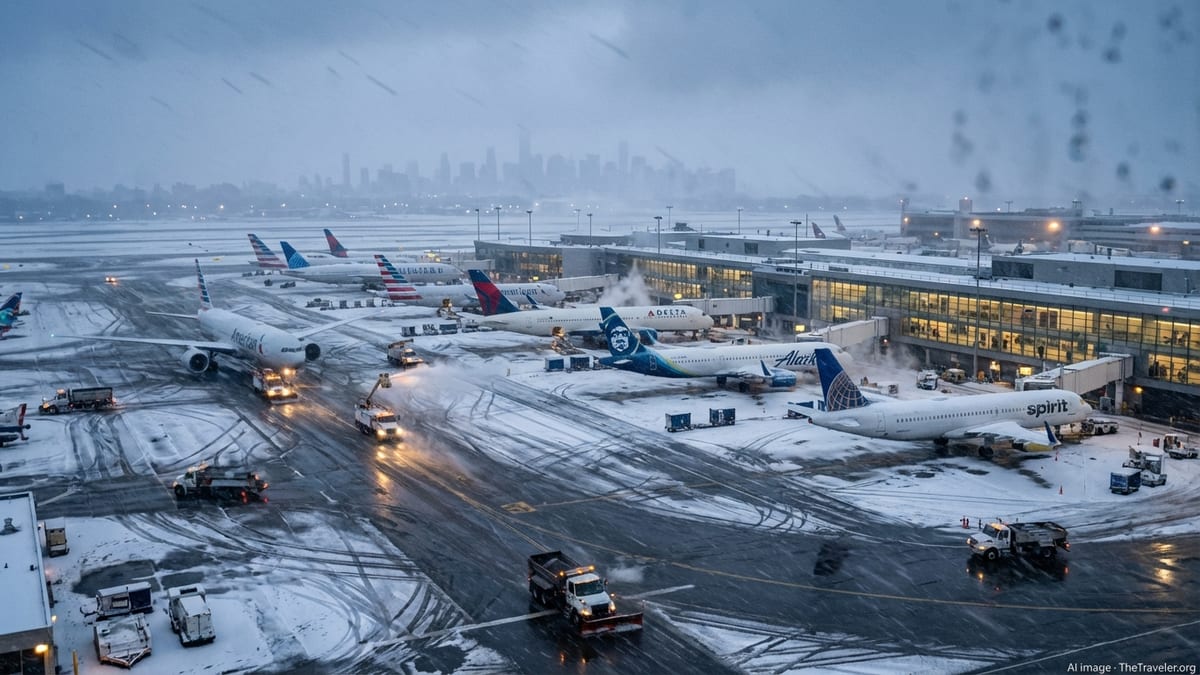
Historic Nor’easter Slams a Critical Aviation Corridor
Forecasters describe the current nor’easter as potentially one of the most disruptive winter storms to hit the New York metropolitan region in recent years, with heavy snow, fierce winds and whiteout conditions converging at the busiest air travel crossroads in the United States. New York’s John F. Kennedy, LaGuardia and Newark Liberty airports sit at the heart of a dense web of domestic routes and long-haul international services, making them especially vulnerable when weather grinds operations to a halt.
As snow bands intensify and wind gusts climb toward hurricane-force thresholds along parts of the coast, visibility has dropped sharply on runways and taxiways. Airport authorities have warned that deicing queues, runway closures and limited staffing during the worst of the storm are forcing airlines to sharply curtail schedules rather than risk aircraft, crew or passenger safety. Officials stress that today’s cancellations are likely a floor, not a ceiling, with more disruptions expected as the storm stalls over the region.
Meteorologists say the system’s rapid strengthening meets the criteria for what is commonly labeled a bomb cyclone, a storm that deepens quickly as it feeds on contrasting air masses over the Atlantic. For aviation planners, that rapid intensification complicates forecasting windows and forces carriers to make aggressive decisions sooner than they might in a more typical winter storm.
Major U.S. Carriers Slash Schedules to and from the Northeast
To prevent passengers and crews from becoming stranded at gridlocked airports, the country’s largest carriers began canceling flights preemptively as forecasts coalesced around a high-impact scenario. American Airlines, Delta Air Lines, JetBlue Airways, United Airlines, Southwest Airlines, Alaska Airlines and Spirit Airlines have collectively scrubbed more than 6,400 departures and arrivals over a roughly 48-hour window, centered on New York, New Jersey and southern New England.
American Airlines is focusing its cuts on key Northeast hubs, including JFK, LaGuardia, Newark and Philadelphia, suspending large portions of its schedule during the storm’s peak. Delta has implemented wide-ranging schedule reductions at its New York and Boston operations, pairing cancellations with aircraft repositioning so planes are staged outside the worst-hit zone and ready to fly in once conditions improve.
JetBlue, with a historically strong presence in New York and Boston, is among the most heavily affected. The carrier has pared back a significant share of its flights in and out of JFK, LaGuardia, Newark and Boston Logan, a move designed to ease pressure on ground operations and avoid a backlog of aircraft waiting for gates or deicing. United is executing similar cuts at Newark Liberty, one of its most important transatlantic gateways, temporarily scaling back both domestic connections and select international rotations.
Southwest, Alaska Airlines and Spirit are trimming services that feed into the storm zone, including flights from the Midwest, Southeast and West Coast that would otherwise connect into the New York area. While many of these airlines do not maintain large hub operations at all three New York metro airports, their decision to pull down capacity underscores how deeply intertwined U.S. air networks have become.
New York, New Jersey and Connecticut Bear the Brunt
The core of the disruption is concentrated in the tri-state area, where airport authorities and airlines have warned travelers to avoid nonessential trips until the nor’easter passes. At JFK and LaGuardia in New York, and Newark Liberty in New Jersey, combined cancellations now number in the thousands, with many of Monday’s and Tuesday’s flights proactively removed from schedules even before the heaviest snow began to fall.
Newark Liberty is seeing particularly steep impacts as a primary hub for United and a significant base for JetBlue and other carriers. A large share of its Sunday and Monday operations has been canceled, including both arrivals and departures, a step that normally only occurs in the face of major coastal storms or severe operational meltdowns. State officials in New Jersey have urged travelers to verify flight status before leaving home and to prepare for lengthy waits if they must travel.
In neighboring New York and Connecticut, the picture is similar. Flights at regional airports, including Westchester County Airport and Connecticut’s Bradley International, have been trimmed or canceled outright as airlines focus limited resources on safely maintaining operations at the largest hubs. Ground transportation is also affected, with icy roads and limited public transit schedules compounding the difficulty of reaching airports that are operating at a fraction of normal capacity.
Authorities in all three states have emphasized that aviation disruptions could extend beyond the immediate snowfall, as strong winds and drifting snow hamper cleanup efforts. Even once runways are cleared, airlines must navigate crew scheduling, aircraft positioning and passenger rebooking, meaning normal operations could be days away.
Ripple Effects Across the United States and Beyond
Because New York-area airports serve as critical connection points, the nor’easter’s impact is radiating far beyond the Mid-Atlantic and New England. Flight-tracking data show cluster cancellations and delays at airports across the country that normally send or receive a high volume of traffic through the New York region, including major hubs in Chicago, Atlanta, Dallas, Miami, Los Angeles and Seattle.
Travelers in cities with no snow in the forecast are discovering that their flights are grounded anyway because the aircraft or crew needed to operate their route are out of position in the storm zone. Airlines are using a combination of cancellations, rebookings and aircraft swaps to manage these network-wide challenges, but some passengers are facing multi-day delays, overnight stays in hub cities or rerouting through less congested airports.
The storm is also constraining cargo movements at a time when supply chains remain sensitive to sudden shocks. Major freight carriers and integrators that rely on overnight services through East Coast gateways are diverting aircraft or rerouting shipments to alternative hubs farther south and inland. Logistics specialists warn that time-sensitive deliveries, including medical supplies and e-commerce orders, could experience temporary slowdowns, particularly in and out of the Northeast corridor.
Even rail and bus networks are feeling the pressure, as stranded passengers turn to alternative modes of transportation. Intercity rail operators and coach companies are reporting higher than usual demand on routes linking Boston, New York, Philadelphia and Washington, although these services are themselves vulnerable to snow-clogged tracks and highways.
Which Countries and International Routes Are Affected
While the nor’easter is a domestic weather event, its reach is unmistakably international. New York’s airports, particularly JFK and Newark, are among the most important transatlantic and transpacific gateways in the world, linking the United States to Europe, the Middle East, Africa, Latin America and parts of Asia. As carriers pare back operations, travelers on multiple continents are encountering cancellations, diversions and missed connections.
Transatlantic services connecting the New York region with major hubs in the United Kingdom, Ireland, France, Germany, Spain, Italy and the Netherlands are among the hardest hit, with numerous flights scrubbed or rescheduled. Passengers originating in London, Paris, Frankfurt, Madrid, Rome and Amsterdam are being offered rebookings on later dates or reroutings through other U.S. gateways such as Boston, Washington or Chicago, where conditions permit.
Flights linking New York to Canada, particularly services to Toronto, Montreal and Ottawa, are also disrupted, as are routes to key destinations in the Caribbean and Central America. Popular leisure markets including Mexico, the Dominican Republic, Jamaica, the Bahamas and Costa Rica are seeing cancellations as aircraft and crews are unable to depart or arrive on schedule in the storm-affected corridor.
Long-haul operations to South American and Middle Eastern destinations are likewise feeling the squeeze. Services between the New York area and cities such as São Paulo, Rio de Janeiro, Buenos Aires and Doha are confronting schedule changes, extended ground times or last-minute aircraft swaps. While airlines are prioritizing the operation of select international flights where possible, capacity is limited and seats for rebooked travelers are at a premium.
What Stranded Travelers Can Expect from Airlines
For many passengers, the most pressing question is what support they can expect if their flight is canceled or severely delayed. Airlines across the board have activated weather-related travel waivers, allowing affected customers to change travel dates and, in some cases, origins or destinations without incurring change fees. Some carriers are also waiving fare differences for rebooked travel within a limited window, easing the financial sting for those forced to adjust plans.
However, because the nor’easter is a weather event considered outside of airline control, passengers are not universally entitled to compensation such as hotel rooms or meal vouchers, policies that typically apply when disruptions stem from mechanical or staffing issues. Instead, support varies by carrier and is often assessed on a case-by-case basis. Travelers are being urged to monitor airline apps, text alerts and airport departure boards closely, and to contact customer service channels only when necessary to avoid overwhelming call centers.
Experts recommend that passengers whose flights are canceled decide quickly whether they still need to travel, as the limited number of available seats on later flights will likely sell out fast. Those willing to depart from or arrive at alternative airports, or to accept connections instead of nonstop service, may have better odds of finding a workable itinerary. Travel insurance policies that include trip interruption coverage can also offer an additional layer of protection, though terms and conditions vary widely.
Importantly, travelers who ultimately choose not to fly are typically entitled to a refund when their flight is canceled outright, regardless of ticket type. That option may appeal to those whose trips are discretionary or easily postponed, particularly as forecasters warn that lingering disruptions could persist even after skies clear.
How Airlines Prepare for Recovery After the Storm
Behind the scenes, airline operations centers are already planning the complex restart of normal schedules once the nor’easter begins to weaken. Recovery from a storm of this magnitude requires far more than simply reopening runways: carriers must ensure that aircraft, pilots and flight attendants are all in the right places, within legal duty limits, and that ground crews and airport infrastructure are ready to handle a surge of delayed travelers.
One of the core strategies is proactively canceling flights during the storm’s peak to avoid cascading delays that can ripple through the network for days. By keeping aircraft parked in safer locations away from the heaviest snow and wind, airlines aim to restart with a cleaner slate, operating a more reliable but temporarily smaller schedule rather than a full timetable riddled with rolling disruptions.
Once conditions improve, carriers will gradually restore flights, often prioritizing key trunk routes and international services before secondary domestic connections. Deicing operations will remain a major constraint; each aircraft can require substantial time and resources to clear of ice and snow, especially in subfreezing temperatures. Airport authorities will also need to continue plowing and treating runways, taxiways and aprons, as blowing snow can quickly re-cover cleared surfaces.
Analysts caution that the first 24 to 48 hours after a major storm can be some of the most challenging for travelers, as airlines iron out irregular operations. Even if a specific flight appears to be operating, crew shortages, aircraft swaps or residual congestion can still trigger last-minute changes. Passengers are advised to build flexibility into their plans, allow extra time at the airport and keep backup arrangements in mind.
Lessons from Past Winter Meltdowns
The aggressive preemptive cancellations unfolding during this nor’easter reflect lessons learned from previous winter storms and operational crises. In recent years, several U.S. airlines have confronted high-profile meltdowns when severe weather combined with aging technology or rigid crew scheduling systems, leading to days of rolling cancellations and deeply frustrated customers.
Today, carriers and regulators alike emphasize that canceling early and often during a forecast high-impact event can actually reduce overall disruption. By thinning schedules before conditions deteriorate, airlines relieve pressure on airport infrastructure, give ground crews more room to operate safely and minimize the risk of passengers sitting on tarmacs for extended periods or being stranded overnight without accommodations.
At the same time, the current storm underscores the fragility of a global aviation system that operates close to capacity during peak travel periods. With planes and crews tightly scheduled and demand strong on many routes, even a regional weather event can reverberate worldwide, affecting travelers who may be thousands of kilometers from the nearest snowflake.
As the nor’easter continues to track along the coast, both airlines and passengers are bracing for a multi-day recovery. For now, the message from carriers is consistent: if you do not absolutely need to fly into or out of the New York, New Jersey or Connecticut region during the storm window, reschedule. For those who must travel, patience and preparation will be essential companions until the historic system finally moves offshore.