

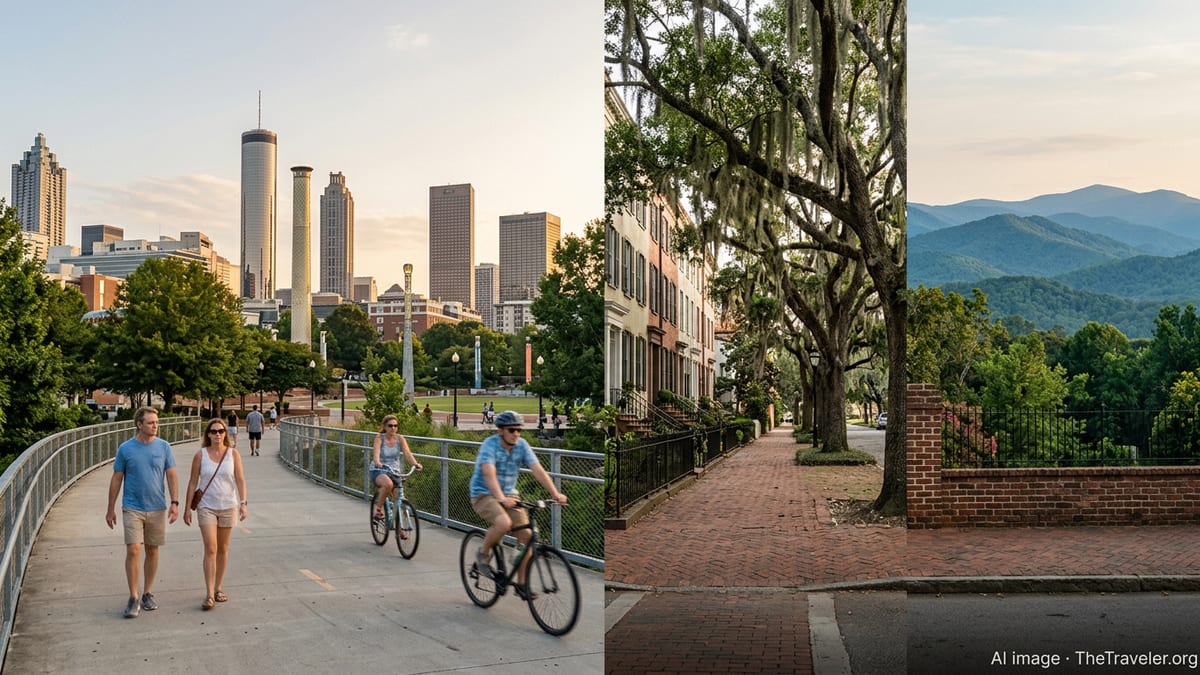
Georgia rewards travelers who like variety. Within a single week you can experience a modern Southern capital with major museums and nightlife, wander cobblestone squares beneath Spanish moss, and wake up to misty ridgelines in the Blue Ridge foothills. This itinerary stitches together Atlanta, Savannah, and the North Georgia mountains into a logical route that feels full but not frantic, with time built in for detours, good meals, and a few quiet sunrises.
How to Use This One Week Georgia Itinerary
This itinerary is designed as a loop starting and ending in Atlanta, which works well whether you fly into Hartsfield-Jackson Atlanta International Airport or arrive by road. It allocates two and a half days in Atlanta, two and a half days in Savannah, and two days in the North Georgia mountains, with driving days planned so you are never in the car more than about four to five hours at a stretch. You can easily reverse the order if you find a better deal on flights or accommodations in Savannah.
The focus is on relaxed but immersive travel. Instead of racing through checklists of attractions, you will have one or two anchor experiences each day, plus unstructured time for wandering neighborhoods, finding local coffee shops, and lingering in parks. In Atlanta and Savannah, that means prioritizing compact districts where you can explore on foot. In the mountains, it means choosing a home base near hiking, small towns, and scenic drives, rather than trying to cover the entire region.
Because Georgia’s weather can shift quickly, this plan remains flexible. You can swap indoor and outdoor activities depending on the forecast, and you will find suggestions for small backups in case heavy rain or high summer heat make a particular stop less appealing. The goal is to keep the essence of the route intact while letting you adapt the details on the ground.
Georgia has a deep and sometimes difficult history, particularly around civil rights. This itinerary includes opportunities to engage with that history thoughtfully in Atlanta and Savannah. Many visitors find that balancing those visits with time in gardens, along rivers, and in the mountains leads to a more complete sense of the state and its people.
Days 1–2: Atlanta’s Culture, Green Spaces and Neighborhoods
Begin your week in Atlanta, a city that often surprises first-time visitors. Beyond its role as a transportation hub, Atlanta offers a dense cluster of major attractions around Centennial Olympic Park in the downtown core. Here you can walk between the Georgia Aquarium, World of Coca-Cola, and the National Center for Civil and Human Rights in just a few minutes, thanks to a pedestrian-friendly campus known as Pemberton Place surrounding the park. This makes it easy to spend your first full day focused on a small geographic area without needing to constantly move your car.
The Georgia Aquarium remains one of the country’s largest, with multiple galleries that can easily occupy half a day, especially if you attend an animal presentation. Pair it with a visit to World of Coca-Cola next door, where exhibits trace the history and global reach of the brand and end in a lively tasting room. If you prefer a deeper look at social history, set aside several hours for the National Center for Civil and Human Rights, which presents moving, interactive exhibits on the American civil rights movement and contemporary human rights issues.
In the late afternoon, trade downtown’s towers for the Atlanta BeltLine, a growing ring of multiuse trails built on former rail corridors. The Eastside Trail, one of the most popular segments, connects neighborhoods like Inman Park, Old Fourth Ward, and Piedmont Park with a paved path lined by murals, adaptive reuse warehouses, and patios. New segments on the Westside now provide nearly seven miles of continuous trail, making it increasingly practical to explore by bike or on foot between Washington Park, Grove Park, and the core of the city. As the BeltLine continues to expand, it has become one of the best places to feel Atlanta’s present-day energy.
On your second day, slow the pace and explore Atlanta’s neighborhoods. Start in the Martin Luther King Jr. National Historical Park, which includes his boyhood home, Ebenezer Baptist Church, and a visitor center that contextualizes Atlanta’s role in the civil rights movement. Continue to nearby Sweet Auburn and Edgewood Avenue for lunch and a sense of how historic districts are evolving. Later, head to Midtown’s arts district to visit the High Museum of Art or the Museum of Design Atlanta, then unwind in Piedmont Park, the city’s signature green space with skyline views and shaded walking paths around Lake Clara Meer.
Day 3: Crossing the State to Savannah
The drive from Atlanta to Savannah typically takes about four hours along Interstate 16, not accounting for stops. Plan a relaxed morning departure so you arrive in Savannah by mid-afternoon, giving yourself time to get oriented before dinner. If you prefer to break up the ride, consider pausing in Macon to stretch your legs among historic homes and cherry tree-lined streets, or in the small city of Dublin for a quick walk and lunch in its compact downtown.
As you approach Savannah, the landscape shifts toward flat marshes and wide rivers, signaling the transition from the Piedmont to the coastal plain. Once you arrive, park near the Historic District and switch to walking as your primary way of getting around. The core of Savannah is famously laid out in a grid of leafy squares, many framed by 19th-century row houses and churches, with live oaks draped in Spanish moss arching overhead. Checking into a hotel or inn within or near this grid makes it easier to enjoy the early evening light on the squares.
Use your first few hours in Savannah for simple orientation rather than trying to pack in too much. Stroll through a handful of squares near your lodging, perhaps Johnson, Chippewa, or Madison Square, noticing how each one has a slightly different character. Head toward River Street at the northern edge of the Historic District, where cobblestones, old cotton warehouses, and a promenade along the Savannah River create one of the city’s most recognizable scenes. From here, you can watch container ships glide past as you get your bearings.
If you arrive with extra energy, consider a short evening river cruise or a ride on the Savannah Belles Ferry across to Hutchinson Island and back. The small passenger ferries usually operate daily at no cost, offering a quick way to see the skyline from the water. Grab dinner in the Historic District, perhaps on a quieter side street away from River Street’s busiest stretches, and try to get an early night so you can explore fully the next day.
Days 4–5: Savannah Squares, Riverfront and Tybee Island
Your full day in Savannah should be devoted to soaking up the Historic District on foot. Start early, when the light is soft and the streets are quieter. Wander through a chain of squares, perhaps beginning at Forsyth Park with its famous fountain and then weaving north through Monterey, Calhoun, Lafayette, and the others. Many visitors are surprised by how close the squares sit to one another; you can traverse several in a short walk, yet each feels like its own small neighborhood park.
Along the way you will pass landmarks such as the Cathedral Basilica of St. John the Baptist, the Mercer Williams House, and the stately buildings that make up the Savannah College of Art and Design’s presence in the city. Galleries, small museums, and house tours provide options if you want to step indoors during the heat of the day, while shady benches and cafe patios invite slower breaks. Because the Historic District is relatively compact, you can easily return to your hotel to rest midday and head out again in the evening.
In the late afternoon or early evening, return to the riverfront for a different atmosphere than you experienced on arrival day. River Street’s cobbles can be uneven, so take care as you walk. Browse small shops in the former cotton warehouses, pause to watch street performers, and look for the Waving Girl statue honoring Florence Martus along the waterfront. As the sun sets, the combination of old brick, industrial river traffic, and glowing streetlights gives the scene a cinematic feel without feeling overly polished.
On your fifth day, trade city streets for the Atlantic shore. Tybee Island sits roughly 18 miles east of Savannah, often a 25- to 30-minute drive in light traffic, longer on busy summer weekends. The island has a laid-back, slightly weathered personality compared with some more manicured beach towns. You can choose a central beach area with amenities or seek quieter stretches farther from the main pier. Bring sunscreen and plenty of water, especially during the humid summer months.
Beyond sunbathing and swimming, consider climbing the Tybee Island Light Station for sweeping views of the coastline or walking along the back rivers where marsh grasses and tidal creeks create a more subtle coastal landscape. If you visit in spring, be aware that large events such as college-oriented beach gatherings occasionally take place on certain weekends, bringing heavier crowds and stricter parking controls. When possible, plan your beach day for a weekday or shoulder season month for a more relaxed experience.
Days 6–7: North Georgia Mountains and Blue Ridge Foothills
After time on the coast, the final leg of your week leads you into the North Georgia mountains, part of the southern Appalachian chain. From Savannah, you can either return through Atlanta and continue to the mountains, or angle northwest via smaller highways if you prefer a more scenic, though somewhat longer, route. Many travelers aim for mountain towns such as Blue Ridge, Dahlonega, or Helen as home bases, each offering its own character but all within reach of hiking trails, waterfalls, and overlooks.
Blue Ridge has become a popular choice thanks to its walkable downtown, craft breweries, and the historic depot that serves as the departure point for the Blue Ridge Scenic Railway. The railway runs a roughly four-hour round trip along the Toccoa River into the Appalachian foothills, with a layover in the twin towns of McCaysville, Georgia and Copperhill, Tennessee. The ride appeals to families and travelers who prefer to take in mountain scenery without a strenuous hike, especially in spring and fall when the foliage is at its most colorful.
If you would rather spend your time on the trail, consider basing yourself near Dahlonega, a former gold rush town that now serves as a gateway to the Chattahoochee National Forest. Nearby recreation areas such as Dockery Lake offer simple campgrounds and day-use areas set amid ridges and small trout lakes, while trailheads connect to routes that climb into the Blue Ridge Mountains. Peaks like Black Mountain and areas near the southern terminus of the Appalachian Trail, around Springer Mountain, provide moderate hikes with rewarding views and a taste of long-distance hiking culture.
Your final morning in the mountains can be as active or restful as you like. Early risers may want to catch sunrise from a roadside overlook, when fog often lingers in the valleys and low light paints the ridges in soft blues and greens. Others may prefer a slow breakfast on a cabin porch, listening to birds and distant creek sounds before driving back to Atlanta. From towns like Blue Ridge or Dahlonega, the return to Atlanta usually takes around 90 minutes to two hours, making it feasible to catch an evening flight or continue your road trip to another Southern destination.
When to Visit and How to Navigate Weather
Timing your visit to Georgia can significantly shape your experience, especially over the course of a week that spans urban, coastal, and mountain environments. Spring and fall are generally the most comfortable months for this itinerary, with milder temperatures and lower humidity than midsummer. In April and May, azaleas and other flowering shrubs bloom across Atlanta and Savannah, while the mountains begin to green. October and early November often bring vivid foliage in the North Georgia hills while coastal waters remain relatively warm.
Summer brings long daylight hours and a lively atmosphere, particularly at the beach and along Atlanta’s BeltLine, but it also comes with high humidity and frequent afternoon thunderstorms. Plan to do your most strenuous walking in the mornings and evenings, leaving indoor museums, long lunches, or a midday rest for the hottest hours. Pack lightweight, breathable clothing and a refillable water bottle, and do not underestimate how warm urban streets can feel compared with shaded squares or mountain trails.
Winter is cooler but usually milder than in more northern states, especially in Atlanta and Savannah, where daytime highs often land in the 50s or 60s Fahrenheit. However, the mountains can experience occasional ice or light snow, which may temporarily affect smaller roads and some outdoor activities. If you plan a winter trip, build in an extra margin of flexibility, check local advisories for trail and road conditions, and choose accommodations with cozy indoor spaces in case you prefer to hunker down during a cold snap.
Across seasons, sudden showers are common, so travel with a compact umbrella or light rain jacket. In the coastal and mountain sections of the trip, insect repellent can make evenings more pleasant, particularly around marshes and lakes. Checking daily forecasts for each leg of the journey, rather than relying on a single statewide outlook, will help you adjust plans without losing the overall flow of the itinerary.
Practical Tips for Driving, Lodging and Safety
Because this itinerary spans multiple regions, renting a car is the most practical way to connect Atlanta, Savannah, and the North Georgia mountains. Major rental agencies serve Hartsfield-Jackson Atlanta International Airport and downtown locations, and highway infrastructure between cities is generally straightforward. Plan for Atlanta traffic during weekday rush hours, when interstates around the city can slow significantly. If your schedule allows, time your arrivals and departures for late morning or early afternoon to avoid the heaviest congestion.
Within Atlanta and Savannah, consider parking once and exploring dense areas on foot or by rideshare. Atlanta’s BeltLine and Midtown are increasingly pedestrian-friendly, but distances between neighborhoods can still be substantial, so a mix of walking and short rides often makes sense. In Savannah, much of the Historic District is best enjoyed at walking pace, with short rides to reach outlying sites or return to your accommodations after dark. The Savannah Belles Ferry, when in operation, can be a convenient and scenic way to cross the river without moving your car, although schedules and docking points may adjust periodically.
Accommodations range widely, from full-service hotels in downtown Atlanta and riverfront Savannah to small inns in the Historic District and cabins in the mountains. Booking well ahead for spring and fall weekends is especially important, as festivals, college events, and leaf-peeping season can tighten availability. In mountain areas, confirm details such as road access to your cabin, parking conditions, and whether your rental includes basics like linens and kitchen supplies, since local grocery options can be more limited than in the cities.
In terms of safety, the same common-sense precautions used in any urban area apply in Atlanta and Savannah. Stay aware of your surroundings, especially at night, keep valuables out of sight in parked cars, and stick to well-lit streets when walking after dark. In the mountains, prepare for changing conditions by carrying extra water, a basic first-aid kit, and layers even on warmer days, as temperatures can drop quickly with elevation or after sunset. Cell coverage can be patchy on some forest roads and trails, so share your plans with a travel companion or your lodging host when heading out for longer hikes.
The Takeaway
One of the strengths of this one week Georgia itinerary is its balance. Atlanta introduces you to the state’s modern face, with major cultural institutions, evolving neighborhoods, and visible layers of civil rights history. Savannah adds a slower, more romantic rhythm, where centuries-old city planning and riverfront commerce still shape daily life. The North Georgia mountains provide a final reset, with clean air, starry skies, and a quieter pace for reflection before you travel home.
Rather than trying to see every corner of the state, this route invites you to go deeper in three distinct regions. Walking the BeltLine and Atlanta’s older streets, you see a city in motion. Wandering Savannah’s squares and riverfront, you feel how carefully planned urban spaces can remain livable for generations. Standing along the Toccoa River or on a Blue Ridge overlook, you sense the longer arc of geology and forest ecology that underpins the human stories.
With thoughtful pacing, seasonal awareness, and a willingness to adapt each day to your interests, this loop can work for first-time visitors and repeat travelers alike. Whether you are most drawn to museums or marshes, neighborhood cafes or mountain cabins, Georgia offers more variety in a week than its modest distances might suggest. By the time you return to Atlanta to catch your flight or continue your road trip, you will have sampled enough of the state’s character to understand why so many visitors start planning a longer return as soon as they leave.
FAQ
Q1. How many days do I really need to see Atlanta, Savannah, and the North Georgia mountains?
Most travelers find that a full week, with roughly two to three days in each area, offers enough time to experience key highlights without feeling rushed. If you have fewer days, consider focusing on just two regions instead of squeezing all three into a shorter trip.
Q2. Is it better to start this itinerary in Atlanta or Savannah?
Starting in Atlanta is often more convenient because of its larger airport and rental car options, but you can easily reverse the loop. Many visitors enjoy beginning with the city energy of Atlanta, relaxing in Savannah mid-trip, and ending with quiet time in the mountains before flying home.
Q3. Do I need a rental car for the entire week?
A car is the easiest way to connect the three regions, but you could structure the trip so that you rely on walking and rideshares within Atlanta and Savannah, then rent a car only for the intercity and mountain segments. Availability and pricing can vary by season, so compare options before you finalize plans.
Q4. When is the best time of year to follow this itinerary?
Spring and fall generally offer the most comfortable weather across all three regions, with blooming gardens and mild temperatures in spring and mountain foliage in autumn. Summer is still enjoyable but can be hot and humid, especially in the cities and on the coast, while winter brings cooler air and fewer crowds.
Q5. Is this itinerary suitable for families with children?
Yes, the combination of large attractions in Atlanta, walkable squares in Savannah, and outdoor activities in the mountains can work very well for families. You may want to build in extra downtime, choose accommodations with space for kids to unwind, and adjust hiking lengths based on your children’s ages.
Q6. How far apart are Atlanta, Savannah, and the mountain towns?
Driving from Atlanta to Savannah typically takes about four hours, depending on traffic and stops. Many North Georgia mountain towns are around 90 minutes to two hours from Atlanta by car. Plan fuel and rest stops accordingly, especially if you are not used to longer drives.
Q7. Can I do this trip without visiting the beach at Tybee Island?
Yes, Tybee Island is a flexible side trip rather than an essential component. If you prefer more time in Savannah’s Historic District or want to add additional museums, you can easily skip the beach day or replace it with another nearby coastal site or river excursion.
Q8. What kind of hiking experience do I need for the North Georgia mountains?
You do not need to be an expert hiker to enjoy the region. Many trails near popular recreation areas are well-marked and moderate in difficulty, with options ranging from short waterfall walks to half-day ridge hikes. If you are new to hiking, start with shorter routes and check conditions locally before heading out.
Q9. Are there any safety concerns I should be aware of on this route?
Common-sense precautions go a long way. In cities, stay aware of your surroundings, secure valuables, and choose well-lit routes at night. In the mountains, prepare for changing weather, carry sufficient water and basic supplies, and let someone know your plans before longer hikes. Following posted guidance at beaches, parks, and trails will address most routine risks.
Q10. How far in advance should I book accommodations and major attractions?
For peak spring and fall periods, booking lodging several months in advance is wise, especially in the mountains and Savannah’s Historic District. Tickets for popular attractions such as the Georgia Aquarium can often be purchased closer to your visit, but checking availability early and reserving timed entries where offered will help you avoid long lines and last-minute changes.