

More news on this day
Johannesburg’s hospitality scene has gained a new standard-bearer for discreet, high-end travel with the opening of Park Hyatt Johannesburg in Rosebank, where a reimagined heritage mansion now anchors a fresh vision of urban luxury in South Africa’s largest city.
Get the latest news straight to your inbox!
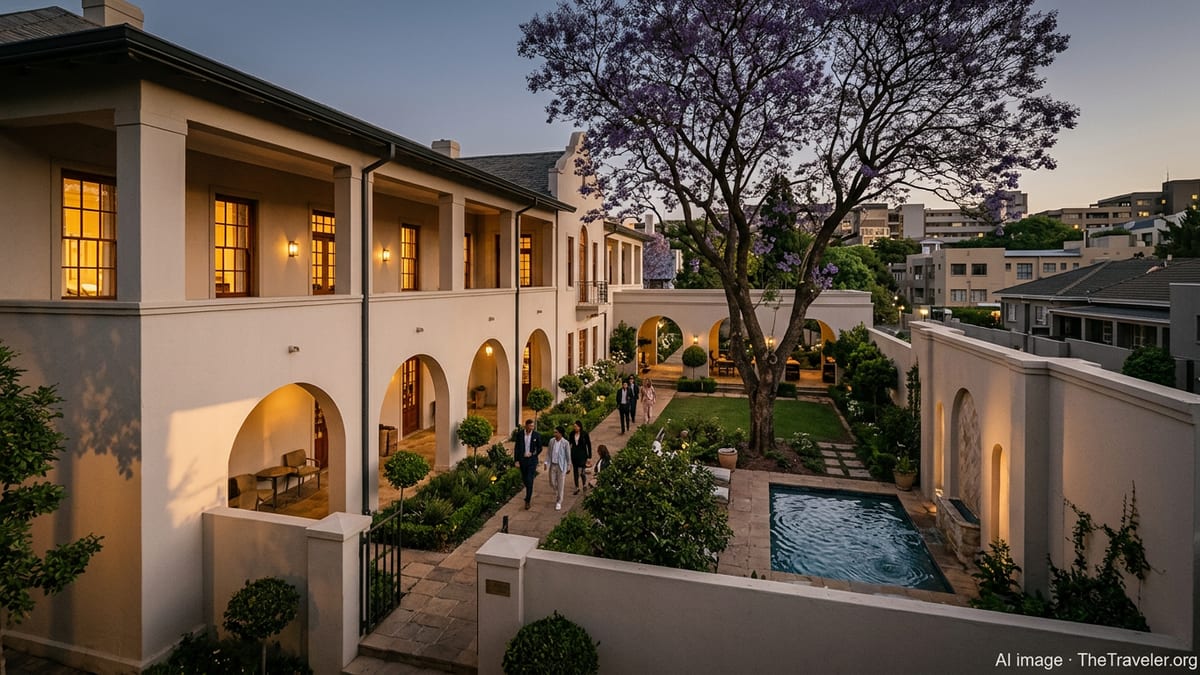
A Heritage Mansion Reborn as a City Sanctuary
Opened on July 1, 2025, Park Hyatt Johannesburg marks the brand’s third destination in Africa and signals a confident bet on Johannesburg’s evolving status as a luxury city-break hub. Set in Rosebank, one of the city’s most walkable and culturally dynamic districts, the 31-key property is positioned as an intimate alternative to the mega-hotel model that has long defined business travel in the city.
The hotel occupies a 1930s-era mansion long known to locals as the Winston Hotel, now carefully restored and reimagined rather than replaced. Architects and designers have retained graceful arches, deep verandas, high ceilings and a central open-air courtyard, preserving the building’s classical lines while upgrading every surface and system to contemporary luxury standards.
Framed by sculpted gardens and a mature jacaranda tree, the courtyard has been recast as the property’s serene heart, with a heated outdoor pool and shaded seating creating a resort-like atmosphere just minutes from Rosebank’s offices and galleries. The effect is of a private residence turned urban retreat, where the city’s intensity fades as soon as guests pass through the gates.
Hyatt executives describe the property as a “residential-style” expression of the Park Hyatt brand, with a focus on quiet, highly personalized service. The small key count underlines that ambition, enabling staff to recognize returning guests and tailor stays in a way that is difficult for larger hotels to match.
Art-Led Design and a Sense of Place
Inside, Park Hyatt Johannesburg leans into art and design as a primary storytelling device. The public spaces are lined with works by South African artists, many created site-specifically, and arranged thematically by floor to echo the country’s landscapes, botanical heritage and archival imagery.
Guestrooms and suites, all with king beds and many with private patios overlooking the gardens, pair a restrained neutral palette with tactile details: Ndebele-inspired throws, hand-finished joinery, and curated photography and illustration that reference South Africa’s diverse biospheres. Room themes carry titles such as Trees, Forest, Safari and Explorer, subtly connecting visitors to the wider region beyond the city limits.
Marble-clad bathrooms with deep soaking tubs, generous showers and locally sourced amenities reinforce the property’s emphasis on calm, restorative spaces rather than showy opulence. Floor-to-ceiling windows draw in natural light and foreground views of the landscaping, a deliberate counterpoint to Johannesburg’s reputation as a hard-edged commercial capital.
The hotel has also partnered with luxury publisher Assouline to place collectible books, candles and design objects throughout lounges and suites, further positioning the property at the intersection of hospitality, culture and contemporary African aesthetics.
Culinary Ambition in Room 32 and The Lounge
Dining is a central part of the hotel’s proposition, with the flagship restaurant Room 32 designed as an immersive, chef-driven space. Its name nods playfully to the hotel’s boutique scale, and its menu is built around open-fire cooking and seasonal, locally sourced ingredients.
In keeping with Johannesburg’s growing reputation as a serious food city, Room 32 is pitched equally at in-house guests and local diners, with a culinary program that highlights South African produce and heritage flavors without veering into pastiche. The open kitchen structure allows guests to watch chefs at work, reinforcing the sense of connection and craft.
Adjacent to the restaurant, The Lounge serves as a flexible social hub from morning to late evening, with a focus on carefully mixed cocktails, South African wines and a concise selection of premium cigars. A dedicated sommelier curates a wine list that emphasizes terroir and smaller producers, aligning the beverage program with global interest in regional authenticity.
For business travelers, the ability to transition seamlessly from informal meetings over coffee to more formal dinners within the same intimate setting positions the hotel as an attractive alternative to larger convention-oriented properties in Sandton and the broader northern suburbs.
Wellness, Privacy and the New Urban Luxury
Park Hyatt Johannesburg’s wellness offering, centered on a soon-to-open spa, aims to blend international techniques with locally inspired treatments. Rituals built around indigenous ingredients such as rooibos, marula oil and baobab are expected to appeal to globally minded travelers seeking experiences that are grounded in place rather than generic hotel spa menus.
A compact but well-equipped fitness center and the heated outdoor pool complete the wellness footprint, with both facilities oriented toward the gardens to preserve the sense of refuge from the city. The emphasis is on privacy and quiet rather than spectacle, reflecting a broader shift in high-end travel away from ostentatious amenities and toward understated comfort.
The property’s event spaces follow a similar logic. With capacity for around 60 guests, the hotel targets intimate gatherings, board retreats and private celebrations rather than large-scale conferences. For Johannesburg’s financial and creative sectors, which increasingly value discretion and curated experiences, that scale is likely to be a selling point.
Hyatt has highlighted the opening as part of a wider expansion of its luxury and lifestyle portfolio, but in Johannesburg the effect is highly local: a compact urban hideaway that reframes what a city stay in the country’s economic capital can feel like.
Rosebank’s Rise as Johannesburg’s Design District
The arrival of Park Hyatt Johannesburg also underscores Rosebank’s rapid evolution into one of the city’s most desirable neighborhoods for both visitors and residents. With its cluster of contemporary art galleries, design-forward restaurants and pedestrian-friendly shopping streets, the district has emerged as a counterpoint to nearby Sandton’s glass-and-steel skyline.
Situated within walking distance of the Gautrain station, the hotel offers convenient rail access to O. R. Tambo International Airport, an infrastructure advantage that has helped Rosebank lure both business and leisure travelers who value time savings and reduced reliance on road transfers. The location also taps into a growing preference among international visitors for neighborhoods that feel lived-in rather than purely corporate.
For Johannesburg, long viewed primarily as a transit and business gateway, the opening of a small, design-conscious Park Hyatt signals a maturing luxury landscape. Together with a wave of art-focused and boutique properties across the city, the new hotel contributes to a narrative shift: from stopover destination to urban break in its own right.
As global travel patterns continue to rebalance and travelers seek stays that combine privacy, culture and a strong sense of place, Park Hyatt Johannesburg positions itself as a compelling new option in the city, promising a quieter, more curated take on the African metropolis.