

Arriving in the United Kingdom today, many visitors are surprised by how cash-light everyday life has become. From London coffee carts to rural pubs, card and mobile payments are now the default, yet cash has by no means disappeared. Understanding where cards are welcomed, when coins and notes are still handy and how fees and security work in practice will help you pay smoothly and avoid awkward moments at the till.
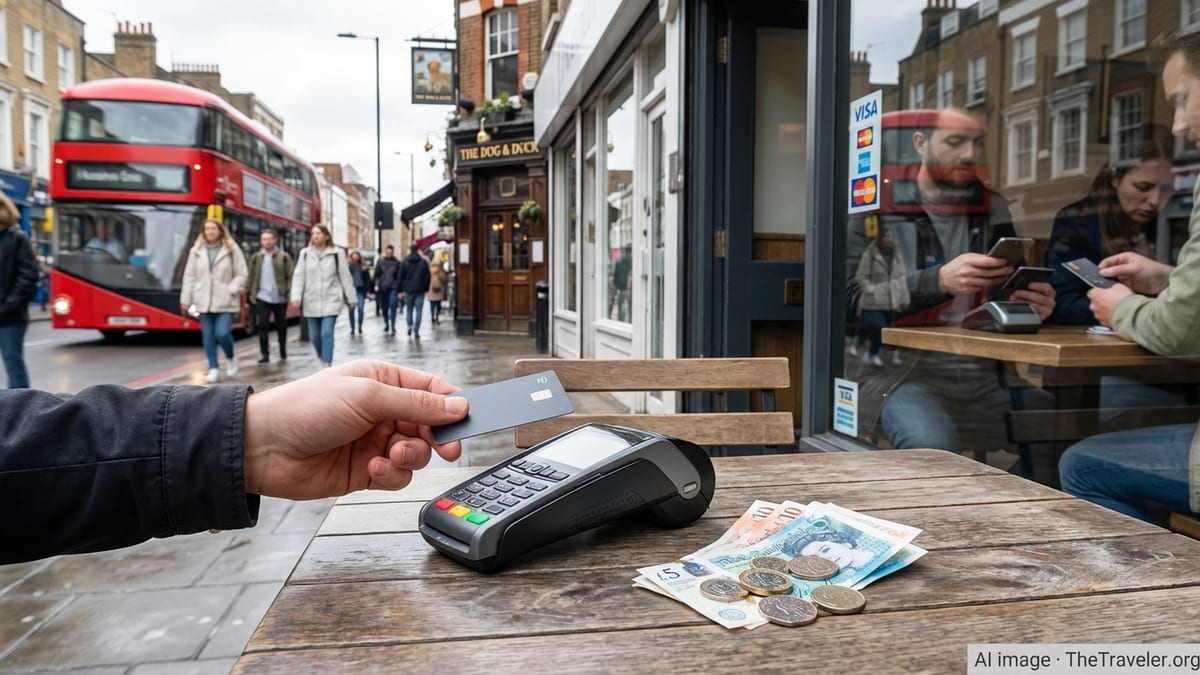
The UK’s Shift From Cash to Cards
Over the past decade the UK has moved decisively toward digital payments, with debit and credit cards now dominating in-store transactions. Industry data indicates that cards account for well over half of all payments and that contactless “tap” transactions have become the norm in shops, restaurants and on public transport. Cash has not vanished, but it now represents a relatively small share of total consumer spending compared with just a few years ago.
This trend is especially visible in cities such as London, Manchester and Edinburgh, where it is increasingly common to see “card only” signs and mobile terminals on every counter. Many younger residents use their phones or smartwatches rather than physical cards, and some never visit cash machines at all. For visitors, this means that arriving with a wallet full of banknotes is no longer essential for most day-to-day purchases.
Outside major cities, the picture is more mixed. Cards are widely accepted in supermarkets, chain stores and petrol stations throughout England, Scotland, Wales and Northern Ireland, but smaller independent shops, traditional pubs and market stalls may still prefer cash, particularly in rural areas. Travellers should expect to rely primarily on cards while keeping a modest amount of cash as a fallback in case a terminal is down or a business does not accept digital payments.
Despite the rapid shift, the government and regulators have repeatedly stressed the importance of protecting access to cash for groups who rely on it, such as some older people and those in more remote communities. For visitors, this policy backdrop means that cash machines, bank branches and post office counters are still available across the country, even as contactless taps continue to rise.
Contactless and Chip & PIN: How Card Payments Work
Most in-person card transactions in the UK are processed either by contactless tap or by inserting your card into a reader and entering a PIN. Virtually all modern payment terminals accept both methods, along with mobile wallets such as Apple Pay and Google Pay. For small and medium-sized purchases, contactless is now the default and is actively encouraged to speed up queues.
As of early 2026, the standard contactless limit set by regulators is in the process of changing. Until March 2026 most physical contactless cards allow individual tap payments up to 100 pounds without a PIN, with additional cumulative limits that trigger a PIN check after several taps in a row. From 19 March 2026 the national cap is due to be scrapped, allowing banks to set their own limits or keep the familiar 100 pound threshold. In practical terms, travellers should still expect most everyday purchases to be processed quickly via contactless, with an occasional request to insert the card and enter a PIN for security.
Mobile wallet payments on phones and watches are treated slightly differently. Because these rely on biometric checks such as fingerprints or face recognition, they are not usually bound by the same low-value cap that applies to plastic cards. This makes them popular for high-value shopping, although retailers can still choose to impose their own limits. For many visitors, loading a debit or credit card into a mobile wallet offers a smooth way to pay without repeatedly handling the physical card.
When contactless is not available, for example at some older petrol pumps or ticket machines, chip and PIN remains the fallback. UK terminals expect a four-digit PIN, which is standard in many countries but can catch out visitors from regions that rely on signatures. Travellers whose cards are signature-only may find that some unattended machines do not accept them, even if staffed tills can process the transaction. It is therefore sensible to carry at least one card with a PIN that you know and have tested before your trip.
Where You Can Rely on Cards and Where Cash Still Helps
In central London and other major cities, cards and mobile payments are close to universal. Hotels, restaurants, bars, supermarkets, department stores, attractions and ticket offices almost always accept mainstream Visa, Mastercard and often American Express. Public transport in London, including the Underground and most buses and trains, is designed around contactless taps and accepts foreign cards that support this technology. Many taxis and ride-hailing services also accept card or app payments as standard.
Beyond the big cities, card acceptance remains strong in chain supermarkets, national retailers, modern pubs and most accommodation providers. Petrol stations on motorways and major A-roads generally accept cards at the pump or in the kiosk. Even small market towns increasingly equip traders with compact wireless terminals that can process contactless payments in seconds. For the majority of travellers, it is entirely feasible to complete a whole trip with very limited use of cash.
There are, however, still pockets where coins and notes remain practical or preferred. Traditional village pubs, independent cafes, tiny newsagents and open-air markets may rely on basic terminals that can be slow or occasionally out of service, and some may operate as cash-only, especially for very low-value purchases. Public toilets in some areas still use coin-operated turnstiles, though local councils have been gradually updating facilities.
Cash is also useful for small tips, charity collections and street performers, as well as for situations where you want to split a bill quickly among friends without navigating multiple card payments. While an increasing number of buskers and vendors now display QR codes or portable terminals, visitors should not assume this everywhere. Carrying a small mix of coins and lower-value notes allows you to navigate these exceptions without needing to hunt for a cash machine at short notice.
Card Fees, Currency Choices and ATMs for Visitors
For most tourists, the practical question is not whether cards will be accepted, but what they will cost. Many banks around the world charge foreign transaction fees when a card is used in a different currency, often as a percentage of the purchase. Some also add extra charges for cash withdrawals from overseas ATMs. Before travelling, it is worth checking your bank’s policy and, if possible, bringing at least one card with low or no foreign usage fees.
At shops, restaurants and hotels, you may occasionally be asked whether you want to pay in pounds sterling or in your home currency. Choosing to pay in pounds and letting your own bank handle the conversion is usually better value than accepting a rate set by the merchant’s terminal, which can be noticeably less favourable. This practice, known as dynamic currency conversion, is entirely optional, and you can politely insist on being charged in local currency if offered the choice.
Cash machines are widely available in towns and cities, attached to bank branches, supermarkets and some convenience stores. Many are free to use for UK-issued cards, but foreign cardholders may see two layers of fees: one from their home bank, and occasionally a usage fee imposed by the ATM operator. Machines that intend to charge an additional fee must display a clear warning on screen before you confirm the withdrawal. If you see a message about an operator fee, you can cancel the transaction and try a different machine nearby.
When withdrawing money, it is again advisable to select pounds rather than agreeing to a withdrawal in your home currency, if given the option. Accepting conversion at the machine can lock in a poor exchange rate. For most travellers, the most economical approach is to rely primarily on a competitive debit or credit card for everyday spending, and to use ATMs sparingly to obtain a modest float of cash for places that do not accept cards.
Security, Fraud Protection and Practical Safety Tips
Digital payments in the UK are governed by regulations that place strong obligations on banks and card issuers to protect customers from fraud. If your card is lost, stolen or cloned and used without your permission, you can typically reclaim the money for unauthorised transactions, provided you report the issue promptly and have not acted with gross negligence. This framework is one reason many residents are comfortable relying so heavily on cards and mobile wallets.
Contactless cards do carry some risk if they fall into the wrong hands, because low-value transactions can be made quickly without a PIN. However, card issuers use various safeguards, such as limits on consecutive taps and automated monitoring systems that flag suspicious patterns. If you misplace a card, it is important to notify your bank or use its app to freeze the card as soon as you realise, which greatly reduces the scope for misuse.
For visitors, sensible precautions mirror those you would take anywhere else. Keep your primary card in a secure place and consider carrying a second card separately in case the first is lost or blocked. Avoid letting cards out of your sight for long periods and be cautious when using them at unattended terminals. When entering a PIN, shield the keypad and be alert to anyone standing unusually close. Many banks now offer instant spending notifications through their apps, which can help you spot unfamiliar transactions quickly.
Cash, too, carries its own risks. Pickpocketing can occur in crowded tourist areas, so keep wallets zipped away and avoid carrying large sums in one place. Because the UK is now so card-oriented, there is generally no need to travel with large quantities of cash. A balanced mix of digital payments for most purchases and a small reserve of notes and coins for exceptions usually offers the safest and most convenient combination.
Tipping, Service Charges and How Payment Method Matters
Tipping customs in the UK can seem subtle to visitors, and the shift from cash to cards has added new questions. In many sit-down restaurants, a discretionary service charge of around 10 to 15 percent may be added to the bill, especially in cities and higher-end venues. If this appears clearly on the receipt, there is no expectation to tip again on top unless you feel the service was exceptional. Where no service charge is included, leaving a similar amount or rounding up the bill is a common approach but not mandatory.
Historically, some diners preferred tipping in cash due to concerns that card tips might not reach staff. However, new legal rules are aimed at ensuring that tips and service charges paid by card are passed on fairly to workers rather than retained by businesses. This means that, in general, you can feel comfortable adding a tip by card if you do not have cash to hand. Payment terminals in restaurants often present preset tip percentages, though you can usually choose a custom amount or decline entirely.
In pubs, coffee shops and casual eateries, tipping expectations are lower. You might see a jar on the counter for spare change, or a card machine prompt asking whether you wish to leave a small percentage. In many cases, customers simply pay the bill with no tip, and staff are unlikely to be offended. Taxi drivers may be tipped by rounding up the fare or adding a small amount via card when the transaction is processed. Hotel staff, such as cleaners or porters, still often receive tips in cash, although some hotels now allow gratuities to be added to the room bill by card.
Recent research in the UK suggests that a significant number of people still prefer to tip in cash, believing it feels more personal and gives greater confidence that the money goes directly to the intended person. For travellers, the practical takeaway is that both cash and card tipping are acceptable. If you value the immediacy of placing a coin or note directly into someone’s hand, keep a small stash of cash. If you rely heavily on cards, you can usually add a gratuity electronically without worrying that it will vanish into company accounts.
Choosing Between Card and Cash: Practical Scenarios
For day-to-day sightseeing and shopping, cards and mobile wallets are almost always the most convenient option. Buying coffee, paying museum admission, taking a train or tapping through the Underground barriers can all be handled swiftly with a single tap. Using a competitive card can also reduce the costs associated with exchanging and carrying cash, particularly on shorter trips where you might otherwise end up taking unused pounds home or paying additional fees to convert them back.
Cash comes into its own in more informal or low-tech situations. At a small village fete or local market, a few stalls may still accept only coins and notes or may struggle when mobile signal is poor and terminals cannot connect. Dropping a pound or two into a charity bucket, paying for a programme at a small community theatre or contributing to a collection at a church service are all examples where cash may feel more appropriate or may be the only option.
Budgeting style is another factor. Some travellers like the discipline that comes from withdrawing a set amount of cash and using that as a daily allowance, helping to keep card spending in check. Others prefer the visibility offered by banking apps, which provide real-time updates and categorised spending summaries for every tap and online purchase. Neither approach is inherently better, but understanding your own habits will help you decide whether to lean more heavily on plastic or paper.
In shared-cost situations, such as group dinners or road trips, mixing methods can be practical. One person might pay a restaurant bill with a card while others reimburse their share in cash, or vice versa. Digital payment apps used between UK residents may not always be accessible to visitors, so having both card and cash available keeps options open and avoids awkward arithmetic at the end of the evening.
The Takeaway
For travellers in 2026, the United Kingdom is effectively a card-first destination. Contactless payments using debit and credit cards or mobile wallets are routine across cities and are increasingly common even in smaller towns. Regulatory protections, improving technology and changing habits have made digital payments fast, familiar and generally secure for residents and visitors alike.
Yet cash retains a modest but meaningful role. It smooths over gaps in card coverage, supports tipping and small informal transactions and can suit travellers who find physical money easier to budget with. Access to cash is still broadly protected, with ATMs and cash services available through banks and post offices across the country.
The most comfortable approach for most visitors is a blended one. Rely on cards or mobile wallets for the bulk of your spending, particularly higher-value purchases and transport, while keeping a small reserve of cash for tips, tiny shops and the occasional cash-only surprise. By understanding how payments work in practice, including fees, security and cultural norms around tipping, you can move confidently through the UK’s cafes, pubs, galleries and trains without your wallet ever becoming a source of stress.
FAQ
Q1. Do I need to carry cash when visiting the UK?
While you can complete most transactions with a card or mobile wallet, it is wise to carry a small amount of cash for tips, small independent shops and occasional cash-only situations.
Q2. Are foreign debit and credit cards widely accepted?
Yes. Visa and Mastercard are broadly accepted across the UK, and many places also take American Express, though not all smaller businesses do.
Q3. Is contactless payment available everywhere?
Contactless is standard in cities and common in towns, especially for transport, restaurants and shops, though a few small or rural businesses still rely on cash or chip and PIN.
Q4. What is the typical contactless limit in the UK?
For most physical cards, individual contactless payments up to around 100 pounds are usually approved without a PIN, though banks may adjust limits and can request PIN checks at intervals.
Q5. Should I pay in my home currency or in pounds?
It is generally better value to pay in pounds and let your own bank convert the currency, rather than accepting a conversion rate offered by the merchant’s terminal.
Q6. Are cash machines easy to find?
Yes. ATMs are common in cities and towns, often at banks and supermarkets, although some may charge fees to foreign cardholders which are shown on screen before you confirm a withdrawal.
Q7. Is it safe to use contactless cards in the UK?
Contactless payments are widely used and protected by banking regulations, but you should still report lost or stolen cards quickly and monitor your account for unfamiliar transactions.
Q8. Can I add tips by card in restaurants?
In most restaurants you can add a tip directly on the card machine or via a discretionary service charge on the bill, and current rules are designed to ensure these tips reach staff.
Q9. Are there many cashless-only businesses?
Some chains and individual venues have adopted card-only policies, particularly in cities, so relying solely on cash can be inconvenient in modern urban areas.
Q10. How much cash should I bring for a short trip?
For a long weekend, many visitors find that withdrawing the equivalent of 40 to 80 pounds in cash is enough for small purchases and tips, with most other spending on cards.