

More news on this day
Philippine Airlines has filed with US authorities for permission to launch a new nonstop service between Manila and Chicago as early as the summer 2026 travel season, aiming to open the first direct air bridge between the Philippines and the US Midwest hub.
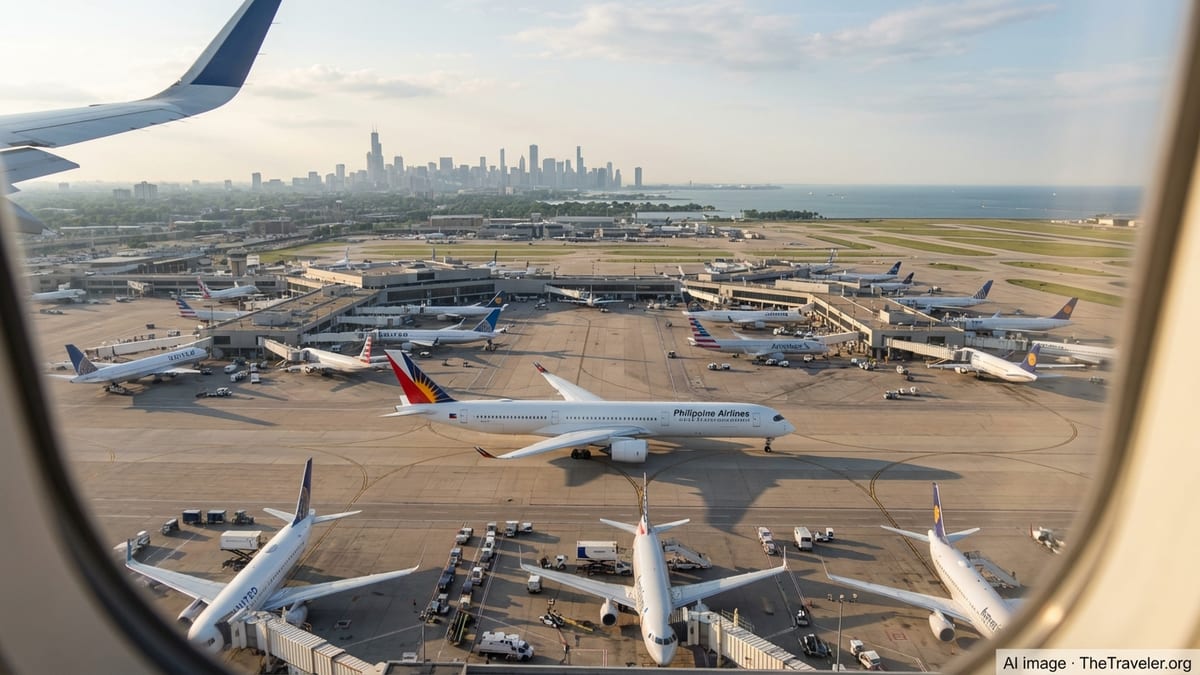
Bid Filed With US Regulators for Summer 2026 Launch
The flag carrier submitted its application to the US Department of Transportation on February 24, requesting authority to operate scheduled passenger flights between Manila’s Ninoy Aquino International Airport and Chicago O’Hare International Airport. The airline has asked regulators for expedited approval so it can begin selling tickets in time for the International Air Transport Association’s summer 2026 season, which runs from late March to late October.
If cleared, the route would be among the world’s longest commercial services, with a great-circle distance of just over 8,100 miles. Philippine Airlines highlighted that the proposed flights fall within the framework of the existing US–Philippines air services agreement, which allows Philippine carriers to serve designated mainland gateways plus additional points chosen by the Philippine government. Chicago has now been selected as one of those additional points.
The application did not disclose a start date, schedule, weekly frequency or aircraft type. However, the request signals the airline’s intent to firm up details quickly, positioning the new link for launch sometime during the summer 2026 window, subject to regulatory clearance and operational planning.
Chicago Poised to Become Strategic Sixth US Gateway
The proposed Chicago service would deepen Philippine Airlines’ footprint in North America, where it already operates nonstop flights from Manila to Los Angeles, San Francisco, New York, Seattle and Honolulu, alongside services to US territories Guam and Saipan. Industry data show the carrier commands a dominant share of capacity in the US–Philippines market, and Chicago is seen as a logical next step in its transpacific strategy.
Chicago O’Hare is one of the busiest hubs in the United States, offering extensive onward connections across the Midwest and to the East Coast. Philippine Airlines argues that a nonstop link will provide a new option for travelers who currently rely on one-stop itineraries via East Asian and Gulf hubs to reach Manila and other Philippine destinations.
No airline has operated nonstop commercial flights between Manila and Chicago in at least two decades, forcing passengers to route through cities such as Seoul, Taipei, Tokyo or Hong Kong. A direct service is expected to appeal to the large Filipino diaspora in the region, as well as to business travelers and tourists seeking shorter travel times and fewer connections.
Serving a Growing Filipino Community and Trade Corridor
The demographic case for the new route is strong. According to recent US Census data cited by the airline and aviation analysts, more than 128,000 people of Filipino descent live in Illinois, with nearly a quarter of a million residing across the broader 12-state Midwest region. Chicago ranks among the top American cities by Filipino population, behind established coastal gateways where Philippine Airlines already flies nonstop.
Beyond visiting friends and relatives traffic, the airline is targeting demand from business travelers, students and tourists moving between Southeast Asia and the central United States. Closer air links are expected to support trade and investment flows, with Chicago serving as a major center for finance, logistics, health care, technology and higher education.
Travel industry observers note that the timing also aligns with a broader rebound in transpacific demand and an expected uptick in leisure and family travel in 2026. While Chicago is not among the host cities for the 2026 FIFA World Cup, analysts say the overall visibility of North America as a tourism destination could still benefit long-haul carriers such as Philippine Airlines.
Ultra Long-Haul Mission Aligned With Fleet Expansion
The ultra long-distance nature of the Manila–Chicago sector means Philippine Airlines will likely deploy its latest generation widebody aircraft. The carrier is in the midst of a fleet renewal program that includes a new batch of Airbus A350-1000 jets, deliveries of which began in late 2025. With a range of roughly 9,000 nautical miles, the type is suited to missions similar in length to the proposed Chicago service.
The airline has already extended a long-term flight-hour services agreement with Airbus to support its A350, A330 and A320 family aircraft, a move aimed at boosting reliability and availability across its long-haul and regional network. Industry analysts say the Manila–Chicago proposal underscores how Philippine Airlines plans to leverage these aircraft to deepen its presence in key North American markets.
While the carrier has not announced a definitive aircraft assignment for the route, the Manila–Chicago sector would likely become one of Philippine Airlines’ longest services, comparable to or slightly shorter than its Manila–New York flights. The additional ultra long-haul flying would further position Manila as a hub for connecting traffic between Southeast Asia, North Asia and North America.
Strengthening Manila’s Role as a Regional Gateway
The Chicago filing comes as Philippine Airlines restructures parts of its domestic and regional operation to make more room for larger jets at Manila’s congested main airport. From late March, the airline plans to move turboprop flights to secondary hubs such as Clark, Iloilo and Cebu, freeing up slots for long-haul and high-density narrowbody services.
At the same time, the carrier is adding frequencies and new routes across the Pacific, including increased service to Los Angeles and the resumption of direct flights to Saipan in 2026. Together with the potential Chicago launch, these moves are intended to solidify Manila’s role as a primary gateway between the Philippines, the wider Asia-Pacific region and North America.
Travel agents and tourism officials in both countries are watching the regulatory process closely. If US authorities grant timely approval and the airline proceeds as planned, passengers across the Midwest could gain a new, nonstop link to Manila by the peak of the 2026 summer season, marking a significant milestone in US–Philippines aviation ties.