

Phnom Penh is often introduced to travelers as a city of riverfront cafes and gilded spires, yet its most defining landmarks tell a more complex story. Within a relatively compact radius lie the Royal Palace, the National Museum, and the country’s most powerful memorial sites, including Tuol Sleng Genocide Museum and the Choeung Ek Genocidal Center.
Together, they chart Cambodia’s journey from royal grandeur to cultural rebirth and the darkest chapters of the Khmer Rouge era, inviting visitors not just to look, but to reckon, reflect, and learn.
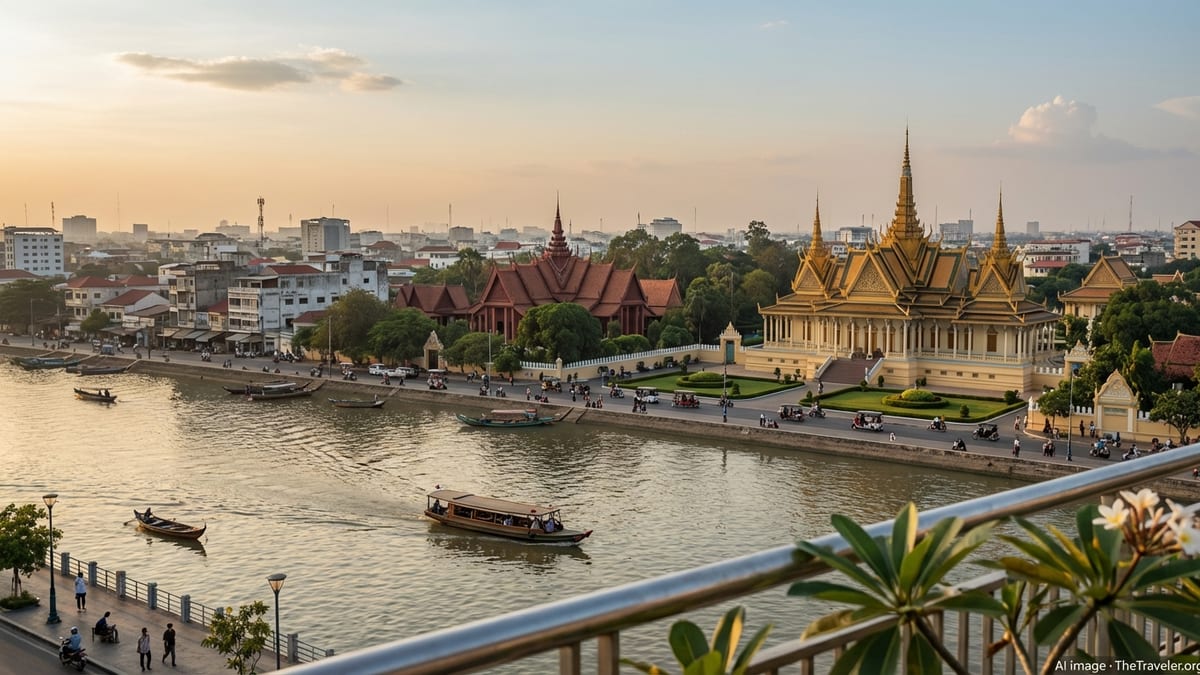
Royal Palace: Living Seat of the Monarchy
The Royal Palace dominates central Phnom Penh with a cluster of golden roofs, courtyards, and manicured gardens that feel worlds apart from the motorbike-filled streets outside its walls. Reopened to tourists in late 2022 after a prolonged closure, it again serves as the most accessible window into Cambodia’s royal traditions and modern constitutional monarchy. Portions of the complex remain in active use by the royal family, which gives the site a sense of lived-in continuity rather than museum-like stasis.
For visitors, the main draw is the Throne Hall, a soaring reception space used for coronations and state ceremonies. The building’s high ceilings, royal regalia, and murals embody classical Khmer architecture blended with 19th- and 20th-century influences. Although access is limited to public areas and photography rules vary, the Throne Hall offers a rare glimpse into how Cambodia stages its most important national rituals today.
Equally compelling is the Temple of the Emerald Buddha, also called Wat Preah Keo Morakot, an ornate pagoda within the palace compound. Here, floors are inlaid with silver tiles and display cases hold Buddha images and royal religious objects. Visitors move through a series of courtyards and stupas, encountering a fusion of sacred space and royal symbolism. The experience is intentionally uplifting and ceremonial. Compared with the city’s genocide memorials, the palace emphasizes continuity, legitimacy, and the spiritual underpinnings of Cambodian statehood.
Experiencing the Palace: Atmosphere, Etiquette, and Practicalities
Stepping inside the Royal Palace grounds, many travelers are struck first by quiet. The rush of traffic recedes behind high walls, replaced by the sound of birds, temple bells, and gardeners at work. Paths between buildings are lined with frangipani trees and clipped hedges, creating a setting that is more contemplative than grandiose. Visitors are asked to respect the palace’s dual role as residence and ceremonial heart of the nation by dressing modestly, avoiding loud conversation, and keeping to marked routes.
The palace is best visited in the morning or late afternoon when temperatures are more manageable and light is soft on the gilded roofs. While opening hours have largely stabilized since tourism resumed, it is common for portions of the palace to close unexpectedly for official events or royal ceremonies. Travelers planning a tight schedule should build in some flexibility and be prepared for partial access at times. Compared with museums and memorials, which rarely shut for official functions, the palace is the most likely major site to be affected by the political calendar.
From a logistical perspective the palace is the most straightforward landmark to reach. Located between the Tonle Sap and the center of Phnom Penh, it can be accessed on foot from the riverfront hotels or via a quick tuk-tuk ride from most central districts. This accessibility, combined with its visual impact, makes it the natural starting point for understanding Phnom Penh’s layout and its layered history. Travelers emerging from the palace grounds will find themselves only a short walk from the National Museum, creating an easy progression from monarchy to material culture.
National Museum of Cambodia: Culture in Transition
The National Museum of Cambodia, just north of the Royal Palace, has long served as the country’s principal repository for Khmer sculpture and artifacts. Built in a reddish traditional style around a central courtyard, it houses thousands of statues, lintels, ceramics, and everyday objects that trace Cambodian civilization from its earliest Hindu-Buddhist kingdoms to the Angkor era and beyond. For many travelers, the museum contextualizes the temples of Angkor by revealing original carvings rescued from jungle sites or returned from overseas collections.
Today the museum is in the midst of a significant modernization and expansion program scheduled to run through 2026. Backed by international cultural agencies, this project aims to upgrade exhibition spaces, climate control, and interpretive materials, as well as create new galleries for the growing number of repatriated artifacts. In recent years, high-profile restitutions from major Western museums and private collections have sent important Khmer sculptures back to Phnom Penh, further enriching the museum’s holdings and prompting a rethink of how to present them.
For visitors, this transition has two main consequences. First, certain rooms or wings may be closed or in flux as renovations proceed, so the museum experience can feel uneven from gallery to gallery. Second, new or re-curated exhibits can appear with little fanfare, meaning that repeat visitors in 2026 and beyond are likely to find a subtly different institution from the one they saw just a few years earlier. Compared with the relatively stable presentation at genocide memorials, the National Museum is a moving target, reflecting the active process of cultural recovery and re-interpretation.
Inside the Galleries: Comparing Past and Present Narratives
Walking through the National Museum, travelers encounter an arc of Cambodian history that contrasts sharply with the trauma on display at Tuol Sleng and Choeung Ek. Here, the emphasis is on creative achievement: sinuous stone apsaras, serene Buddha faces, and dynamic depictions of Hindu deities from Angkor and pre-Angkorian sites. Labels often describe how these pieces were once part of temple complexes now in ruins, highlighting the fragility of heritage in a country battered by war and looting.
Recent returns of Khmer deities from Western museums underscore this fragility and the ongoing work of repair. Sculptures that spent decades in foreign galleries now appear in Phnom Penh’s showcases with carefully researched provenance and, increasingly, diplomatic context. Rather than simply celebrating their beauty, new displays highlight how and why such pieces left Cambodia, and what their restitution means for national identity. This narrative of loss and recovery resonates deeply when visitors later confront the mass violence documented at the genocide sites.
In practical terms the National Museum offers one of the gentlest introductions to Cambodian history. It is suitable for travelers of most ages, including families with children, although some sections are quieter and less interactive than modern museums elsewhere. Compared with the emotionally heavy experience of the memorials, time in the museum is reflective rather than harrowing, allowing visitors to appreciate the depth of Cambodia’s cultural heritage before or after engaging with its more recent tragedies.
Tuol Sleng Genocide Museum: School Turned Prison
Tuol Sleng Genocide Museum, known during the Khmer Rouge period as Security Prison 21 or S 21, is housed in a former Phnom Penh high school where an estimated 15,000 people were imprisoned, tortured, and condemned between 1975 and 1979. Classrooms were subdivided into cells, equipped with shackles, and turned into interrogation chambers. Today, the site remains one of the world’s most starkly preserved modern torture centers, recognized in 2025 as part of a World Heritage inscription that includes other former Khmer Rouge sites.
The museum is centrally located, making it easy to reach from most of Phnom Penh’s hotels by tuk-tuk or taxi. It is open daily from morning through late afternoon and operates with clear visitor regulations emphasizing respectful dress and conduct. The atmosphere inside is quiet, somber, and deliberately unadorned. Many rooms retain the original iron beds, leg irons, and stains visible in photographs taken by Vietnamese forces when they entered the prison in 1979. Large black-and-white portraits of victims line entire walls.
Compared with the Royal Palace and National Museum, Tuol Sleng’s power lies less in objects than in the raw authenticity of its spaces. Visitors are not looking at curated relics behind glass, but walking along the same corridors where prisoners were marched to interrogation and where guards logged meticulous records of their suffering. Audio guides and personal guides in multiple languages help explain the broader context of the Khmer Rouge regime, its paranoid ideology, and the machinery of terror that turned ordinary citizens into both perpetrators and victims.
Memory, Education, and Emotional Impact at Tuol Sleng
Tuol Sleng functions simultaneously as a memorial, a research site, and a human rights educational center. Exhibitions range from archival photographs and prisoner confessions to paintings by survivors depicting scenes of torture. Temporary displays often focus on specific survivor testimonies, efforts to identify victims from the archives, or broader questions of justice and reconciliation. Scheduled programs, including documentary screenings and survivor dialogues on certain days, invite visitors to engage more deeply with the human stories behind the statistics.
The emotional impact of a visit can be intense. Many travelers describe feeling a heavy silence as they move from building to building, reading names, ages, and confessions written under duress. The museum recommends that visitors under 14 not attend due to the graphic nature of some material. Even for adults, pacing and self-care are important. It can be wise to plan a quiet afternoon afterward rather than rushing on to entertainment or nightlife. In contrast to the uplifting message at the Royal Palace, Tuol Sleng is designed to confront the worst of human behavior and prompt reflection on how such crimes become possible.
From a comparative standpoint, Tuol Sleng offers the most detailed narrative about the inner workings of the Khmer Rouge security apparatus. Where Choeung Ek focuses on the final stage of execution and burial, Tuol Sleng documents arrest, interrogation, and the transformation of a modern city school into a tool of state terror. Visitors who see both gain a fuller understanding of the system as a whole. While logistics are simple and admission fees are modest, the true cost of visiting is emotional rather than financial.
Choeung Ek Genocidal Center: The Killing Fields
About 17 kilometers south of central Phnom Penh, the Choeung Ek Genocidal Center occupies a former orchard and Chinese cemetery that became one of the Khmer Rouge’s most notorious execution grounds. Prisoners from Tuol Sleng and other facilities were transported here, usually at night, to be killed and buried in mass graves. After the regime fell, investigators exhumed thousands of bodies, uncovering a landscape of pits, bone fragments, and scraps of clothing. Today, Choeung Ek is marked by a memorial stupa filled with human skulls and bone fragments, arranged by age and sex.
The site operates daily, with opening hours stretching from early morning to late afternoon, and an admission fee that usually includes an audio guide available in multiple languages. The drive from Phnom Penh takes 30 to 45 minutes by tuk-tuk or private car, following increasingly quiet roads as the city thins into fields and village houses. Visitors are required to dress modestly, covering shoulders and knees, in recognition of the site’s status as both cemetery and shrine.
Compared to Tuol Sleng, Choeung Ek is more open and landscaped, with grassy paths winding between marked mass grave pits. Many of these graves remain only partially excavated, and during the rainy season it is still possible to see small fragments of bone or cloth emerging from the soil. Signage and the audio tour explain not only what happened here, but also how the site has been managed over the decades and how Cambodians negotiate the need to remember with the desire for spiritual peace.
UNESCO Recognition and the Ethics of Visiting Choeung Ek
In 2025, UNESCO formally recognized Choeung Ek, along with Tuol Sleng and another former Khmer Rouge prison, as World Heritage sites. The inscription signaled a broader international shift toward acknowledging modern atrocity locations as heritage worthy of preservation, not only ancient temples and archaeological ruins. For Cambodia, this recognition brought renewed attention and resources to ensure that the physical evidence of crimes is preserved for future generations without turning the grounds into a spectacle.
Management of Choeung Ek has for years involved a cooperation between public authorities and a private concessionaire operating as a non-profit. Revenues from ticket sales and audio guides contribute to educational initiatives intended to draw lessons from the past. This model has sparked debate about how best to fund and manage sites of mass suffering, but it has also allowed Choeung Ek to maintain a relatively high standard of interpretation, cleanliness, and visitor services compared with many mass grave sites elsewhere in the world.
For travelers, ethical considerations should guide behavior at Choeung Ek. Photography is generally permitted, but many survivors and families of victims prefer that visitors refrain from posing for smiling portraits near the stupa or mass graves. Loud conversation, music, and consumption of food within the memorial grounds are discouraged or prohibited. In practical terms, it is wise to bring tissues or water, as the combination of heat, audio testimony, and visual evidence can be emotionally and physically draining. Seen alongside the Royal Palace’s ceremony and the National Museum’s artistry, Choeung Ek completes a triangle of understanding about the extremes of Cambodian experience.
Planning Your Route: How the Landmarks Complement Each Other
To grasp Phnom Penh’s landmarks in context, it helps to think in terms of narrative flow rather than checking off sights. One effective approach is to begin with the Royal Palace and National Museum, move on to Tuol Sleng, and finish with Choeung Ek. This order mirrors Cambodia’s journey from precolonial and royal heritage through the turbulence of the 20th century and into the horrors of the Khmer Rouge period. By starting with culture and ceremony, travelers bring a sense of what was at stake when the regime tried to remake society by force.
Alternatively, some visitors prefer to reverse the sequence, confronting Tuol Sleng and Choeung Ek first and then spending time in the National Museum and palace gardens as a way to decompress. Both sequences are valid, but mixing a genocide memorial directly with lighthearted leisure activities can feel jarring. Phnom Penh’s compact size makes it easy to allocate different halves of a day to different themes, with riverside cafes and shaded parks serving as buffers between emotionally demanding sites.
Practical logistics are relatively simple. The Royal Palace and National Museum are within walking distance of each other in the city center. Tuol Sleng lies a short tuk-tuk ride to the southwest. Choeung Ek is the only major site that requires a longer journey out of town, often arranged through hotels, travel agencies, or ride-hailing apps. Admission fees for all these locations are modest by global standards, but travelers should carry cash in US dollars or Cambodian riel, as card facilities are not universally available, particularly at Choeung Ek.
Respect, Reflection, and Responsible Tourism
What distinguishes Phnom Penh from many capitals is the tight proximity of sites that celebrate royal and artistic achievements and those that document mass murder. This proximity challenges visitors to move beyond simple sightseeing and consider how societies rebuild after trauma. The same city that crowns kings and stages classical dance performances is also home to classrooms filled with mugshots of the disappeared and fields still yielding human remains after heavy rain.
Responsible tourism in this context means paying careful attention to local expectations around dress and behavior, supporting institutions that invest in research and education, and giving space to Cambodian voices. Guides at Tuol Sleng, curators at the National Museum, and staff at Choeung Ek are often engaged in long-term projects of documentation and outreach. By purchasing audio guides, attending talks or film screenings when available, and treating these experiences as more than quick photo stops, travelers contribute to a wider ecosystem of remembrance.
Visitors should also be aware that for many Cambodians, the events memorialized at Tuol Sleng and Choeung Ek are within living memory. Survivors, former refugees, and their descendants walk the same streets as holidaymakers and business travelers. Approaching conversations about the Khmer Rouge era with humility, avoiding intrusive questions, and recognizing that not everyone wishes to revisit these memories are important elements of cultural sensitivity. Ultimately, Phnom Penh’s landmarks invite a kind of tourism rooted in empathy, curiosity, and respect.
The Takeaway
Phnom Penh’s Royal Palace, National Museum, and genocide memorials form a powerful constellation of landmarks that together tell the story of a nation shaped by both splendor and suffering. The palace and museum highlight continuity, creativity, and the deep cultural roots of Cambodian civilization. Tuol Sleng and Choeung Ek confront the machinery of terror that sought to erase those very foundations within a single generation.
Travelers who engage thoughtfully with all of these sites will come away with more than a collection of photographs. They gain a layered understanding of how Cambodia has navigated the transition from royal courts to revolution, from devastation to reconstruction, and from silence to public remembrance, now underscored by international recognition through World Heritage status. The experience can be challenging, but it is also profoundly illuminating.
In the end, comparing Phnom Penh’s landmarks is less about deciding which is most worth visiting and more about understanding how each plays a distinct role in a shared narrative. Together they offer a rare opportunity to move, in the space of a day or two, from golden spires to stone deities to classrooms of terror and fields of graves, and then back again to a city that continues to evolve. For travelers willing to look closely and listen carefully, Phnom Penh becomes not just a destination but a living archive of memory, resilience, and hope.
FAQ
Q1. How much time should I allocate to visit the Royal Palace in Phnom Penh?
Most visitors spend between one and two hours exploring the publicly accessible sections of the Royal Palace, including the Throne Hall, surrounding courtyards, and the Temple of the Emerald Buddha. If you enjoy photography, architecture, or simply sitting in the gardens, plan closer to two hours, especially during cooler morning or late afternoon periods.
Q2. Is the National Museum of Cambodia worth visiting if I have already seen Angkor’s temples?
Yes. The National Museum holds many original sculptures and artifacts that once adorned Angkor’s temples and other historic sites, along with pieces recently returned from overseas collections. Seeing these works up close, often with explanatory labels and thematic displays, provides historical and artistic context that complements a visit to Angkor rather than duplicating it.
Q3. Can children visit Tuol Sleng Genocide Museum and Choeung Ek, and is it advisable?
Both sites allow entry, but Tuol Sleng specifically notes that exhibits may not be suitable for visitors under 14 due to graphic content. Parents should consider their children’s age, sensitivity, and prior understanding of the subject matter. Some families choose to visit only the National Museum and Royal Palace with younger children, saving genocide memorials for older teens or adults.
Q4. What should I wear when visiting the Royal Palace and the memorial sites?
Modest dress is expected at all of these landmarks. Shoulders and knees should be covered, and very tight or transparent clothing is discouraged. At the Royal Palace, visitors who arrive in shorts or sleeveless tops may be denied entry or asked to cover up, while at Tuol Sleng and Choeung Ek modest dress is both a sign of respect and sometimes a formal requirement.
Q5. In what order should I visit the Royal Palace, National Museum, Tuol Sleng, and Choeung Ek?
A common sequence is to start with the Royal Palace and National Museum in the morning, then visit Tuol Sleng in the afternoon, and make a half-day trip to Choeung Ek on a separate day. This pacing allows time to absorb the emotional weight of the genocide sites without rushing, and it balances uplifting cultural experiences with more difficult historical ones.
Q6. Are guided tours or audio guides available at these landmarks?
Yes. The Royal Palace often has local guides available at the entrance. The National Museum may offer guided tours or audio materials depending on current programming. Tuol Sleng provides both personal guides and audio guides in multiple languages, while Choeung Ek typically includes an audio guide in the admission fee. Taking advantage of these options greatly deepens understanding of what you see.
Q7. How far is Choeung Ek from central Phnom Penh, and how do I get there?
Choeung Ek is roughly 17 kilometers south of the city center, and the journey usually takes 30 to 45 minutes each way depending on traffic. The most common options are hiring a tuk-tuk, arranging a car through your hotel or a travel agency, or using a ride-hailing app. It is advisable to agree on the fare or check estimated pricing before departing.
Q8. Are photography and filming allowed at these sites?
Photography is generally allowed in the outdoor areas of the Royal Palace, National Museum, Tuol Sleng, and Choeung Ek, but restrictions may apply inside certain buildings or around specific exhibits. At genocide memorials, visitors are asked to photograph respectfully and avoid posing for lighthearted or staged images near graves, skull displays, or victim portraits. Always check posted rules and follow staff guidance.
Q9. Do I need to book tickets in advance for these attractions?
For most individual travelers, advance booking is not necessary. Tickets for the Royal Palace, National Museum, Tuol Sleng, and Choeung Ek are typically purchased on arrival at the entrance. During major national holidays or peak tourist seasons, crowds can be heavier, but long sold-out situations are uncommon. Day tours combining several sites may require prior reservation through agencies.
Q10. How should I emotionally prepare for visiting Tuol Sleng and Choeung Ek?
It helps to approach both sites with an understanding that they present extremely painful history in a direct way. Reading a brief overview of Cambodia’s recent past beforehand, allowing enough time for a slow and thoughtful visit, and planning a quiet period afterward can make the experience more manageable. Many visitors find it valuable to talk with travel companions about what they have seen, or to process their thoughts in a journal, while keeping in mind that for Cambodians these events are part of living memory.