


More news on this day
Phnom Penh is rolling out a fresh green season tourism strategy that seeks to turn Cambodia’s rainy months into a showcase for sustainable urban growth, revitalised riverfronts and the capital’s layered cultural heritage.
Get the latest news straight to your inbox!
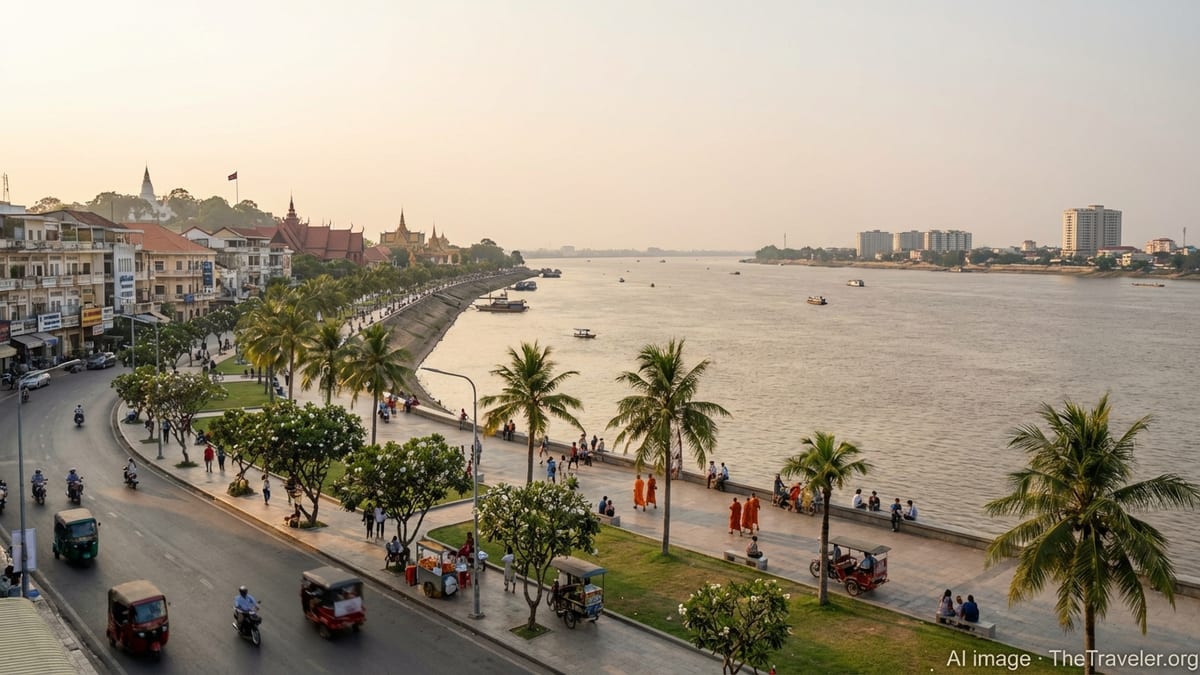
From Low Season to Lush Season
For years, the months from May to October have been described in Cambodian tourism marketing as the low season, a period when heavier rains and fewer public holidays in key source markets translated into thinner visitor numbers. Recent policy shifts are recasting this stretch as the green season, positioning the rains as a core attraction rather than an obstacle.
Reports indicate that national campaigns branded around the green season are now highlighting cooler temperatures, dramatic skies and countryside landscapes that transform into vivid shades of green. Phnom Penh, which sits where the Mekong, Tonle Sap and Bassac rivers meet, is being promoted as an ideal base to experience these seasonal changes while still enjoying the comforts of an urban hub.
Travel guidance from regional and international operators increasingly frames the rainy months as a strong value window, with lower hotel prices and fewer crowds at major sites. Publicly available information shows that tourism planners see this rebranding as essential to smoothing demand across the year, reducing pressure on infrastructure during the dry-season peak and creating a more resilient industry.
In the capital, the new messaging encourages visitors to look beyond beach or temple itineraries and see the city itself as a green season destination. Afternoon showers that clear the air, cooler evenings along the riverfront and photogenic reflections on rain-washed streets are being woven into a narrative of Phnom Penh as a cinematic monsoon city.
A Master Plan for a Greener Capital
The green season push is unfolding alongside wider urban sustainability goals. Planning documents and assessment reports on Phnom Penh’s development outline ambitions to become a cleaner and greener city, with expanded public parks, tree-lined boulevards and enhanced blue-green corridors along waterways.
Recent evaluations of urban strategies describe targets for preserving heritage buildings while improving drainage, public transport and pedestrian access. These efforts are framed as essential not only for residents but also for the tourism economy, which is expected to rely increasingly on a reputation for livability, safety and environmental responsibility.
According to published coverage of Cambodia’s tourism roadmap, national planners are seeking to align visitor growth with climate goals by promoting low-impact travel experiences, encouraging longer stays and channeling investment toward energy-efficient accommodation and attractions. Phnom Penh’s role in this vision is to serve as both gateway and model, illustrating how a fast-growing capital can nurture green spaces and cultural districts even as it densifies.
In practical terms, that means supporting initiatives such as waste reduction campaigns, river clean-up drives and sustainability certification efforts among hotels and tour operators. These programs, while still emerging, are presented as building blocks of a green season that is memorable for lush views and clean, well-managed public spaces.
Riverfront Revival and Waterway Experiences
The confluence of three major rivers has always defined Phnom Penh’s geography, but the green season strategy places this waterfront identity at the center of new tourism experiences. Publicly available information points to a growing number of river cruise operators, sunset boats and dining vessels active during the rainy months, when water levels rise and the city’s skyline is mirrored in broad, fast-moving channels.
Campaign materials emphasize that the monsoon period coincides with some of the Mekong system’s most dramatic natural cycles, including the seasonal reversal of the Tonle Sap River. For visitors, this translates into opportunities for boat excursions that highlight both the engineering challenges of flood management and the traditional riverside communities that have adapted to these rhythms over centuries.
Partnerships between tourism authorities and development organizations are also focusing on plastic waste reduction along key waterways. River clean-up drives and awareness programs are promoted as ways to improve the visitor experience while supporting local livelihoods that depend on fisheries, transport and waterside markets.
As part of the green season narrative, the riverfront is being reimagined as an open-air stage where sustainability, leisure and culture meet. The goal is to ensure that a cruise past stilt houses, modern towers and gilded pagodas feels like a single, coherent story of a city determined to thrive with the water rather than in spite of it.
Showcasing Heritage in the Rain
Phnom Penh’s renewed focus on the green season places equal emphasis on its architectural and cultural heritage. Museums, royal compounds, pagodas and French-era townhouses are being packaged as experiences that take on a different character under rain-darkened skies and in the softer light that follows afternoon storms.
Travel features about the capital increasingly highlight how the monsoon months accentuate details that can be washed out in the intense dry-season sun, from the deep reds of traditional tiles to the verdant courtyards of historic villas. Visitors are encouraged to time indoor visits around showers, using museum stops, cafes and galleries as natural pauses in a day shaped by shifting weather.
Heritage-focused itineraries developed for the green season often extend beyond the city center to include nearby silk islands, riverside villages and modern memorials. Public information about festival calendars notes that some religious observances and community events fall within the rainy period, offering additional layers of color for travelers seeking local encounters.
This approach positions the season not merely as a discounted version of peak travel months, but as a distinct lens on Phnom Penh’s story. Rain-slicked boulevards, incense drifting through temple halls and lotus ponds brimming with new water are all presented as part of a living heritage that relies on the rhythm of the monsoon.
Incentives, Connectivity and Responsible Growth
Alongside storytelling, Phnom Penh’s green season strategy is backed by practical incentives designed to nudge travel decisions. Tourism operators and hotel groups are promoting discounted stays, bundled city tours and added-value experiences such as spa treatments or cooking classes during the rainy months.
According to regional travel reports, airlines serving Cambodia have historically adjusted capacity during the monsoon, but the new push aims to maintain more consistent connectivity by stimulating demand. The opening of modern airport infrastructure, paired with digital payment tools and tourism apps, is expected to make short-notice travel during the green season more appealing to regional visitors.
Industry commentary also underscores the need to ensure that growth remains manageable. Messaging around the green season frequently references small-group excursions, community-based tourism in nearby provinces and responsible wildlife or nature experiences, all framed as alternatives to overcrowded peak-season routes.
By weaving together incentives, infrastructure improvements and a growing portfolio of sustainable experiences, Phnom Penh is seeking to deliver what planners describe as a majestic masterpiece of green-season travel. The strategy aims to show that the city’s future prosperity can be built around the return of the rains, revealing a capital where monsoon clouds and cultural treasures share the same spotlight.