

More news on this day
Just over two hours’ flying time from the UK, Spain’s Picos de Europa is emerging as one of Europe’s most dramatic yet under-the-radar mountain escapes, helped by a fresh wave of low-cost Ryanair connections to the nearby northern coast.
Get the latest news straight to your inbox!
New Budget Links From the UK to Spain’s Northern Coast
Travel data platforms show that Santander Airport on Spain’s Cantabrian coast is gaining renewed attention from UK travellers, with low advertised fares on Ryanair from several British airports. Flight schedule aggregators indicate that Ryanair and its UK arm are operating and planning multiple weekly services between the UK and Santander, including a London Stansted route scheduled at around two hours’ flight time. Recent fare searches from UK cities to Santander have returned headline prices under £30 one way on selected dates, reinforcing the destination’s appeal as a budget-friendly entry point to the region.
Industry route listings also point to new and resumed UK links into northern Spain for the 2026 season, with non-stop services between London Stansted and Santander listed at around five flights per week. Separate fare-comparison data highlights low-cost options from other UK airports into Santander with Ryanair, often undercutting prices to more traditional Spanish holiday hubs. For UK travellers, this combination of short flight times and aggressively priced seats is bringing the Picos de Europa firmly within easy long-weekend range.
While other regional airports in northern Spain, including Asturias, have seen reductions in Ryanair capacity compared with previous years, publicly available timetables still position Santander as one of the most convenient low-cost gateways for the Picos area. Travel guides and booking engines commonly reference Santander and Asturias airports as the main international access points for the national park, with road links from both taking visitors inland to the mountains in a matter of hours.
A National Park That Still Feels Like a Secret
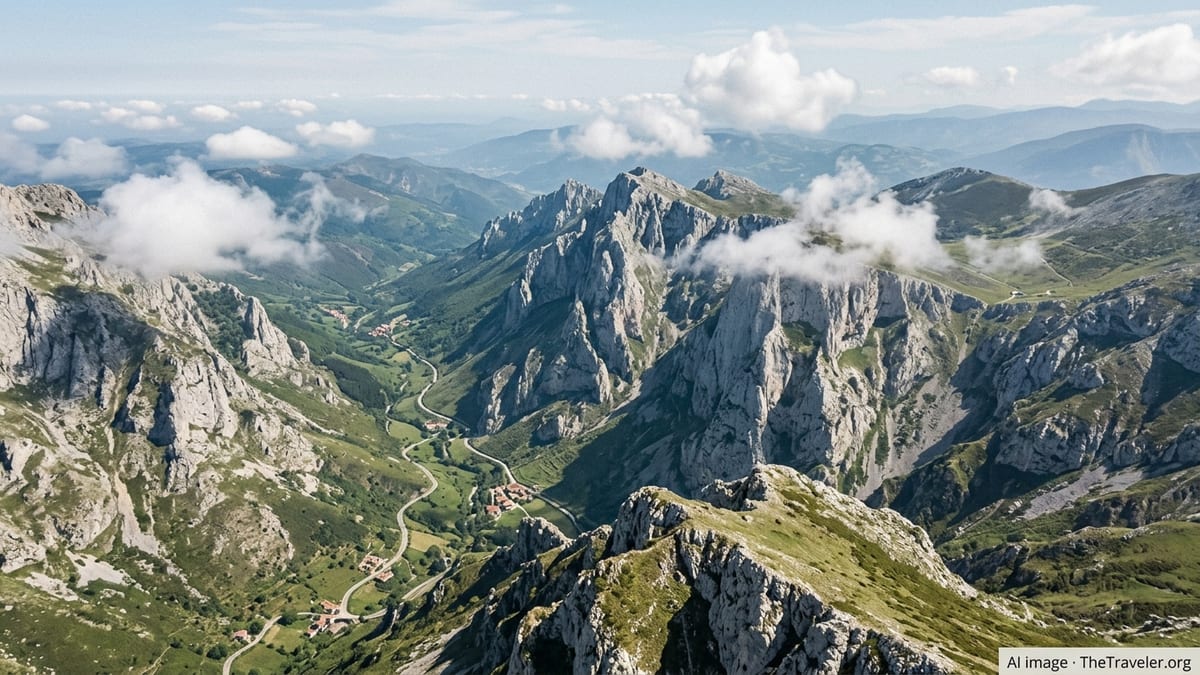
Despite its relative proximity to the UK, Picos de Europa National Park remains far less known than the Alps or the Dolomites. Tourism profiles describe a compact but spectacular limestone massif straddling the regions of Asturias, Cantabria and Castile and León, where jagged peaks rise abruptly from deep river gorges and green valleys. The highest summits, including Torre de Cerredo at more than 2,600 metres, provide a dramatic skyline that has made the area a favourite among Spanish hikers and climbers for decades.
Travel overviews note that the park’s three main massifs are cut by canyons such as the Cares Gorge, one of Spain’s best-known long-distance day hikes. Yet accommodation providers and regional tourism bodies still characterise visitor numbers as modest compared with other European mountain ranges. Many UK travellers remain unfamiliar with the park’s existence, even as social media coverage of its viewpoints, high ridges and traditional stone villages has quietly grown.
One factor preserving the park’s under-the-radar status is its lack of large resort infrastructure. Most visitors base themselves in small towns such as Potes, Cangas de Onís or Arenas de Cabrales, using local guesthouses and rural hotels. Public information emphasises that this pattern of small-scale, locally run accommodation has helped the region maintain a more traditional mountain character, even as access improves.
Big-Mountain Scenery on a Short Break Budget
Travel-planning guides frequently highlight the value-for-money aspect of a Picos trip, especially for visitors arriving via low-cost carriers into Santander. With return flights from the UK advertised at prices comparable to domestic rail tickets, the main additional costs are car hire or bus transfers from the coast, along with mid-range accommodation in the valleys. Several independent resources suggest that three to five days is enough to experience a cross-section of the park, making it a realistic long-weekend or short-break destination.
The park offers a variety of access points for visitors with different fitness levels. Cable cars such as the Fuente Dé ascent in Cantabria provide quick access to high viewpoints, while well-marked paths allow for shorter walks around lakes like Enol and Ercina in the Covadonga area. More experienced hikers can tackle sections of classic routes including the Cares trail, which follows a narrow path cut into limestone cliffs high above the river, offering views that have become emblematic of the Picos landscape.
Compared with more established Alpine resorts, dining and day-to-day expenses in the surrounding villages are often described as moderate. Traditional mountain dishes based on local cheeses, beans and cured meats remain staples of village restaurants and bars, and are typically priced below equivalents in many central European destinations. Combined with budget air connections, this pricing has led travel commentators to describe the region as one of western Europe’s better-value mountain escapes.
From Cantabrian Coast to High Peaks in a Single Day
One of the region’s distinctive draws is the ease with which travellers can combine coastal scenery with high mountains. Maps and route planners show that it is possible to drive from the beaches west of Santander into the central valleys of the Picos de Europa in roughly two hours, depending on traffic and exact starting point. This allows visitors on short itineraries to swim or surf on the Cantabrian coast in the morning and be walking under limestone cliffs by the afternoon.
Publicly available travel advice often recommends hiring a car on arrival at Santander Airport for maximum flexibility, particularly for those planning to move between different valleys or trailheads. However, regional bus routes also serve key gateway towns, providing an option for travellers who prefer not to drive mountain roads. Once in the valleys, many popular walks begin directly from village centres or from trailheads accessible by short taxi rides.
Weather information for the Picos region stresses that conditions can change quickly, with Atlantic fronts bringing cloud and rain even in summer. For this reason, practical guides advise visitors to pack layers, waterproofs and proper footwear, and to build flexibility into their plans. The same sources highlight spring and early autumn as particularly appealing seasons, combining more stable weather windows with quieter trails and lower accommodation prices than at the height of summer.
Growing Attention, But Still Off the Main Tourist Map
Although Picos de Europa is drawing more coverage in English-language travel media, it remains far less intensively marketed than Spain’s Mediterranean coasts or major cities. Booking and trend reports still classify the region as a niche choice for UK visitors, dominated by walkers, nature enthusiasts and independent travellers. Package-holiday penetration is limited, and most itineraries are still assembled by travellers themselves or by specialist walking-tour operators.
Regional authorities have published material emphasising sustainable tourism, encouraging longer stays and visits outside peak summer months. Efforts include promoting lesser-known valleys and villages to spread visitor numbers more evenly, as well as highlighting cultural attractions such as Romanesque churches, hilltop monasteries and traditional cheese caves. This strategy aims to grow tourism-linked income while avoiding the overtourism pressures seen in some other European mountain areas.
For now, the convergence of cheap Ryanair flights into Santander, relatively short UK flight times and a still-quiet national park gives Picos de Europa the qualities of a classic “best-kept secret.” Travellers willing to look beyond the standard Spanish holiday map are increasingly finding that within a single weekend, it is possible to step off a budget flight from the UK and into some of the most striking mountain scenery in western Europe.