

More news on this day
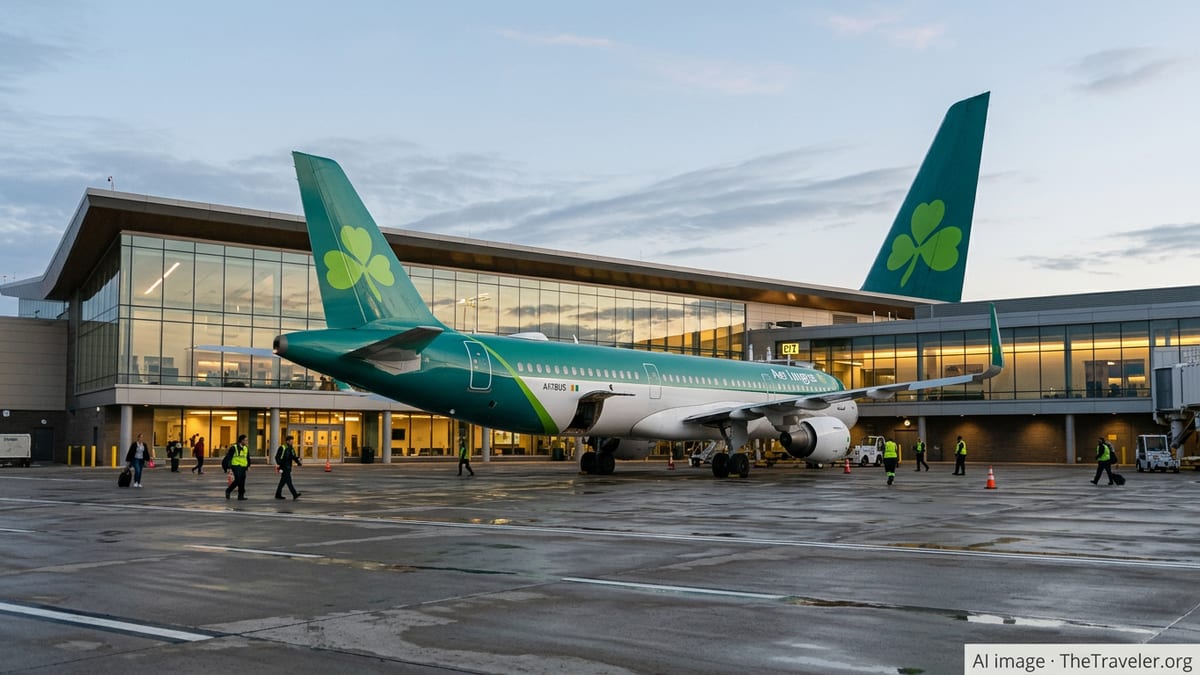
Travelers in western Pennsylvania will soon be able to fly directly from Pittsburgh to Dublin for the first time, as Aer Lingus prepares to launch year-round nonstop service that airport officials say heralds a new era for Pittsburgh International Airport.
New Transatlantic Lifeline for Pittsburgh
The Irish flag carrier will begin Pittsburgh–Dublin flights on May 25, 2026, creating the first scheduled nonstop air link between Pittsburgh International Airport and Ireland’s capital. The route, announced in December 2025 and now open for booking, is scheduled four times a week and positioned as a permanent fixture with only a brief winter pause in January and February.
Aer Lingus will operate the service with its Airbus A321neo LR, a long-range narrow-body jet configured for transatlantic missions. The aircraft offers both economy seating and a business-class cabin with lie-flat seats, aimed at capturing a mix of leisure travelers, visiting friends and relatives traffic, and corporate passengers shuttling between the two markets.
Airport leaders describe the Dublin flight as a long-sought goal that could reshape connectivity for the Pittsburgh region. With Dublin serving as Aer Lingus’ primary transatlantic hub, passengers from western Pennsylvania will be able to connect onwards to major cities across the United Kingdom and continental Europe on a single ticket and with through-checked bags.
The new service also arrives at a moment when Pittsburgh International is sharply focused on rebuilding and diversifying its long-haul network. After years of gradual recovery following the loss of hub status and pandemic disruptions, adding a second European carrier and a third nonstop destination across the Atlantic signals fresh momentum.
Historic Ties and Sports Links Shape the Route
The announcement of the Dublin service taps into deep cultural and sporting ties between Pittsburgh and Ireland. Regional officials frequently note that the Pittsburgh metro ranks among the top large U.S. cities for residents claiming Irish ancestry, creating a ready-made base of travelers with family and heritage connections on both sides of the Atlantic.
Local leaders have also emphasized the long-running relationship between Ireland and the Pittsburgh Steelers’ Rooney family. The organization’s Irish roots, its philanthropic work through The Ireland Funds, and previous initiatives linked to the U.S. ambassadorship in Dublin have kept the two communities closely aligned, helping to raise Pittsburgh’s profile in Irish political and business circles.
Those connections have increasingly extended into sports tourism. The forthcoming NFL regular-season game in Dublin featuring the Steelers, as well as future college football showcases branded under the Aer Lingus banner, are expected to generate spikes in demand and keep Pittsburgh visible in the Irish market. Aviation observers say this combination of heritage, tourism and marquee sporting events helped strengthen the business case for a nonstop route.
For Aer Lingus, Pittsburgh is another carefully targeted mid-sized U.S. city with strong outbound Europe demand but limited direct options. The airline has used a similar playbook in markets such as Cleveland and Raleigh-Durham, where Dublin functions as a compact, user-friendly gateway for connections deeper into Europe.
New Terminal, New Strategy for PIT
The Dublin announcement comes on the heels of Pittsburgh International’s high-profile terminal transformation, a roughly 1.7 billion dollar project that opened to passengers in late 2025. The new facility consolidates check-in, security and boarding, and was designed in part to better accommodate long-haul and international operations.
Airport executives have cautioned that infrastructure alone cannot guarantee new routes, but they argue the modern terminal has helped position Pittsburgh as a more competitive candidate for global airlines weighing U.S. expansion. With Aer Lingus onboard, PIT now counts 16 airlines and three European destinations, reflecting a strategy centered on selective, sustainable growth rather than a return to legacy hub status.
The broader goal is to rebuild Pittsburgh’s connectivity map in ways that support the region’s economic ambitions. Local officials see nonstop long-haul service as a tool to attract foreign investment, boost tourism, and make it easier for multinational firms to maintain operations in western Pennsylvania without routing staff through larger coastal gateways.
From the passenger perspective, the Dublin route slots neatly into PIT’s evolving mix of domestic and international options. It complements existing transatlantic services and joins a growing roster of leisure-focused flights to sun destinations and seasonal European gateways, signaling that the airport’s network is maturing beyond purely domestic point-to-point traffic.
Gateway to Europe via Dublin Hub
Dublin’s role as a connective hub is central to the appeal of the new route. From the Irish capital, Aer Lingus and its partners offer links to major European cities including Paris, Rome, Amsterdam, Berlin, Geneva and Madrid, as well as key regional markets across the United Kingdom and Ireland. For many Pittsburgh travelers, that means a one-stop journey to dozens of destinations that previously required at least two connections.
Another selling point is the passenger experience in Dublin itself. The airport is smaller and generally less congested than some of Europe’s mega-hubs, and its layout allows for relatively quick domestic and European transfers. Travelers heading back to the United States can also take advantage of U.S. preclearance facilities in Dublin, clearing immigration and customs before boarding and arriving stateside as domestic passengers.
Airline analysts note that this model has underpinned Aer Lingus’s broader North American expansion strategy. By funnelling passengers from a collection of secondary U.S. cities into Dublin and onward to Europe, the carrier can build viable loads on long-haul flights without relying solely on origin-and-destination traffic between any single pair of cities.
For Pittsburgh, the payoff could be substantial. Travel agents in the region anticipate that the Dublin flight will quickly become a preferred option for business travelers heading to European financial and tech hubs, as well as leisure travelers seeking more flexible itineraries across multiple countries without an initial backtrack through larger U.S. gateways.
Regional Impact and Competitive Landscape
The Pittsburgh–Dublin route also arrives amid shifting competitive dynamics in transatlantic air service. While some carriers have trimmed or reshuffled long-haul schedules, especially from secondary U.S. markets, Aer Lingus is betting that carefully chosen city pairs like Pittsburgh can sustain consistent, year-round demand when paired with strong connecting networks.
Local tourism and economic development agencies are moving quickly to capitalize. VisitPITTSBURGH and regional chambers are expected to mount joint marketing campaigns in Ireland and across Europe, pitching the Pittsburgh region as a destination for cultural tourism, outdoor recreation and emerging tech and healthcare industries.
At the same time, the new route raises the bar for Pittsburgh’s competitors. Other mid-sized airports in the eastern United States have aggressively courted transatlantic carriers with incentive packages and infrastructure upgrades. Pittsburgh’s ability to secure a new European flag carrier and put its new terminal to work may spur similar efforts in peer cities eager to win or retain comparable service.
For now, though, focus in Pittsburgh is firmly on the countdown to May 2026. With tickets on sale and the inaugural flight date set, travelers across the region are beginning to sketch out itineraries that, for the first time, put Ireland and much of Europe within a single, seamless overnight hop from their home airport.