

More news on this day
Porter Airlines is pushing deeper into the North American market with a trio of new routes linking Toronto and Ottawa to Austin, Chicago O’Hare and Deer Lake, underscoring the carrier’s rapid post-pandemic growth and its ambition to compete more aggressively in key business and leisure corridors.
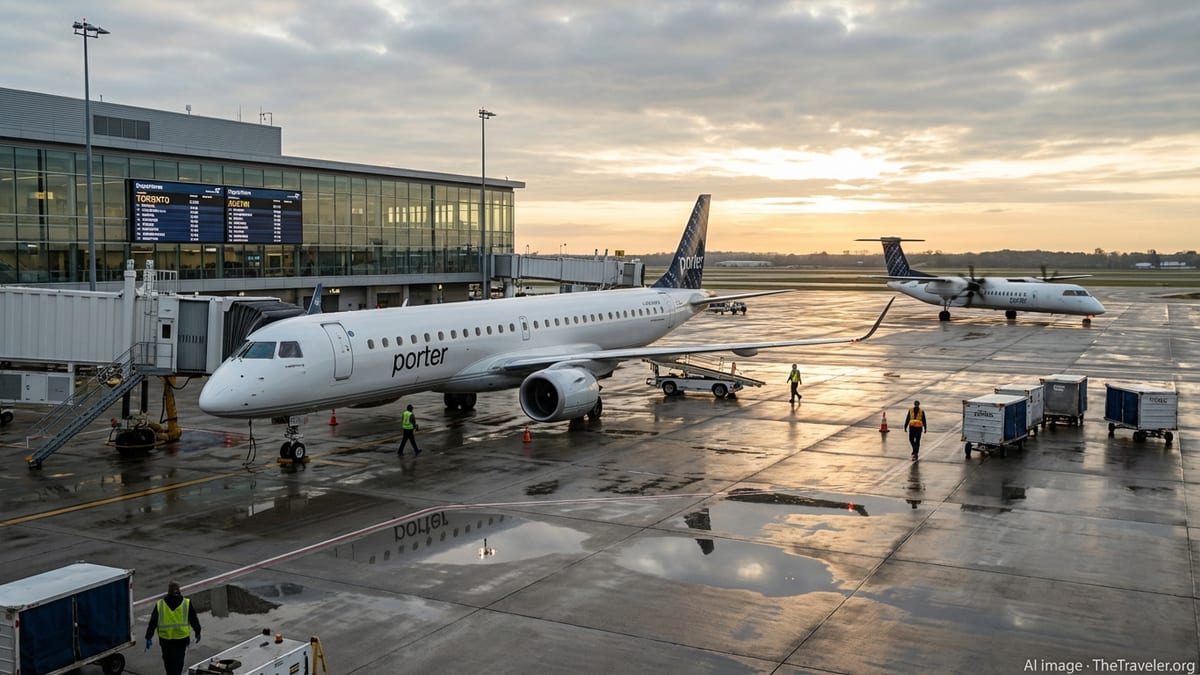
New Austin Service Extends Porter’s Reach Into Central Texas
Porter Airlines will make its debut in the Central Texas market this spring, adding Austin-Bergstrom International Airport to its growing list of U.S. destinations. The Canadian carrier is set to launch nonstop flights between Toronto Pearson and Austin on May 21, 2026, providing a new north-south link between two fast-growing tech and creative hubs. The service will operate five times weekly on a year-round basis, reflecting Porter’s confidence in steady demand between the cities.
The route will be flown with Porter’s Embraer E195-E2 jets, which feature a two-by-two all-economy configuration that eliminates middle seats. The aircraft choice aligns with the airline’s strategy of offering a more comfortable product on longer routes while maintaining competitive pricing. For travelers in both markets, the new connection opens up easier access to Canada’s largest city and a major U.S. center for music, technology and culture.
Airport officials in Austin have framed the arrival of Porter as part of a broader effort to strengthen international connectivity at the rapidly expanding airport. The Toronto link adds another option for Central Texas residents heading to Canada or beyond via Porter’s network and interline partners, while also giving Canadian travelers a nonstop gateway to Austin’s festivals, culinary scene and outdoor attractions.
Porter executives, for their part, have emphasized that Austin fits neatly into the carrier’s bid to build a more robust North American footprint beyond its original eastern Canada core. By pairing Toronto Pearson with a city like Austin, where demand spans business, technology, education and tourism, the airline is targeting a market that can support consistent year-round traffic rather than strictly seasonal peaks.
Chicago Move Shifts Billy Bishop Flights to O’Hare
Alongside the Austin launch, Porter is making a significant strategic shift in Chicago by transferring its long-standing service from Midway Airport to O’Hare, the city’s primary international hub. Beginning September 1, 2026, flights from Billy Bishop Toronto City Airport will touch down at Chicago O’Hare instead of Midway, marking a major change to a route Porter has operated since 2008.
The transition is accompanied by a sizable increase in frequency. Porter will ramp up its Toronto City to Chicago schedule to three daily flights, operated by De Havilland Dash 8-400 turboprops. The expanded timetable is designed to better serve business travelers who value multiple daily options and same-day return possibilities, while also giving leisure passengers more flexibility on weekend and holiday trips.
Operating into O’Hare positions Porter within one of North America’s busiest connecting hubs, offering smoother links to onward domestic and international flights on partner airlines. Chicago aviation officials have welcomed the move, highlighting the role of O’Hare as a growing platform for Porter and pointing to the airline’s developing codeshare relationship with established U.S. carriers.
For Porter, the shift also dovetails with infrastructure upgrades at Toronto’s downtown Billy Bishop Airport, including a new U.S. preclearance facility due to open in the near term. Once operational, preclearance is expected to speed up the passenger experience on U.S.-bound flights from the island airport and make connections via O’Hare more seamless for travelers originating in Toronto’s core.
Seasonal Ottawa–Deer Lake Route Boosts Access to Western Newfoundland
On the domestic front, Porter is strengthening its presence in Atlantic Canada by launching a seasonal route between Ottawa and Deer Lake, Newfoundland and Labrador. Beginning June 10, 2026, the carrier will operate the service five times weekly, providing a new link between Canada’s capital and a key gateway to western Newfoundland’s national parks, fjords and coastal communities.
The new route builds on Porter’s growing investment in Deer Lake, which has recently seen additional service from Toronto Pearson and Halifax. Deer Lake only joined Porter’s network in 2024, but strong performance and provincial efforts to expand air access have encouraged the airline to test more seasonal and potentially year-round connectivity. The Ottawa flights are initially scheduled as seasonal, capturing peak summer travel demand and the busy tourism period in Newfoundland and Labrador.
Provincial officials have framed Porter’s Deer Lake expansion as part of a broader strategy to support tourism, economic development and resident mobility. Additional connections from central Canada make it easier for visitors to reach attractions such as Gros Morne National Park, while also giving local residents more options for travel to major cities without needing to backtrack through larger hubs.
Porter is assigning its Embraer E195-E2 jets to the Ottawa–Deer Lake route, signaling an expectation of solid demand and a desire to offer a higher level of onboard comfort on the longer domestic sector. The combination of better seat pitch, complimentary snacks and drinks, and inflight Wi-Fi is positioned as a differentiator in what has become a competitive market for Canadian leisure travelers heading east in the summer.
Network Strategy: Building a North American Footprint
The latest additions in Austin, Chicago and Deer Lake come as Porter continues to redefine itself from a regional carrier centered on Toronto’s downtown airport into a broader North American player. Since taking delivery of the Embraer E195-E2 jets and launching operations from Toronto Pearson, the airline has steadily layered in new transborder and longer domestic routes that extend far beyond its original short-haul turboprop niche.
By targeting cities such as Austin and moving into O’Hare, Porter is explicitly aligning itself with markets that combine strong point-to-point demand with rich connecting opportunities. In Chicago, access to a major hub gives Porter customers more itinerary options through partner airlines, while in Austin the carrier is betting on two-way demand between fast-growing metropolitan regions that share ties in technology, culture and education.
Within Canada, the decision to keep investing in Deer Lake underscores the importance Porter places on secondary and regional markets that are eager for competition and improved connectivity. Seasonal services from Ottawa and Toronto complement existing flights from Halifax, offering multiple entry points into Newfoundland and spreading tourism benefits more widely across the province’s western region.
Industry analysts say this blended strategy of adding high-profile U.S. destinations while deepening service in under-served Canadian markets helps Porter diversify its revenue base. It also positions the airline to capture both premium-leaning business travelers attracted to its refined economy product and value-conscious leisure travelers seeking alternatives to larger incumbents.
Competitive Landscape on the Austin and Chicago Routes
Porter’s new Austin service places it directly into competition with Air Canada, which already connects Toronto Pearson and the Texas capital. Although Air Canada currently operates more weekly seats on the route, Porter is wagering that its onboard product, schedule and pricing will be enough to win over a share of both business and leisure travelers. The Canadian market to Texas has been slower to fully recover than some other transborder flows, but there is growing demand from the technology, entertainment and conference sectors that link the two cities.
In Chicago, Porter’s move from Midway to O’Hare parallels a broader pattern among carriers seeking the connectivity and brand visibility that comes with operating at a major international hub. The airline will face competition from larger U.S. and Canadian carriers that already serve Toronto and Chicago, but it is banking on the convenience of Billy Bishop’s downtown location paired with frequent service to differentiate its offering.
Porter’s codeshare and interline partnerships are expected to play an important role in how the Chicago route evolves. With three daily flights into O’Hare, there is scope to build timed connections to a range of onward destinations across the United States. That could make Porter more attractive to Canadian travelers heading beyond Chicago, as well as to American passengers using O’Hare as a jumping-off point for trips to Toronto and the rest of the airline’s network.
While competition remains intense on both sides of the border, Porter’s leadership has argued that there is room in the market for an airline that pairs a more upscale economy product with a network focused on convenience and smart connections. The Austin and Chicago moves are intended to test that thesis in two of North America’s most dynamic metropolitan regions.
Aircraft Choice Underscores Porter’s Product Positioning
The deployment of Embraer E195-E2 jets on the Austin and Ottawa–Deer Lake routes highlights how central the new aircraft type has become to Porter’s expansion strategy. With a two-by-two seating configuration, no middle seats and a relatively quiet cabin, the jets allow the airline to sell a differentiated experience on longer segments without the cost base associated with larger narrowbody aircraft.
On the Austin route, the E195-E2 offers the range and efficiency needed for the roughly three-and-a-half hour flight between Toronto Pearson and Central Texas. Passengers can expect features that include complimentary snacks and drinks, beer and wine served in real glassware, and Wi-Fi connectivity. For those opting into Porter’s more inclusive fare products, additional legroom, priority services and enhanced meal options on longer flights reinforce the airline’s positioning at the premium end of the economy spectrum.
The Dash 8-400 turboprops that will operate between Billy Bishop and Chicago O’Hare remain a core part of Porter’s identity. These aircraft are well-suited to shorter, high-frequency business routes and to operations from the physically constrained downtown Toronto airport. Their relatively low fuel burn and quick turnaround times help the airline maintain competitive costs while offering a level of onboard comfort that exceeds expectations for a turboprop.
By pairing different aircraft types with different market profiles, Porter is signaling that it sees both regional and longer-haul opportunities ahead. The flexibility to deploy jets on routes such as Austin and Deer Lake while retaining turboprops for core short-haul business markets gives the carrier multiple levers as it refines its network.
Economic and Tourism Impacts for Destination Communities
For the cities and regions on the receiving end of Porter’s expansion, the new routes are expected to bring tangible economic and tourism benefits. In Austin, tourism officials see the Toronto connection as a fresh pipeline for international visitors drawn to the city’s live music venues, major festivals and growing food scene. The route also offers Austin-based companies easier access to Canadian partners and clients, potentially boosting business travel in both directions.
In western Newfoundland, additional air access has long been a priority for local leaders, who argue that reliable, competitively priced flights are essential to attracting visitors and supporting small businesses tied to tourism. The Ottawa–Deer Lake service is timed to coincide with the region’s peak summer hiking, wildlife and coastal touring season, and hoteliers and tour operators are optimistic that easier access from central Canada will translate into longer stays and more repeat visits.
Chicago’s O’Hare, meanwhile, gains another international carrier as Porter joins a roster of global airlines serving the hub. City officials have welcomed the investment as a sign of confidence in Chicago’s role as a central node in North American aviation. Additional flights from Toronto’s downtown airport are expected to support business ties, tourism and conference traffic between the two cities, while also feeding travelers into O’Hare’s extensive domestic and international network.
Across all three markets, the arrival or expansion of Porter adds competitive pressure that can influence fares, schedules and service standards. Travelers stand to benefit from more choice and, potentially, improved connectivity as the airline’s relationships with other carriers deepen over time.
What Travelers Can Expect as Routes Come Online
With launch dates staggered across 2026, passengers will see the new routes come into effect over several months. The Toronto Pearson to Austin service is scheduled to begin first on May 21, followed by the seasonal Ottawa–Deer Lake link starting June 10. The shift from Chicago Midway to O’Hare for flights from Billy Bishop Toronto City Airport will complete the trio of changes on September 1.
Travelers using the Austin and Deer Lake routes can expect service on Embraer E195-E2 aircraft, featuring two-by-two seating, complimentary snacks and drinks, and Wi-Fi on board. Those flying between downtown Toronto and Chicago O’Hare will continue to experience Porter’s Dash 8-400 turboprops, which have been a hallmark of the airline’s short-haul operations since its inception. Across the network, Porter is positioning the new routes as integral parts of its broader effort to offer more choice and a consistent onboard experience.
As the Austin, Chicago and Deer Lake services ramp up, industry observers will be watching load factors, fare trends and schedule adjustments for signs of how successfully Porter is embedding itself in its new and reconfigured markets. If performance is strong, the airline could look at further frequency increases, additional seasonal links or even new destinations built around similar business and leisure demand patterns.
For now, the additions mark another milestone in Porter’s evolution from a niche regional operator to a carrier with ambitions that stretch across North America. The combination of a refined economy product, strategic airport choices and a willingness to challenge incumbents on both sides of the border sets the stage for a competitive next chapter in the airline’s growth story.