


Portugal and Germany are two of Europe’s most discussed bases for remote workers. Both offer political stability, EU market access, and strong connectivity, but they diverge significantly in tax burden, work-relevant lifestyle factors, and infrastructure maturity. This briefing compares the two countries through a remote-work lens, focusing strictly on how tax treatment, daily working environment, and digital infrastructure affect the practicality of relocating as a remote professional.
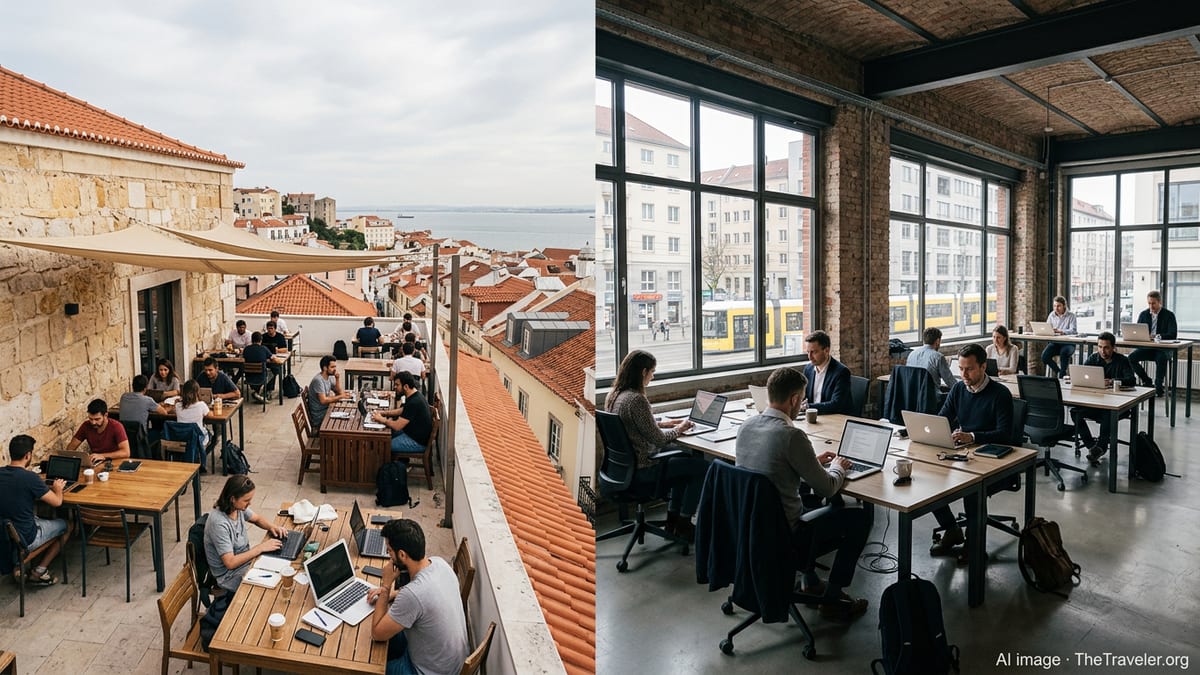
Tax Residence and Overall Burden for Remote Workers
For remote workers, the starting point is typically tax residency. Both Portugal and Germany treat individuals as tax resident if they spend more than roughly 183 days per year in-country or establish a primary home there. Once resident, both operate on worldwide income taxation with access to double tax treaties, which is critical for those paid from foreign employers or clients.
Portugal applies progressive personal income tax rates that, after recent reforms, start in the low teens and rise to a top marginal rate around the high 40 percent range for higher incomes, with many mid-range professional salaries falling into marginal brackets around the high 20s to mid 30s. Social security contributions also apply to employment and most self-employment, increasing the effective burden. Germany likewise uses a progressive income tax system, with a tax-free basic allowance and marginal rates that climb from around 14 percent to 42 percent, plus a solidarity surcharge at higher incomes and mandatory social contributions to pension, health, unemployment, and long-term care systems. For upper-middle professional incomes, combined German tax plus social charges often leads to effective burdens that are high by international standards but relatively predictable.
From a purely tax-rate perspective, both countries sit in the high-tax group within Europe, though Germany’s combined tax and social security on salaries is typically heavier for high earners than the effective rates many remote workers experience in Portugal. However, Portugal has recently scaled back prior special regimes, which reduces its tax advantage for new arrivals who do not qualify for current incentive programs. Remote workers planning to remain fully location-independent with flexible residence may find that staying under the 183-day threshold in either jurisdiction substantially changes their tax exposure, but once settled as residents both jurisdictions expect comprehensive reporting and tax compliance.
The practical implication is that Germany offers stability and clear rules with little reliance on special incentives, while Portugal has moved from an aggressively tax-attractive regime for foreigners toward a structure closer to the European mainstream. For decision-making, remote workers should assume globally competitive but not low tax levels in both countries, with planning opportunities mainly in treaty use, business structuring, and social security coordination rather than headline rate arbitrage.
Special Regimes and Treatment of Foreign-Sourced Remote Income
Remote workers often focus on how each country treats foreign-sourced income, including salaries paid by overseas employers and freelance revenues from clients abroad. Portugal previously attracted significant numbers of digital workers through the Non-Habitual Resident (NHR) regime, which combined a flat 20 percent rate on some Portuguese-source professional income with reductions or exemptions on certain foreign-source income for a decade. That scheme has been closed to most new entrants, with replacement incentive frameworks now tightly targeted at specific high value activities, research, and investment-oriented roles, typically linked to Portuguese entities.
For a typical remote employee working for a foreign company or a self-employed digital freelancer serving international clients, the default assumption in Portugal today is taxation under the standard progressive scale on worldwide income, subject to relief under double tax treaties. Some new incentive regimes preserve a 20 percent flat rate on qualifying Portuguese-source income for certain high-skill functions, but eligibility criteria are precise and often require association with recognized Portuguese employers, universities, or innovation projects. As a result, many remote workers who are technically “digital nomads” do not qualify and instead face ordinary tax treatment.
Germany does not maintain a digital-nomad-specific tax regime and has no equivalent of Portugal’s former NHR. Taxation applies broadly to worldwide income for residents, with nuanced rules on business income allocation, permanent establishment risk for companies, and foreign tax credits. For remote employees paid by a non-German employer, Germany typically taxes the salary if the work is physically performed in Germany, while double tax agreements are applied to avoid double taxation. Self-employed professionals resident in Germany are subject to income tax on net business profits and may also face trade tax depending on how their activity is classified.
This contrast means that, in 2026, Portugal’s earlier reputation as a low-tax haven for foreign remote workers is only partially warranted and primarily for a narrower set of qualifying profiles. Germany, by comparison, offers a consistent but relatively full tax burden that does not depend on special status. Remote workers prioritizing long-term predictability over temporary incentives may appreciate the German approach, whereas those who can align with Portugal’s targeted incentive categories could still realize meaningful tax savings relative to standard Portuguese rates.
Day-to-Day Lifestyle Conditions Relevant to Remote Work
While lifestyle in the broad sense covers many factors, remote workers primarily need to understand conditions that directly affect work capacity: cost relative to local purchasing power, availability of professional workspaces, language environment, and daily rhythm around working hours. Both Portugal and Germany offer extensive coworking presence in major cities, but their day-to-day context differs materially.
Portugal’s major urban centers such as Lisbon and Porto have dense coworking ecosystems, strong English penetration in professional circles, and a service industry increasingly accustomed to remote professionals working from cafes and shared spaces. The overall price level in Portugal is generally lower than in Germany, especially outside the most in-demand central districts, which can make it easier for remote workers to access daily services, meals, and local transport without compressing budgets. However, in top neighborhoods popular with expatriates, local price inflation has reduced some of the historical affordability advantage, which matters for those seeking to work from central, amenity-rich areas.
Germany offers a more uniform standard of infrastructure and amenities across its larger cities and many secondary centers, with widespread coworking chains and strong business services. Daily costs are higher on average than in Portugal, but they are matched by higher local incomes and a dense network of reliable public services that simplify daily logistics. English is widely used in business and tech environments, particularly in Berlin, Munich, and Hamburg, though outside these hubs a working knowledge of German is more important for navigating administrative and some professional settings.
For remote professionals, the trade-off is between Portugal’s relatively lower everyday cost structure and more relaxed work-adjacent environment versus Germany’s more structured and formal context with cost levels to match its high-wage economy. Both environments can be highly functional for remote work; the choice depends on whether a worker prioritizes budget flexibility and a more informal rhythm (Portugal) or the predictability and density of services associated with a mature industrial economy (Germany).
Digital Infrastructure and Internet Performance
Digital infrastructure quality is a decisive factor for remote workers whose income depends on uninterrupted high-speed connectivity. Both Portugal and Germany are advanced EU economies with extensive broadband networks, but their performance profiles differ in notable ways, particularly around mobile internet speed and fiber coverage.
Portugal has invested heavily in fiber-to-the-home and high-speed fixed broadband. Recent European Commission reporting shows that a very high share of Portuguese fixed subscriptions deliver at least 100 Mbps, exceeding the EU average and demonstrating extensive coverage of high-capacity access even outside the main metropolitan cores. Mobile networks in Portugal are also competitive; independent speed test aggregators have ranked the country among the stronger performers in Europe for mobile download speeds, with typical median speeds substantially above the global average and ahead of many larger Western European markets, including Germany.
Germany historically lagged some EU peers in next-generation fixed broadband rollout, particularly in rural areas, due to slower fiber deployment and reliance on legacy copper infrastructure. Over the last several years, significant investment has improved both coverage and speeds, and current median fixed broadband rates are more than sufficient for remote work activities such as video conferencing, cloud-based development, and large file transfers. Nonetheless, the share of households with gigabit-capable connections and fully fiber lines remains lower than in leading fiber adopters like Portugal. On mobile, Germany’s networks are robust and widely available, but performance benchmarking typically places average download speeds below Portugal’s, reflecting both spectrum policy history and network density.
From a remote-work perspective, the difference is not about basic usability but about headroom and resilience. In either country, working from major cities and larger towns offers reliable high-speed connectivity. Portugal’s edge lies in the combination of near-ubiquitous high-speed fixed access and strong mobile performance even in secondary areas, which is beneficial for workers who value the option to move within the country without losing quality of service. Germany’s advantage is network redundancy and integration with other critical infrastructure, but remote workers locating in smaller towns or rural regions should verify local broadband options in detail, as performance can vary more sharply than in Portuguese coastal and urban corridors.
Workplaces, Power Reliability, and Transport Connectivity
Beyond internet speed, remote workers depend on the physical reliability of the work environment: availability of suitable workplaces, power stability, and transport connectivity that supports both local and international collaboration. Both Portugal and Germany perform well on these measures, with differences that may matter depending on the worker’s operational profile.
Portugal’s main cities host a growing network of modern coworking spaces, tech hubs, and serviced offices, many oriented toward international freelancers and startup teams. Power supply in urban areas is stable by European standards, and outages are relatively infrequent. Public transport within cities is functional, although less extensive and less punctual than in Germany, and intercity rail links, while improving, do not match German density. International connectivity is strong in Lisbon and Porto, which have direct flights to major European hubs and some long-haul destinations, which is important for remote workers who need periodic in-person meetings abroad.
Germany provides a highly developed ecosystem of office centers, coworking spaces, and business parks distributed across numerous cities, not only in Berlin or Munich. Power grid reliability is very high, with rare and short-lived outages, supported by a large and diversified energy system. Public transport networks in major urban areas are dense and integrated, and the national rail system links cities at high frequency, which simplifies domestic travel for client visits or team retreats. Major airports in Frankfurt, Munich, and other cities offer extensive global connectivity, often enabling same-day connections to most world regions.
For remote workers who rarely leave their primary base and value proximity to a familiar international community and coworking culture, Portugal’s main hubs are well suited. Those whose work involves frequent domestic or international business travel, or who need to collaborate regularly with corporate teams across multiple European locations, may find Germany’s transport and power infrastructure particularly advantageous.
Work-Relevant Lifestyle Factors: Climate, Time Zone, and Social Environment
Work-relevant lifestyle considerations include climate as it affects daily comfort and seasonality of energy needs, alignment with client time zones, and the social environment for professional networking. While these are lifestyle factors, they have direct implications for productivity and work patterns.
Portugal’s temperate climate reduces winter heating demands and allows for consistent use of outdoor and semi-outdoor workspaces for much of the year, which some remote workers find beneficial for well-being and sustained focus. The country’s location in the Western European time zone offers convenient overlap with both European and North American East Coast schedules, particularly valuable for remote employees and freelancers serving transatlantic clients. The concentration of international remote workers in Lisbon, Porto, and a few coastal towns has created sizable English-speaking professional communities, which can make onboarding into local networks faster.
Germany has more pronounced seasonal variation, with colder winters and shorter daylight hours, especially in the north, which can affect energy costs and daily rhythms. However, its time zone alignment with central and eastern Europe facilitates collaboration with continental teams, and large corporate ecosystems in major cities create opportunities for in-person career advancement that go beyond the fully remote sphere. International communities exist in cities like Berlin and Munich but are more distributed across sectors such as technology, manufacturing, and research, resulting in a more heterogeneous but also more embedded professional environment.
For remote workers whose income is tied to global clients and who value a strong English-speaking remote-work scene, Portugal may feel easier to integrate into quickly. For those whose remote role is linked to European corporate structures or who anticipate transitioning between remote and hybrid office models, Germany’s ecosystem can support a wider range of medium- and long-term career paths, even if the immediate day-to-day environment is somewhat less informal.
The Takeaway
Evaluated through the combined lenses of taxation, work-shaped lifestyle conditions, and digital infrastructure, both Portugal and Germany offer credible bases for remote workers, but with distinct profiles. Portugal currently combines strong fiber and mobile connectivity, generally lower everyday costs relative to Western European peers, and a dense international remote-work community in key cities. However, its tax environment for new foreign residents has shifted toward the European mainstream, with special regimes now more selective and many ordinary remote workers facing standard progressive taxation on worldwide income.
Germany presents a higher but stable overall tax and social security burden with no broad digital-nomad-specific incentives, balanced by highly reliable power, transport, and administrative systems and a diversified, corporate-heavy economy that can support evolving career strategies. Its digital infrastructure is more uneven geographically than Portugal’s but entirely adequate in urban and many suburban areas for demanding remote work.
Remote workers seeking maximum tax optimization will no longer find either jurisdiction at the low-tax end of the global spectrum, though Portugal may still be more favorable for specific high-value categories that qualify for incentives. Those prioritizing a mature business environment, strong domestic and international connectivity, and long-term professional optionality may lean toward Germany. Those prioritizing cost-sensitive remote living with strong connectivity, warmer climate, and a concentrated nomad ecosystem may find Portugal more aligned with their working lifestyle.
FAQ
Q1. Is Portugal still significantly lower tax than Germany for remote workers?
In general terms the gap has narrowed. Portugal can be somewhat lighter for some income levels and specific incentive-eligible profiles, but many new remote workers now face broadly comparable progressive tax burdens in both countries.
Q2. Do both Portugal and Germany tax worldwide income for remote workers?
Yes. Once tax resident under each country’s rules, remote workers are normally taxed on worldwide income, with double tax treaties used to mitigate double taxation on the same income stream.
Q3. Are there special tax regimes in Portugal that remote workers can still use?
Portugal has replaced its broad NHR regime with more targeted incentives that preserve favorable rates for specific high-value activities. Many generic remote employees and freelancers no longer qualify and instead use the standard tax scale.
Q4. Does Germany offer any digital-nomad-specific tax breaks?
No. Germany does not operate a dedicated digital nomad or foreign-worker tax regime. Remote workers are taxed under the standard rules for residents, with relief primarily through treaty mechanisms.
Q5. Which country has better internet for remote work, Portugal or Germany?
Both provide adequate connectivity in cities, but Portugal generally shows higher adoption of very fast fixed broadband and stronger average mobile speeds, offering more headroom for bandwidth-heavy remote work.
Q6. Is power reliability a concern for remote workers in either country?
Power networks in both Portugal and Germany are stable by international standards. Germany’s grid is particularly robust, with very low outage frequencies, while Portuguese urban areas also rarely experience disruptive interruptions.
Q7. How do coworking options compare between Portugal and Germany?
Portugal has dense coworking options in Lisbon, Porto, and a few hubs, tailored heavily to digital nomads. Germany offers a larger absolute number of spaces spread across many cities, integrated into broader corporate and startup ecosystems.
Q8. Which country is better if I frequently travel for business within Europe?
Germany is usually superior for frequent business travel, with multiple major international airports and dense rail connections that facilitate same-day trips across much of Europe.
Q9. Does language significantly affect the remote working experience?
English is widely used in Portuguese remote-work circles and in Germany’s major tech and business hubs. Outside core cities, German is more necessary for administration and some services, whereas English often goes further in Portuguese urban centers.
Q10. For a long-term remote career, which country offers more professional optionality?
Germany’s larger and more diversified economy offers broader pathways into hybrid or on-site roles and corporate progression. Portugal is strong for sustaining a remote-first lifestyle, with more limited corporate depth but a concentrated international remote community.