

More news on this day
A new wave of demand in business aviation is pushing private jet departures up by an estimated 4.5 percent worldwide, with the United States and France emerging as major winners as premium travelers follow expanded long haul networks from carriers such as Qatar Airways, Emirates, Lufthansa, and Air India into high-spend luxury tourism corridors.
Get the latest news straight to your inbox!
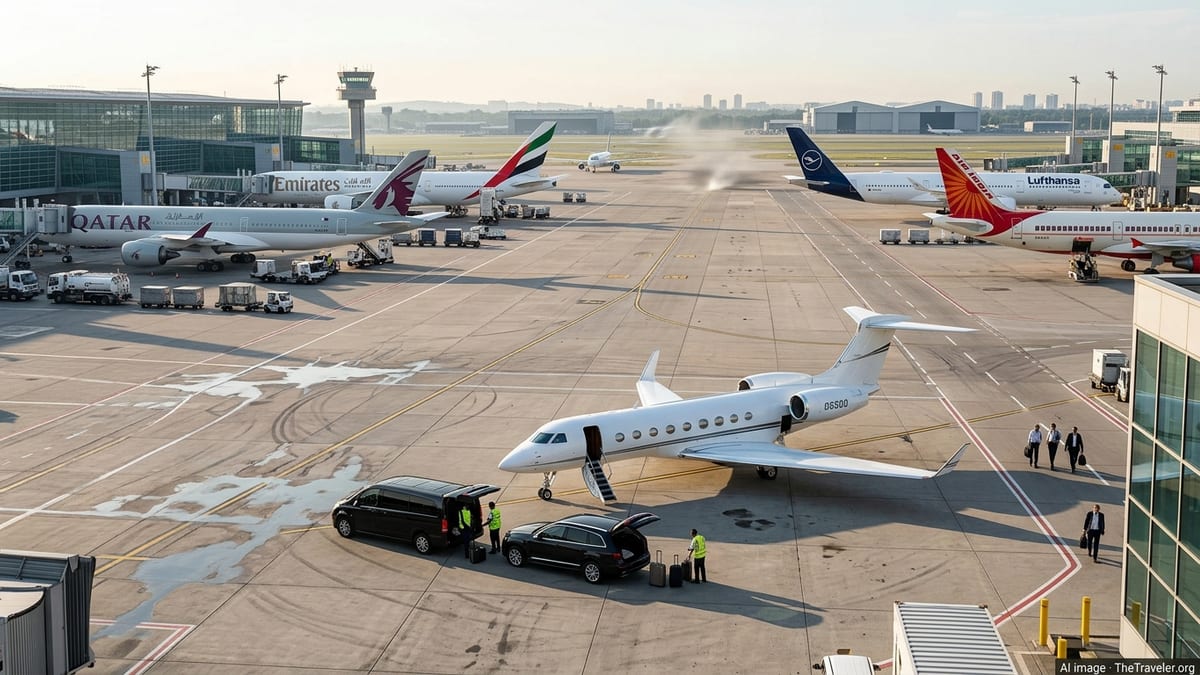
Flagship Carriers Feed a Global Private Jet Upswing
Recent air transport data and market analysis point to a steady shift at the top end of aviation, where premium cabin growth on large network airlines is spilling into business aviation. Carriers including Qatar Airways, Emirates, Lufthansa, and Air India have expanded widebody fleets and long haul frequencies over the past two years, strengthening connectivity between key wealth hubs in the Gulf, Europe, India, and North America.
Industry bulletins show these airlines posting solid traffic gains in 2024 and early 2025, supported by higher capacity on trunk routes linking Doha, Dubai, Frankfurt, and major Indian cities with New York, Miami, Los Angeles, Chicago, and multiple French gateways. As premium cabins fill and corporate travel normalizes, a portion of high net worth and executive travelers are opting to complement scheduled flights with private legs, especially for onward connections into secondary airports and resort destinations.
Global business jet activity is now running several percentage points above pre pandemic levels, with multiple data providers estimating departures up around 3 to 4 percent year over year in early to mid 2025. Within that trend, analysts tracking long haul and transatlantic segments highlight a stronger 4.5 percent upswing in private jet departures that is closely aligned with renewed corporate travel budgets and the expansion of premium long haul networks.
The result is a reinforcing loop. As flagship carriers widen access to premium long haul travel, they generate fresh demand for flexible, point to point connectivity that private jets are well placed to serve, particularly between major airline hubs and luxury tourism hotspots in the United States and France.
United States: Private Jet Gateways Power Luxury Tourism
The United States remains the largest single market for business aviation, and it is where the recent 4.5 percent rise in private jet departures is most visible on the ground. Aviation consultancies tracking flight plans report that business jet activity in the country is several percentage points higher in 2025 than in 2019, despite some softening in overall commercial traffic at certain periods.
South Florida, the New York area, and the US West Coast stand out as beneficiaries. Airports in Miami, Fort Lauderdale, Palm Beach, Teterboro, White Plains, Van Nuys, and Scottsdale are seeing robust private traffic associated with both corporate itineraries and leisure trips to beachfront resorts, golf communities, and high end urban hotels. Reports indicate that a rising share of those travelers are international visitors arriving on carriers such as Qatar Airways, Emirates, Lufthansa, and Air India before transferring to private operators for the final leg.
Tourism and travel data show US business travel spending climbing again, with forecasts for 2025 pointing to low single digit growth in corporate outlays and a persistent tilt toward premium options. High net worth travelers, in particular, are mixing work and leisure, using private jets to link investor meetings with stays in Aspen, Napa Valley, the Hamptons, and coastal Carolina retreats, often timed around major events such as art fairs, Formula 1 races, or global conferences.
This pattern has important implications for local economies. Research on private aviation’s impact in the US finds that the sector supports hundreds of thousands of jobs and hundreds of billions of dollars in economic output. When international visitors step off a widebody aircraft in New York or Houston and onto a private jet bound for a resort town, they are bringing high value spend directly into smaller communities that depend on upscale tourism.
France Emerges as Europe’s Private Jet Luxury Hub
France is consolidating its position as one of Europe’s most important centers for business aviation and luxury tourism. Industry analyses describe French business aviation as a market worth close to one hundred billion euros, with Paris Le Bourget alone handling tens of thousands of private jet movements annually, making it Europe’s leading dedicated business aviation airport.
The country is riding a broader European recovery in high end travel. Data for 2024 and 2025 show France among the strongest markets for travel and tourism revenue growth, boosted by a combination of returning long haul visitors, major cultural events, and a dense network of luxury hotels and villas. The expansion of premium long haul services from airlines such as Lufthansa and Emirates into French and nearby European hubs is helping widen the funnel of affluent travelers who may then charter private jets onward.
At the same time, the global market for very light jets is accelerating, with some forecasts projecting a more than doubling in value between 2020 and 2030. France, along with the United States, Spain, and Italy, is flagged in recent industry coverage as a likely beneficiary of this trend, as compact jets offer a flexible way to serve smaller airfields near wine regions, alpine resorts, and coastal enclaves on the Riviera.
For high net worth travelers, this translates into new itineraries that pair scheduled premium or business class into Paris, Nice, Lyon, or Geneva with private jet hops to Courchevel, Saint Tropez, Bordeaux, or emerging destinations in Occitanie and Provence. For French tourism operators, it represents an opportunity to capture higher yield visitors who arrive in smaller numbers but spend significantly more per trip.
Follow the Money: Where Travelers and Investors Can Cash In
As private jet departures rise and luxury tourism booms in the United States and France, opportunities are opening on several fronts. For travelers, the increasing overlap between commercial premium cabins and private charters means more integrated high end options. Airlines such as Emirates and Qatar Airways are investing heavily in premium economy and business class upgrades, while business jet operators are refining on demand charter, jet card, and fractional ownership products that can attach to those long haul flights.
Travel advisors and tour designers focused on affluent clients can build new products that stitch together scheduled premium flights with private segments. A typical itinerary might involve business class from Mumbai or Doha into New York on Air India or Qatar Airways, followed by a private jet to Jackson Hole or Napa, with stays at boutique properties that emphasize privacy and tailored experiences. In the French context, packages linking Lufthansa or Emirates long haul arrivals in Paris with private flights to Bordeaux chateaux or alpine chalets are gaining traction among family groups and corporate retreats.
Investors and entrepreneurs are also watching the infrastructure side. Private terminals, fixed base operators, and high end ground services near business aviation airports in both countries are seeing stable demand. Boutique hotel projects, villa developments, and luxury ground transport services clustered around these nodes are increasingly designed with private jet visitors in mind, from discrete transfer lounges to helicopter connections and on site concierge teams.
Digital platforms that aggregate private jet charter inventory, match empty legs with travelers, or connect ultra high net worth individuals with bespoke travel designers are another area of growth. As global business jet departures climb and more routes link the Gulf, India, Europe, and North America, these platforms are positioned to capture transaction fees and data insights across an expanding web of luxury travel flows.
Navigating Sustainability and Policy Headwinds
The rapid growth of business aviation has also drawn scrutiny, particularly in Europe. Environmental groups and some policymakers are questioning the climate impact of private jets, and France has been at the center of debates over restrictions on short hop flights and potential new levies on high emitting travel. Publicly available research shows that while business aviation still represents a small share of overall emissions, its per passenger footprint is significantly higher than commercial flights.
In response, both airlines and business jet operators are accelerating investments in sustainable aviation fuel and more efficient aircraft. Lufthansa and Emirates, for example, are active in programs testing higher blends of sustainable aviation fuel, while manufacturers and operators in the business jet segment are promoting new models with improved fuel burn and exploring carbon offset or contribution schemes tied to luxury travel packages.
For travelers, this shift is creating a market for lower impact premium experiences. Some high end tour operators now highlight flights using higher shares of sustainable aviation fuel, promote longer stays that reduce trip frequency, or pair private jet use with philanthropy or conservation support in destination communities. For investors, early involvement in sustainable aviation fuel production, electric ground mobility at private terminals, or carbon accounting services for luxury travel brands may offer new upside as regulation tightens.
Despite the headwinds, most industry forecasts still point to continued long term growth in both business aviation and luxury tourism, led by the United States and Europe. As carrier networks expand and private jet departures rise, the intersection of global hubs served by Qatar Airways, Emirates, Lufthansa, and Air India with high end destinations in the US and France is likely to remain one of the most lucrative fault lines in premium travel, for those prepared to navigate both the opportunities and the responsibilities that come with it.