

More news on this day
Qantas has confirmed it will replace the Airbus A330 with its new Airbus A321XLR on the Brisbane–Manila route from late 2026, a high-profile move that showcases the narrowbody jet’s long-range capabilities and underscores the flag carrier’s wider fleet modernisation strategy.
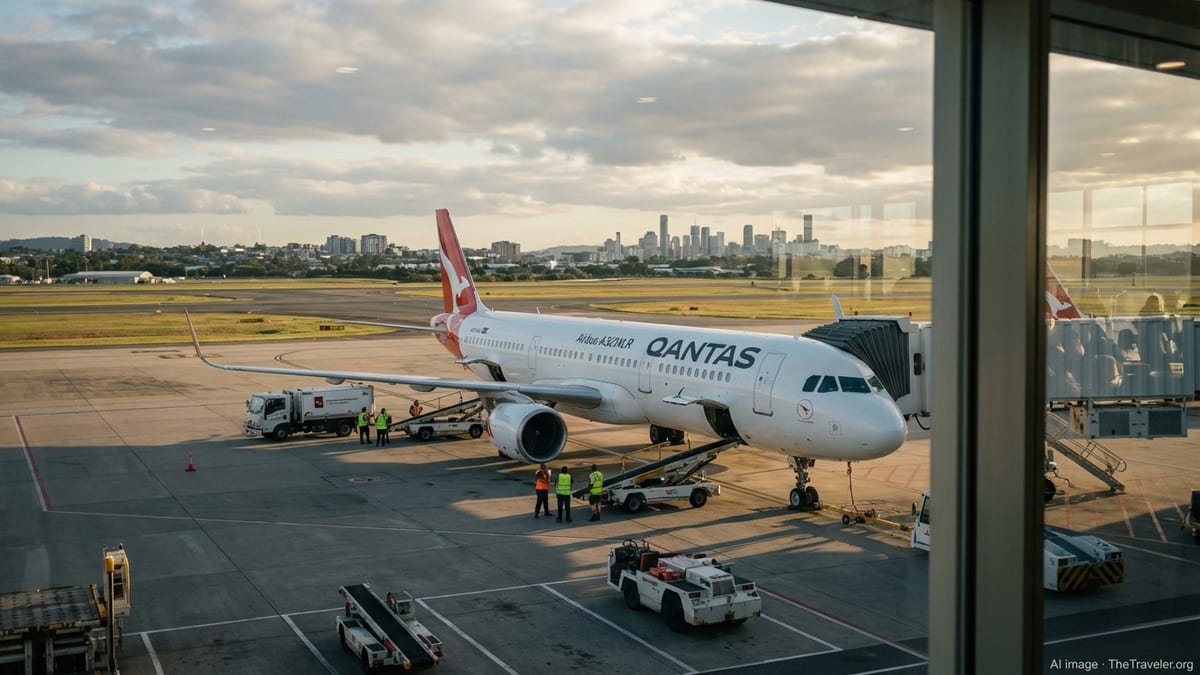
Brisbane–Manila Becomes First International A321XLR Route
The Brisbane–Manila service has been chosen as Qantas’ launch pad for international operations with the Airbus A321XLR, with the type scheduled to take over the route from 25 October 2026. The aircraft will operate daily, replacing a mix of Airbus A330 services that currently run several times a week between Queensland’s capital and the Philippine capital.
The change comes roughly two years after Qantas inaugurated Brisbane–Manila flights using the A330 and positioned the route as a key link for both leisure and visiting-friends-and-relatives traffic. Upgauging frequencies while downshifting the gauge to a smaller, more efficient aircraft reflects how the airline is fine-tuning capacity on thinner but strategically important city pairs.
Manila’s selection as the first international A321XLR destination highlights the importance of the Philippines market to Qantas. Strong demand from Queensland’s Filipino community and growing two-way tourism have given the carrier confidence that a daily schedule, even on a smaller jet, will sustain and potentially grow passenger numbers over time.
The move also signals a broader shift in how Australian carriers serve Southeast Asia, with long-range narrowbodies increasingly seen as the right tool for secondary city pairs that cannot always justify widebody capacity year-round.
From Widebody Comfort to Single-Aisle Efficiency
For travellers, the most immediate change will be the swap from an A330 widebody to a single-aisle A321XLR on a sector that can approach seven to eight hours, particularly on the northbound leg. The A330 currently offers fully flat business class seats with direct aisle access and large seatback screens, making it a popular choice on the overnight return from Manila to Brisbane.
By contrast, the A321XLR entering service on this route will feature a domestic-style business cabin with 20 reclining seats in a 2–2 configuration and no individual seatback entertainment screens. In economy, Qantas is leaning on a denser layout but has carved out an Economy Plus section with extra legroom, an attempt to preserve some comfort differentiation on the long narrowbody flight.
While some frequent flyers may see the change as a downgrade in onboard comfort, particularly in premium cabins, Qantas is betting that the aircraft’s modern interiors, quieter engines and improved cabin environment will offset the loss of widebody amenities for many passengers. The airline is also positioning personal-device streaming, inflight connectivity and refreshed catering as key elements of the onboard experience.
Operationally, the A321XLR offers Qantas more flexibility and lower trip costs on a route where demand can fluctuate by season and weekday. The smaller gauge reduces the risk of flying empty seats while enabling a daily pattern that may be more attractive to both leisure and corporate travellers than less frequent widebody services.
A321XLR at the Heart of Qantas Fleet Renewal
The Brisbane–Manila switch is part of a sweeping renewal of the Qantas fleet, in which the A321XLR is slated to become a backbone aircraft for domestic and short to medium haul international flying. Qantas has committed to a large order for the type, with multiple units already in service on trunk domestic sectors such as Sydney–Melbourne, Sydney–Perth and Brisbane–Sydney.
The A321XLR’s appeal for Qantas lies in its combination of single-aisle economics with widebody range, enabling missions of up to around 4,700 nautical miles. Compared with older narrowbodies, the jet delivers significant fuel-burn and emissions reductions, aligning with the group’s sustainability targets while supporting growth into Asian markets.
From a network-planning perspective, the aircraft opens up a tier of routes that might have been marginal for A330s or Boeing 787s, but are well suited to a high-density narrowbody with extended range. Manila from Brisbane is a textbook example: strong demand but not always enough to fill a widebody at high frequencies, and a flight time that sits comfortably within the A321XLR’s capabilities.
As more A321XLRs arrive over the next several years, Qantas is expected to progressively reshuffle its flying programme, redeploying A330s to higher-yield long haul services or retiring them as new-generation widebodies such as the Airbus A350 and additional Boeing 787s join the fleet.
Strategic Play in the Australia–Philippines Corridor
The decision to put the newest narrowbody in the Qantas stable onto Brisbane–Manila also speaks to the rising profile of air travel between Australia and the Philippines. The corridor has grown steadily on the back of a sizeable Filipino diaspora in Australia, rising business links and increasing holiday traffic in both directions.
Queensland in particular has cultivated closer economic and cultural ties with the Philippines, and Brisbane Airport has been positioning itself as a northbound hub for the state. Qantas’ move to a daily schedule, even with fewer seats per flight, is likely to improve connectivity and timetable options for onward domestic and regional passengers.
The competitive landscape is also a factor. Philippine Airlines has been active in the Brisbane market with its own single-aisle aircraft equipped with lie-flat seats in business class, setting a high bar for comfort on the route. Qantas, in response, is relying on schedule strength, local brand recognition and its broader network to retain and attract passengers.
For travellers, the change will present a clear trade-off between product features and timing. Some may prioritise flatbeds and widebody space, while others value daily departures, through-ticketing and frequent flyer benefits. How the market responds will offer an early test of Qantas’ wider strategy of using long-range narrowbodies on regional international sectors.
Signals of a New Era in Qantas Aircraft Strategy
Beyond the specifics of Brisbane–Manila, the A321XLR deployment is an emblem of how Qantas intends to shape its fleet over the next decade. The airline is moving away from a reliance on ageing A330s and older narrowbodies, instead constructing a tiered fleet of new-generation jets tailored to route length and demand.
At the top end, A350s and 787s will handle ultra-long haul and flagship intercontinental services. In the mid-range, the A321XLR will bridge the gap between dense domestic sectors and regional international missions into Asia and the Pacific. Smaller types such as the A220 will focus on thinner domestic and short regional routes, offering right-sized capacity with improved economics.
This approach is designed to give Qantas more agility as market conditions shift, whether due to economic cycles, geopolitical events or evolving tourism patterns. The ability to move an A321XLR between domestic and international flying, or to swap it onto routes like Brisbane–Manila as demand dictates, reduces the risk of mismatched capacity and improves overall fleet utilisation.
For passengers, that will mean seeing more of the same aircraft types across different kinds of journeys, but also facing a wider variety of cabin products depending on route. Brisbane–Manila’s shift from an A330 to an A321XLR encapsulates both sides of that equation: a modern, efficient jet for the airline, and a new travel experience for those onboard.