

More news on this day
Thousands of passengers across the Gulf and wider Middle East are facing mounting disruption as Qatar Airways cancels 261 flights and delays 14 more, compounding a regional aviation crisis centered on major hubs in the United Arab Emirates, Saudi Arabia, Iran and Turkey.
Get the latest news straight to your inbox!
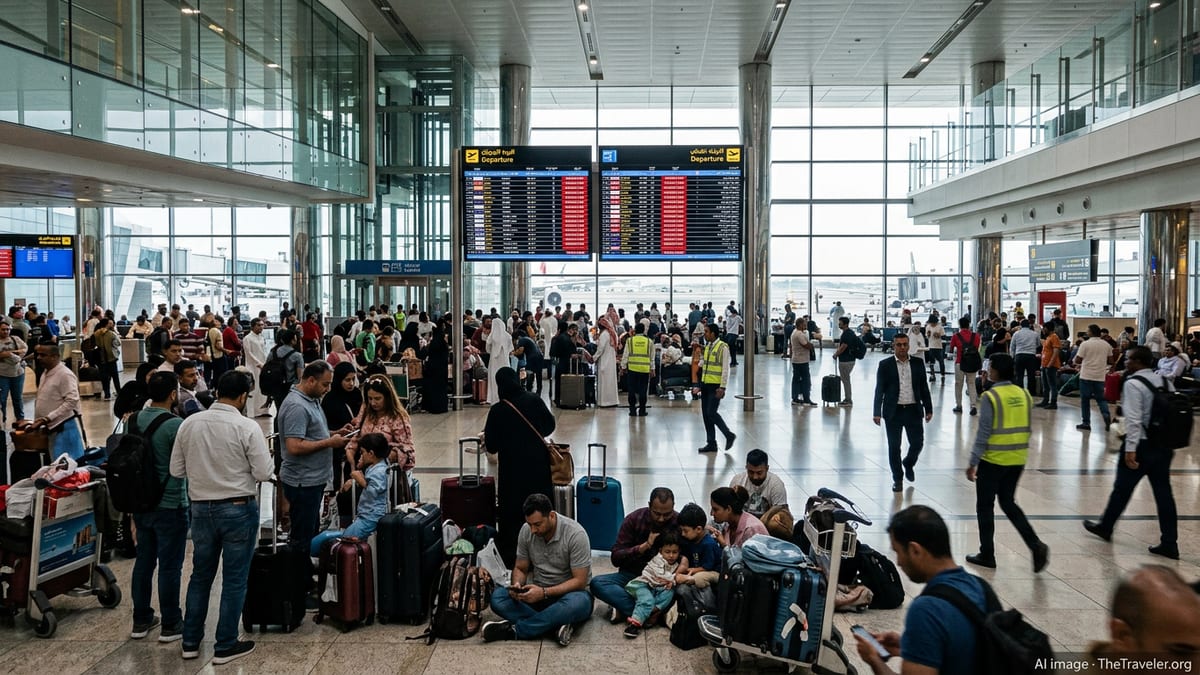
Wave of Cancellations Hits Key Gulf and Levant Hubs
Recent schedule data and regional media coverage indicate that Qatar Airways has withdrawn or heavily reduced services across several of its busiest regional routes, with Dubai, Abu Dhabi, Riyadh, Kuwait City, Damascus, Tehran, Istanbul and Beirut among the hardest hit. The tally of 261 cancelled flights and 14 delays reflects several days of disruption as airspace restrictions, security concerns and operational constraints ripple outward from Doha into neighboring countries.
Published reports describe departure boards at airports such as Dubai International and Abu Dhabi International dominated by cancelled Qatar Airways services, while connecting flights onward to cities in Saudi Arabia, Oman, Jordan, Lebanon, Syria, Iran and Turkey have also been thinned out or removed entirely. Flight tracking information shows many Qatar Airways routes that normally operate multiple times per day either grounded or reduced to limited relief operations designed mainly to reposition aircraft and move stranded travelers.
Publicly available travel advisories point to a combination of regional airspace closures, rerouted corridors and constrained capacity at Doha’s Hamad International Airport as key drivers behind the scale of the cancellations. With Qatar Airways built around a hub-and-spoke model centered on Doha, even partial restrictions at the hub are quickly magnified across short-haul services to neighboring capitals, leaving passengers in transit particularly vulnerable to missed connections and extended layovers.
The impact is being felt not only on point-to-point journeys between Doha and Gulf cities, but also on long-haul itineraries that rely on Doha, Dubai and Abu Dhabi as transfer points between Asia, Europe, Africa and the Americas. As a result, travelers based in or transiting through the UAE, Saudi Arabia, Oman, Jordan, Lebanon, Syria, Iran and Turkey are increasingly reporting last-minute cancellations, involuntary rerouting and multi-day delays.
Stranded Passengers Face Long Waits and Limited Alternatives
Accounts shared on travel forums and social media highlight the practical consequences of Qatar Airways’ large-scale schedule cuts. Travelers describe receiving email notifications of flight cancellations with limited advance notice, sometimes after already arriving at airports in Dubai, Riyadh or Istanbul. In many cases, replacement options on Qatar Airways are not available for several days, reflecting the airline’s reduced operating program and tight capacity on the few remaining services.
Some passengers report being automatically rebooked on later Qatar Airways flights via Doha, often with much longer routings and overnight transits. Others indicate that itineraries involving multiple Gulf stops, such as Dubai–Doha–Kuwait City or Riyadh–Doha–Beirut, have become increasingly difficult to reassemble, as onward sectors are also being removed from the schedule. Travel agency advisories circulating online recommend that affected customers proactively monitor their booking status and be prepared for repeated changes as the situation evolves.
Published coverage from regional outlets notes that alternative carriers are under growing pressure as stranded Qatar Airways customers look to Emirates, Etihad, flydubai, Saudia, Oman Air and Turkish Airlines for replacement journeys. However, airspace restrictions and capacity constraints are limiting the ability of those airlines to absorb additional demand, leading to sharply higher fares on remaining seats and lengthy waiting lists on popular routes between the Gulf, Levant and major European and Asian destinations.
Passengers traveling for time-sensitive reasons, including business commitments, medical appointments and family events, appear particularly affected. Reports indicate that some travelers are abandoning itineraries entirely, opting instead for full refunds where available or shifting plans to later in March and April in the hope that schedules and airspace conditions will stabilize.
Airspace Restrictions and Security Concerns Underpin Disruption
According to aviation notices and regional news reporting, the latest turmoil in Qatar Airways’ network is closely tied to a broader pattern of airspace restrictions and security advisories affecting multiple Middle Eastern flight corridors. In recent weeks, airspace closures and precautionary reroutings have been reported over or around parts of Iran, Iraq and neighboring waters, forcing airlines to redesign flight paths or suspend services altogether.
Doha’s Hamad International Airport, one of the busiest hubs in the region, has operated under limited conditions as authorities prioritize essential and relief operations. Travel updates circulated by airlines and airport operators reference “restricted capacity” and “temporary operating corridors,” language that signals a focus on safety and controlled traffic volumes rather than full commercial schedules. In such an environment, a hub carrier like Qatar Airways faces strong incentives to consolidate flights, leading to widespread cancellations on shorter regional legs.
Knock-on effects have been particularly acute for neighboring hubs in the UAE and Saudi Arabia, which depend on dense connectivity with Doha for both origin-and-destination traffic and through passengers. Flight tracking data and airport departure boards in Dubai, Abu Dhabi and Riyadh reflect a patchwork of cancellations affecting not only Qatar Airways but also partner and competitor carriers contending with the same airspace constraints. With key routes into Damascus, Tehran, Istanbul and Beirut also affected, the disruption has reached deep into the Levant and beyond.
Aviation analysts quoted in regional business coverage note that while Gulf airlines have gained experience rerouting around temporary hotspots in the past, the current combination of airspace restrictions, geopolitical tensions and high seasonal demand makes this wave of cancellations particularly challenging to manage. The high degree of interdependence among Gulf and Levant hubs means that decisions taken in Doha quickly affect airport operations and passenger flows in the UAE, Saudi Arabia, Oman, Jordan, Lebanon, Syria, Iran and Turkey.
Travel Industry Braces for Extended Turbulence
Industry commentary suggests that Qatar Airways’ 261 cancellations and 14 delays may represent only an initial phase of schedule adjustments if regional airspace limitations persist. Online booking systems and travel agency bulletins show rolling waves of changes to mid-March departures, with some flights removed from sale days in advance while others are cancelled within 24 to 48 hours of departure as conditions change.
Tour operators and corporate travel managers in the Gulf are beginning to factor prolonged disruption into their planning, steering new bookings away from the most affected routing combinations and, where possible, favoring nonstop services that avoid congested corridors. Publicly available guidance from several travel management firms encourages clients to build additional buffer time into itineraries, avoid tight connections in Doha, Dubai and Abu Dhabi, and consider alternative hubs in Europe or Asia when planning long-haul journeys.
Hotels near major airports in the UAE, Saudi Arabia, Turkey and Oman are also feeling the impact, as stranded passengers seek short-notice accommodation. Hospitality industry reports indicate an uptick in same-day bookings near Dubai International, Abu Dhabi International, Riyadh’s King Khalid International and Istanbul Airport from travelers whose Qatar Airways flights have been cancelled or significantly delayed.
While some relief flights and limited corridors are gradually reopening, reports indicate that schedules are far from normalized. Airlines and airports across the region appear to be adjusting operations day by day, balancing safety requirements with pressure to move stranded passengers and restore connectivity. Until a more stable airspace and security environment emerges, travelers in and around the Gulf and Levant can expect Qatar Airways and other carriers to continue operating with reduced frequencies and heightened risk of last-minute changes.
Advice for Affected Travelers Across the Region
Travel guidance circulating through airline customer updates, airport notices and independent travel advisories offers a broadly consistent set of recommendations for those affected by Qatar Airways’ cancellations in the UAE, Saudi Arabia, Oman, Jordan, Lebanon, Syria, Iran and Turkey. Passengers are urged to check flight status frequently through official channels and to ensure that contact details in their bookings are up to date so that schedule changes and rebooking options can be communicated quickly.
Experts in consumer travel rights writing in regional media stress the importance of understanding fare conditions and disruption policies. Some Qatar Airways tickets issued for travel during the affected period reportedly qualify for free date changes, vouchers or refunds, while others may be subject to stricter rules. Travelers are advised to retain all documentation related to cancellations and delays, including boarding passes and written notifications, to support any subsequent claims with airlines or travel insurers.
For those who must travel urgently, publicly available commentary from travel consultants suggests considering alternative routings that bypass the most disrupted hubs and airspace. This can include flying via more northerly or southerly corridors, even at the cost of longer flight times and additional stops, in exchange for a higher probability of operating flights. However, such options are highly dependent on day-to-day capacity and may carry significantly higher fares in the current environment.
With the situation evolving rapidly, regional observers expect further updates from airlines and aviation authorities in the coming days. Until then, the cancellation of 261 Qatar Airways flights and delays to 14 more serve as a visible measure of how fragile connectivity remains across a region where aviation is central to business, tourism and family life.